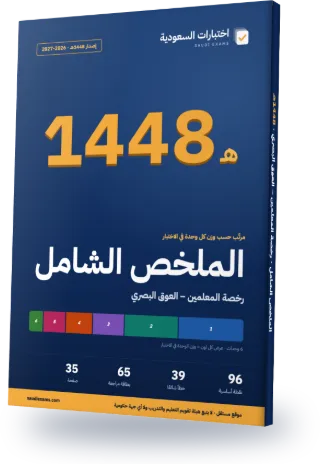
Teacher License – Visual Impairment Complete Review Guide 2026–2027
Every exam topic in a 35-page Arabic PDF, ordered from the heaviest unit to the lightest. The first three chapters alone cover about 69% of the exam questions.
- 35Pages
- 96Key points
- 39Common mistakes
- 65Flashcards
Guide map
Each chapter is one exam unit, ordered by its weight in the real exam.
| Chapter | Unit | Weight | Exam questions | Key points |
|---|---|---|---|---|
| 1 | Planning Instruction for Students with Visual Impairment | 29% | 26 | 15 |
| 2 | General Principles of Special Education | 25% | 22 | 18 |
| 3 | Planning Instruction in Special Education | 15% | 13 | 18 |
| 4 | Motivating and Supporting Learners with Visual Impairment | 13% | 11 | 14 |
| 5 | General Principles of Visual Impairment | 11% | 10 | 15 |
| 6 | Motivating and Supporting Learning in Special Education | 7% | 6 | 16 |
Chapter 1 in full: Planning Instruction for Students with Visual Impairment
29% of the exam, about 26 questions. These are its key points, as in the guide.
- In Braille: dot 1 top-left, 2 mid-left, 3 bottom-left, 4 top-right, 5 mid-right, 6 bottom-right.
- A number sign before the first ten letters represents digits.
- With slate and stylus one writes right to left (mirror image) and reads left to right after turning the page.
The rest of chapter 1, on this page
- The Perkins brailler has six keys and a space bar and writes left to right.
- A refreshable Braille display shows text in changing raised dots.
- A screen reader converts text to speech (such as NVDA and JAWS); magnifiers and large print serve low-vision students.
- Audiobooks and recording supplement, but do not replace, learning Braille for those who need it.
- Pre-reading: hand exercises, discriminating textures, shapes and sizes, and tracing raised lines.
- Children learn Braille from letter to word to sentence, reading with both index fingers.
- The white cane detects obstacles and is not a support to lean on.
- Sighted guide: the blind person holds the guide's arm above the elbow and walks half a step behind.
- Describing places and clock directions (food at 3 o'clock) helps orientation.
- Daily living skills teaching starts with hand-over-hand modelling and moves to independence.
- Teaching needs clear verbal description of anything shown visually, plus tactile models.
- The programme is designed from the functional vision assessment and the best reading medium.
Common mistakes in this chapter
- Confusing the slate (written right to left, read left to right) with the Perkins brailler (written left to right).
- Teaching Braille without adequate tactile preparation.
- Using Braille only for a low-vision student without assessing the best reading medium.
- Pulling or pushing a blind person; correctly, the person holds the guide's arm.
- Moving furniture in the classroom without telling the student.
The other chapters are in the full guide
One purchase · lifetime access · review guide included
7-day review plan
The chapters are spread over 6 days by weight so each day carries a similar load. Day 7 is a full exam.
Day 1 · 29% of the exam
Chapter 1: Planning Instruction for Students with Visual Impairment
Day 2 · 25% of the exam
Chapter 2: General Principles of Special Education
Day 3 · 15% of the exam
Chapter 3: Planning Instruction in Special Education
Day 4 · 13% of the exam
Chapter 4: Motivating and Supporting Learners with Visual Impairment
Day 5 · 11% of the exam
Chapter 5: General Principles of Visual Impairment
Day 6 · 7% of the exam
Chapter 6: Motivating and Supporting Learning in Special Education
Before you read: see your score today
10 free questions from the main units, no sign-up. Then you know which chapter to start with.
Try 10 free questions and see your levelA look at each chapter
The first three key points of each chapter, as they appear in the guide (in Arabic in the PDF).
Chapter 1: Planning Instruction for Students with Visual Impairment
- In Braille
- A number sign before the first ten letters represents digits.
- With slate and stylus one writes right to left (mirror image) and reads left…
Chapter 2: General Principles of Special Education
- Groups served by special education usually include
- Inclusion places the student with a disability in the regular school with suitable support…
- The cascade of services, least to most restrictive
Chapter 3: Planning Instruction in Special Education
- Inclusive education
- Universal Access (UA)
- The multi-tiered system of supports (MTSS) has three tiers
Chapter 4: Motivating and Supporting Learners with Visual Impairment
- Teachers introduce themselves when approaching and say when they leave.
- Address the student by name so he knows he is the one addressed.
- Diagrams, tables and classroom events are described in clear, precise language.
Chapter 5: General Principles of Visual Impairment
- Acuity of 6/60 means a person sees at 6 metres what a person with…
- Low vision
- The normal visual field is about 180 degrees; narrowing (tunnel vision) hinders mobility even…
Chapter 6: Motivating and Supporting Learning in Special Education
- Consultation
- Collaboration
- Three well-known team models
The full guide comes with lifetime access
The full guide (35 pages) is included with lifetime access to this exam, together with every question and full mock exam. Chapter 1 is free for everyone.
Questions about the guide
Is the guide free?
Chapter 1 is free to read on the guide page. The full guide comes with lifetime access to this exam; 7-day access does not include it.
Is it up to date for 2026–2027?
Yes. Unit weights and exam facts follow what the exam body last published, and the last check date is printed in the guide. If the standards change we update the file and buyers download the new version.
Does the guide have questions?
No. The guide covers key points and common mistakes; scoring, weak-area practice and full mock exams are on the site.
Can I read it on my phone?
Yes. A5 pages in a single column, with chapters linked from the contents.
- Pages
- 35
- Edition
- 1448 AH · 2026–2027
- Language
- Arabic
- Last updated
All Teacher Exams review guides
Back to Teachers' Professional License – Subject Test: Special Education (Visual Impairment)
Buy this exam
Pick the access that lasts until your test date.
Included
- Timed supplementary practice sessions: 88 questions in 120 minutes
- 519 questions, every option explained with its source
- Practice that starts with your weakest units, plus a review of your mistakes
- Complete Review Guide 2026–2027 (PDF), with lifetime access only
Continue with your Google account and you go straight to the payment page.
You pay on the Waffo Pancake checkout page (in English). The amount is in US dollars and your bank converts it to riyals. One payment with no automatic renewal, by Visa, Mastercard (a mada card with either logo works too), Apple Pay or Google Pay. Your statement shows "WAFFO". Purchases are not refundable.