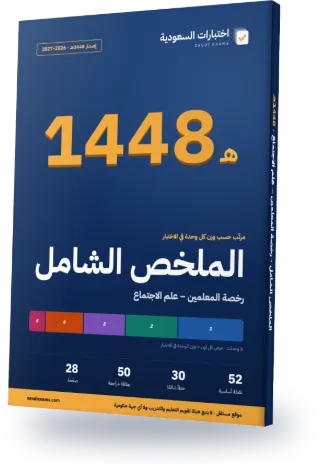
Teacher License – Sociology Complete Review Guide 2026–2027
Every exam topic in a 28-page Arabic PDF, ordered from the heaviest unit to the lightest. The first three chapters alone cover about 73% of the exam questions.
- 28Pages
- 52Key points
- 30Common mistakes
- 50Flashcards
Guide map
Each chapter is one exam unit, ordered by its weight in the real exam.
| Chapter | Unit | Weight | Exam questions | Key points |
|---|---|---|---|---|
| 1 | Applied Sociology | 29% | 26 | 11 |
| 2 | Foundations and Theories of Sociology | 24% | 21 | 11 |
| 3 | Anthropology | 20% | 18 | 10 |
| 4 | Social Research Skills | 19% | 16 | 10 |
| 5 | Teaching Methods and Curriculum | 8% | 7 | 10 |
Chapter 1 in full: Applied Sociology
29% of the exam, about 26 questions. These are its key points, as in the guide.
- Ogburn's cultural lag: material culture changes faster than non-material culture, opening a gap between them.
- Wallerstein's world-system theory divides countries into core, semi-periphery and periphery.
- Ibn Khaldun offered a cyclical account of the rise and fall of states.
The rest of chapter 1, on this page
- Merton's five adaptations: conformity, innovation, ritualism, retreatism and rebellion.
- Sutherland's differential association: criminal behaviour is learned through interaction in close groups.
- Becker's labelling theory: deviance is a label society attaches to an act, and the label can push a person into further deviance.
- Hirschi's four social bonds are attachment, commitment, involvement and belief; weak bonds make deviance more likely.
- The nuclear family is a couple and their unmarried children; the extended family spans more than one generation.
- Endogamy is marriage within the group; exogamy is marriage outside it.
- Agents of socialisation: the family, school, peer group, mosque and the media.
- Push factors drive people out, such as poverty, unemployment and disasters; pull factors draw them in, such as jobs and education.
Common mistakes in this chapter
- Treating all change as progress: change is a descriptive concept, and calling it progress or decline is a value judgement; even planned change can have unintended effects.
- Confusing modernisation and dependency: modernisation traces underdevelopment to internal factors, dependency to the periphery's tie to the core.
- Crediting the Hawthorne studies to scientific management: they founded the human relations approach that stressed social factors at work.
- Mixing up Merton's adaptations: innovation accepts the goals but rejects legitimate means, ritualism keeps the means and drops the goals, rebellion rejects both and puts new ones in their place.
- Placing Lombroso among social explanations: his account of crime is biological, while differential association, labelling and social bond theory are social.
- Reading a population pyramid: a broad base means high births and a young society; a rectangular shape means low births and low deaths.
The other chapters are in the full guide
One purchase · lifetime access · review guide included
7-day review plan
The chapters are spread over 6 days by weight so each day carries a similar load. Day 7 is a full exam.
Day 1 · 29% of the exam
Chapter 1: Applied Sociology
Day 2 · 24% of the exam
Chapter 2: Foundations and Theories of Sociology
Day 3 · 20% of the exam
Chapter 3: Anthropology
Day 4 · 19% of the exam
Chapter 4: Social Research Skills
Day 5 · 8% of the exam
Chapter 5: Teaching Methods and Curriculum
Day 6
Full mock exam: 88 questions in 120 minutes, then review the common mistakes in the units where you lost marks.
How many correct answers do you need?
- Practitioner level 50%44 correct out of 88
- Advanced level 70%62 correct out of 88
- Expert level 80%71 correct out of 88
Before you read: see your score today
10 free questions from the main units, no sign-up. Then you know which chapter to start with.
Try 10 free questions and see your levelA look at each chapter
The first three key points of each chapter, as they appear in the guide (in Arabic in the PDF).
Chapter 1: Applied Sociology
- Ogburn's cultural lag
- Wallerstein's world-system theory divides countries into core, semi-periphery and periphery.
- Ibn Khaldun offered a cyclical account of the rise and fall of states.
Chapter 2: Foundations and Theories of Sociology
- The Sociology Teacher Standards are 13 standards in 5 domains, numbered 6.33.1 to 6.33.13;…
- Domain weights in the candidate guide
- Auguste Comte gave sociology its name after first calling it 'social physics', and set…
Chapter 3: Anthropology
- Tylor's definition of culture
- Malinowski pioneered participant observation through long fieldwork.
- Linton's division
Chapter 4: Social Research Skills
- Measures of central tendency
- Measures of spread
- A correlation coefficient lies between -1 and +1; the sign shows direction and the…
Chapter 5: Teaching Methods and Curriculum
- Bloom's original cognitive taxonomy has six levels
- Vygotsky's zone of proximal development is the gap between what a learner does alone…
- For Piaget, assimilation fits new experience into existing schemas; accommodation changes the schemas to…
The full guide comes with lifetime access
The full guide (28 pages) is included with lifetime access to this exam, together with every question and full mock exam. Chapter 1 is free for everyone.
Questions about the guide
Is the guide free?
Chapter 1 is free to read on the guide page. The full guide comes with lifetime access to this exam; 7-day access does not include it.
Is it up to date for 2026–2027?
Yes. Unit weights and exam facts follow what the exam body last published, and the last check date is printed in the guide. If the standards change we update the file and buyers download the new version.
Does the guide have questions?
No. The guide covers key points and common mistakes; scoring, weak-area practice and full mock exams are on the site.
Can I read it on my phone?
Yes. A5 pages in a single column, with chapters linked from the contents.
- Pages
- 28
- Edition
- 1448 AH · 2026–2027
- Language
- Arabic
- Last updated
All Teacher Exams review guides
Back to Teachers' Professional License – Subject Test: Sociology
Buy this exam
Pick the access that lasts until your test date.
Included
- Timed supplementary practice sessions: 88 questions in 120 minutes
- 510 questions, every option explained with its source
- Practice that starts with your weakest units, plus a review of your mistakes
- Complete Review Guide 2026–2027 (PDF), with lifetime access only
Continue with your Google account and you go straight to the payment page.
You pay on the Waffo Pancake checkout page (in English). The amount is in US dollars and your bank converts it to riyals. One payment with no automatic renewal, by Visa, Mastercard (a mada card with either logo works too), Apple Pay or Google Pay. Your statement shows "WAFFO". Purchases are not refundable.