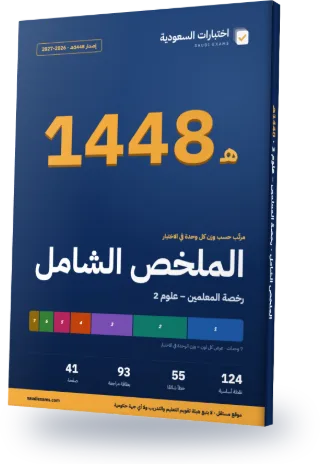
Teacher License – Science 2 Complete Review Guide 2026–2027
Every exam topic in a 41-page Arabic PDF, ordered from the heaviest unit to the lightest. The first three chapters alone cover about 70% of the exam questions.
- 41Pages
- 124Key points
- 55Common mistakes
- 93Flashcards
Guide map
Each chapter is one exam unit, ordered by its weight in the real exam.
| Chapter | Unit | Weight | Exam questions | Key points |
|---|---|---|---|---|
| 1 | Chemistry | 25% | 22 | 18 |
| 2 | Physics | 25% | 22 | 18 |
| 3 | Biology | 20% | 18 | 18 |
| 4 | Earth Science and Astronomy | 10% | 9 | 18 |
| 5 | Science Teaching | 8% | 7 | 18 |
| 6 | History, Nature and Integration of Science | 7% | 6 | 18 |
| 7 | Experimentation, Mathematical Skills and Data Representation | 5% | 4 | 16 |
Chapter 1 in full: Chemistry
25% of the exam, about 22 questions. These are its key points, as in the guide.
- Matter is anything that has mass and occupies space. It divides into pure substances (elements and compounds) and mixtures (homogeneous and heterogeneous).
- Atomic number Z = number of protons. Mass number A = protons + neutrons. In a neutral atom, electrons = Z.
- The modern periodic table orders elements by increasing atomic number, with 18 groups and 7 periods.
The rest of chapter 1, on this page
- Across a period, left to right, atomic radius decreases and electronegativity increases. Down a group, atomic radius increases.
- Electron configuration of iron (Z = 26): 1s² 2s² 2p⁶ 3s² 3p⁶ 4s² 3d⁶, i.e. [Ar] 4s² 3d⁶.
- An ionic bond transfers electrons between a metal and a nonmetal (NaCl). A covalent bond shares electrons between nonmetals (H₂O). A metallic bond is a sea of free electrons.
- One mole contains 6.022 × 10²³ particles (Avogadro's number), and moles = mass ÷ molar mass.
- To balance an equation, make the atoms of each element equal on both sides by changing coefficients only, never the subscripts in formulas. Example: 2H₂ + O₂ → 2H₂O.
- Molarity M = moles of solute ÷ litres of solution. Example: 50.0 mL of 1.5 M NaOH holds 0.075 mol, i.e. 3.0 g (molar mass 40 g/mol).
- A saturated solution cannot dissolve more solute at a given temperature, an unsaturated one can, and a supersaturated one holds more than the normal maximum and is unstable.
- Reaction rate increases with higher concentration, temperature and surface area, and with a catalyst.
- ΔH = enthalpy of products − enthalpy of reactants. ΔH is negative for exothermic reactions and positive for endothermic ones.
- Arrhenius: an acid gives H⁺ and a base gives OH⁻. Brønsted-Lowry: an acid donates a proton and a base accepts one. Lewis: an acid accepts an electron pair and a base donates one (standard 6.5.18).
- pH = −log[H⁺], and at 25 °C pH + pOH = 14. Example: 0.001 M HCl has pH = 3.
- A free element has oxidation number 0; oxygen is usually −2 and hydrogen usually +1. The numbers in a neutral compound add up to zero (standard 6.5.19).
- General formulas of hydrocarbons: alkanes CₙH₂ₙ₊₂, alkenes CₙH₂ₙ, alkynes CₙH₂ₙ₋₂. Benzene, C₆H₆, is aromatic (standard 6.5.20).
- Functional groups: alcohol –OH, aldehyde –CHO, ketone C=O within the chain, carboxylic acid –COOH, ester –COO–, amine –NH₂.
- Fractional distillation separates crude oil by boiling point: gases and light fractions leave at the top of the tower and the heaviest (bitumen) at the bottom (standard 6.5.21).
Common mistakes in this chapter
- Atomic radius decreases across a period (left to right) and increases down a group. Reversing the two gives wrong answers on ordering questions.
- A hydrogen bond is not a covalent bond. It is an attraction between molecules in which H is bonded to F, O or N.
- Substances held together by weak van der Waals forces have low boiling points. Some students pick high because the bonds inside each molecule are strong.
- A catalyst lowers activation energy but does not change ΔH or the equilibrium position. An exothermic reaction has ΔH < 0.
- Diluting changes the volume and concentration but not the moles of solute, which is why M₁V₁ = M₂V₂ works.
- pH = −log[H⁺]. Each pH unit is a tenfold change in concentration, and the lower the pH, the more acidic the solution.
- Oxidation is loss of electrons (oxidation number increases) and reduction is gain. Oxidation occurs at the anode in every type of cell.
- In a galvanic cell the anode is negative and the cathode positive. In an electrolytic cell it is the reverse: anode positive, cathode negative.
The other chapters are in the full guide
One purchase · lifetime access · review guide included
7-day review plan
The chapters are spread over 6 days by weight so each day carries a similar load. Day 7 is a full exam.
Day 1 · 25% of the exam
Chapter 1: Chemistry
Day 2 · 25% of the exam
Chapter 2: Physics
Day 3 · 20% of the exam
Chapter 3: Biology
Day 4 · 10% of the exam
Chapter 4: Earth Science and Astronomy
Day 5 · 8% of the exam
Chapter 5: Science Teaching
Day 6 · 12% of the exam
Chapter 6: History, Nature and Integration of Science
Chapter 7: Experimentation, Mathematical Skills and Data RepresentationDay 7
Full mock exam: 88 questions in 120 minutes, then review the common mistakes in the units where you lost marks.
How many correct answers do you need?
- Practitioner level 50%44 correct out of 88
- Advanced level 70%62 correct out of 88
- Expert level 80%71 correct out of 88
Before you read: see your score today
10 free questions from the main units, no sign-up. Then you know which chapter to start with.
Try 10 free questions and see your levelA look at each chapter
The first three key points of each chapter, as they appear in the guide (in Arabic in the PDF).
Chapter 1: Chemistry
- Matter is anything that has mass and occupies space. It divides into pure substances…
- Atomic number Z = number of protons. Mass number A = protons + neutrons…
- The modern periodic table orders elements by increasing atomic number, with 18 groups and…
Chapter 2: Physics
- Constant-acceleration equations
- Work W = Fd cosθ, kinetic energy KE = ½mv², gravitational potential energy PE…
- In uniform circular motion centripetal acceleration is a = v²/r and centripetal force F…
Chapter 3: Biology
- Characteristics of living things
- Cell theory
- The nucleus holds the DNA and controls the cell, mitochondria make ATP, ribosomes build…
Chapter 4: Earth Science and Astronomy
- A galaxy is a huge collection of stars, gas and dust bound by gravity…
- Terrestrial planets
- Earth rotates on its axis in about 24 hours (day and night) and orbits…
Chapter 5: Science Teaching
- Learner-centred learning
- Scientific literacy is having scientific knowledge and being able to use it to understand…
- STS
Chapter 6: History, Nature and Integration of Science
- Science is organized knowledge built through observation and experiment. Its aims are to describe…
- Characteristics of science
- A scientific fact is a confirmed observation that observers agree on, for example that…
Chapter 7: Experimentation, Mathematical Skills and Data Representation
- GHS has nine pictograms
- A safety data sheet (SDS) gives each substance's properties, hazards, storage, first aid and…
- Never taste a reagent in the lab. To smell, waft the vapor toward your…
The full guide comes with lifetime access
The full guide (41 pages) is included with lifetime access to this exam, together with every question and full mock exam. Chapter 1 is free for everyone.
Questions about the guide
Is the guide free?
Chapter 1 is free to read on the guide page. The full guide comes with lifetime access to this exam; 7-day access does not include it.
Is it up to date for 2026–2027?
Yes. Unit weights and exam facts follow what the exam body last published, and the last check date is printed in the guide. If the standards change we update the file and buyers download the new version.
Does the guide have questions?
No. The guide covers key points and common mistakes; scoring, weak-area practice and full mock exams are on the site.
Can I read it on my phone?
Yes. A5 pages in a single column, with chapters linked from the contents.
- Pages
- 41
- Edition
- 1448 AH · 2026–2027
- Language
- Arabic
- Last updated
All Teacher Exams review guides
Back to Teachers' Professional License – Subject Test: Science 2
Buy this exam
Pick the access that lasts until your test date.
Included
- Full mock exams: 88 questions in 120 minutes, with a score for every unit
- 465 questions, every option explained with its source
- Practice that starts with your weakest units, plus a review of your mistakes
- Complete Review Guide 2026–2027 (PDF), with lifetime access only
Continue with your Google account and you go straight to the payment page.
You pay on the Waffo Pancake checkout page (in English). The amount is in US dollars and your bank converts it to riyals. One payment with no automatic renewal, by Visa, Mastercard (a mada card with either logo works too), Apple Pay or Google Pay. Your statement shows "WAFFO". Purchases are not refundable.