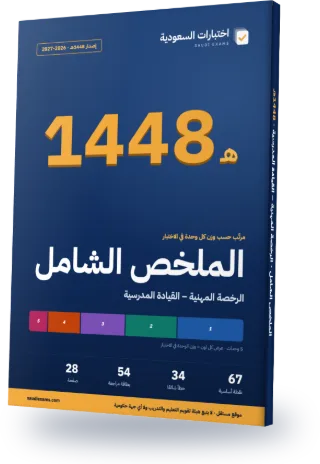
License – School Leadership Complete Review Guide 2026–2027
Every exam topic in a 28-page Arabic PDF, ordered from the heaviest unit to the lightest. The first three chapters alone cover about 75% of the exam questions.
- 28Pages
- 67Key points
- 34Common mistakes
- 54Flashcards
Guide map
Each chapter is one exam unit, ordered by its weight in the real exam.
| Chapter | Unit | Weight | Exam questions | Key points |
|---|---|---|---|---|
| 1 | School leadership | 29% | 22 | 15 |
| 2 | School and professional development | 24% | 18 | 13 |
| 3 | Professional values, regulations and partnership with family and community | 21% | 16 | 13 |
| 4 | Leading teaching and learning | 16% | 12 | 14 |
| 5 | Improving the school environment | 9% | 7 | 12 |
Chapter 1 in full: School leadership
29% of the exam, about 22 questions. These are its key points, as in the guide.
- The school leadership standards are 19 standards in 5 domains, numbered 6.26.x (6 is the general standard, 26 the school leadership specialty).
- The domain weighs 29.4% in the candidate guide: standards 6.26.1, 6.26.2 and 6.26.4 have 5 questions each, 6.26.5 has 4 and 6.26.3 has 3.
- Administrative re-engineering: a fundamental rethink and radical redesign of work systems and methods for a major improvement (sample in the candidate guide).
The rest of chapter 1, on this page
- The learning organisation: its members learn continuously, work in teams and see the school as one connected system with a shared vision.
- Leader competencies include technical, human and conceptual skills; human skills show in managing relationships and resolving staff conflicts (6.26.1/2).
- SWOT analysis: strengths and weaknesses are internal, opportunities and threats are external.
- The school's operational plan includes the programmes that achieve each goal of the plan (sample in the candidate guide).
- The core management functions: planning, organising, directing and controlling (follow-up and evaluation).
- Job satisfaction is measured with a standardised, periodic, anonymous tool given to everyone, not by individual impressions (6.26.2/6).
- Applying quality standards to transactions: one written procedure, a named owner, a time limit and measurement of actual performance (6.26.2/8).
- A sound decision rests on accurate, correct information, and its effect is followed up after implementation (6.26.3/3).
- Planning strategies for expected problems (preventive planning) is part of standard 6.26.3, alongside treating current problems.
- Instructional supervision is a cooperative professional process that improves teaching and learning by developing teachers (6.26.4/1).
- The leader holds professional meetings on educational issues and works with the supervisor to evaluate and develop staff (6.26.4/6-7).
- Reports are a written means of school communication that present organised facts giving a true picture of a topic or situation (sample in the candidate guide).
Common mistakes in this chapter
- Confusing re-engineering with TQM: re-engineering is a radical one-off change, TQM is gradual continuous improvement.
- Listing a factor the school does not control (such as curriculum changes) as a weakness; it belongs to the external factors (opportunity or threat).
- Vision, mission and environmental analysis belong to the strategic plan; programmes, activities and timelines belong to the operational plan.
- Jumping to a solution (buying equipment, punishing at once) before gathering information and analysing causes breaks the scientific approach.
- Delegation is not abdication: the leader delegates authority and stays accountable for follow-up and results.
- Modern instructional supervision is guidance and support for growth, not inspection hunting for mistakes.
- Relying on a single source (one complaint or a personal impression) before deciding; a sound decision rests on accurate information from several sources.
The other chapters are in the full guide
One purchase · lifetime access · review guide included
7-day review plan
The chapters are spread over 6 days by weight so each day carries a similar load. Day 7 is a full exam.
Day 1 · 29% of the exam
Chapter 1: School leadership
Day 2 · 24% of the exam
Chapter 2: School and professional development
Day 3 · 21% of the exam
Chapter 3: Professional values, regulations and partnership with family and community
Day 4 · 16% of the exam
Chapter 4: Leading teaching and learning
Day 5 · 9% of the exam
Chapter 5: Improving the school environment
Day 6
Full mock exam: 75 questions in 120 minutes, then review the common mistakes in the units where you lost marks.
How many correct answers do you need?
- Practitioner level 50%38 correct out of 75
- Advanced level 70%53 correct out of 75
- Expert level 80%60 correct out of 75
Before you read: see your score today
10 free questions from the main units, no sign-up. Then you know which chapter to start with.
Try 10 free questions and see your levelA look at each chapter
The first three key points of each chapter, as they appear in the guide (in Arabic in the PDF).
Chapter 1: School leadership
- The school leadership standards are 19 standards in 5 domains, numbered 6.26.x (6 is…
- The domain weighs 29.4% in the candidate guide
- Administrative re-engineering
Chapter 2: School and professional development
- The domain weighs 23.9%
- Teacher self-evaluation
- School self-evaluation indicators are grouped into domains, including learning outcomes, teaching and learning, and…
Chapter 3: Professional values, regulations and partnership with family and community
- The domain weighs 21.4%
- Standard 6.26.19 has the most indicators in the test (10), followed by 6.26.17 (8).
- Education policy in Saudi Arabia derives from Islam as belief, law and a complete…
Chapter 4: Leading teaching and learning
- The domain weighs 16%
- Piaget's stages
- Social constructivism (Vygotsky)
Chapter 5: Improving the school environment
- The domain weighs 9.3%
- Standard 6.26.14 has 7 indicators, from hard work, cooperation and creativity to equipment, storage…
- Common traits of creative thinking
The full guide comes with lifetime access
The full guide (28 pages) is included with lifetime access to this exam, together with every question and full mock exam. Chapter 1 is free for everyone.
Questions about the guide
Is the guide free?
Chapter 1 is free to read on the guide page. The full guide comes with lifetime access to this exam; 7-day access does not include it.
Is it up to date for 2026–2027?
Yes. Unit weights and exam facts follow what the exam body last published, and the last check date is printed in the guide. If the standards change we update the file and buyers download the new version.
Does the guide have questions?
No. The guide covers key points and common mistakes; scoring, weak-area practice and full mock exams are on the site.
Can I read it on my phone?
Yes. A5 pages in a single column, with chapters linked from the contents.
- Pages
- 28
- Edition
- 1448 AH · 2026–2027
- Language
- Arabic
- Last updated
All Teacher Exams review guides
Back to Professional License – Subject Test: School Leadership
Buy this exam
Pick the access that lasts until your test date.
Included
- Full mock exams: 75 questions in 120 minutes, with a score for every unit
- 510 questions, every option explained with its source
- Practice that starts with your weakest units, plus a review of your mistakes
- Complete Review Guide 2026–2027 (PDF), with lifetime access only
Continue with your Google account and you go straight to the payment page.
You pay on the Waffo Pancake checkout page (in English). The amount is in US dollars and your bank converts it to riyals. One payment with no automatic renewal, by Visa, Mastercard (a mada card with either logo works too), Apple Pay or Google Pay. Your statement shows "WAFFO". Purchases are not refundable.