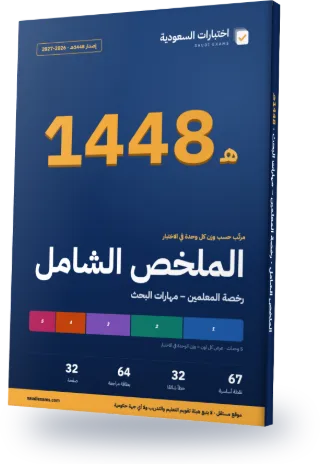
Teacher License – Research Skills Complete Review Guide 2026–2027
Every exam topic in a 32-page Arabic PDF, ordered from the heaviest unit to the lightest. The first three chapters alone cover about 72% of the exam questions.
- 32Pages
- 67Key points
- 32Common mistakes
- 64Flashcards
Guide map
Each chapter is one exam unit, ordered by its weight in the real exam.
| Chapter | Unit | Weight | Exam questions | Key points |
|---|---|---|---|---|
| 1 | Information | 27% | 20 | 15 |
| 2 | Electronic Search | 24% | 18 | 14 |
| 3 | Scientific Research | 21% | 16 | 12 |
| 4 | Methods of Teaching the Subject | 15% | 11 | 13 |
| 5 | Libraries | 13% | 10 | 13 |
Chapter 1 in full: Information
27% of the exam, about 20 questions. These are its key points, as in the guide.
- (3.18.1 Concept, types and importance of information) Data are raw facts, numbers and symbols that mean little alone; information is data processed, interpreted and put in context; knowledge is what forms when a person understands information and links it with experience.
- (3.18.1 Concept, types and importance of information) Types of information include scientific and technical, social and economic, statistical, historical and educational; by form it can be written, audio, visual or digital.
- (3.18.1 Concept, types and importance of information) The importance of information: sound decisions, problem solving, building knowledge, planning and development. The knowledge explosion multiplies output, so the problem becomes selecting what is reliable and relevant, not obtaining it.
The rest of chapter 1, on this page
- (3.18.1 Concept, types and importance of information) Information literacy is the ability to identify an information need, find, evaluate and ethically use information. It is the practical goal of the Research Skills course.
- (3.18.2 Traditional and electronic sources) By originality, sources are primary (theses, original studies, patents, documents, interviews) and secondary (textbooks, encyclopedias, indexes, bibliographies, abstracts).
- (3.18.2 Traditional and electronic sources) By format they are printed (books, periodicals, reports), non-printed (educational films, audio recordings, pictures, maps), electronic (databases, e-books, e-journals, websites) and human (experts, specialists, institutions).
- (3.18.2 Traditional and electronic sources) Reference sources: dictionaries for word meanings, encyclopedias for brief general information, directories for institutions and people with their addresses and activities, atlases for maps, yearbooks for recent developments.
- (3.18.2 Traditional and electronic sources) Periodicals (newspapers, magazines, scholarly journals) beat books on currency; books beat periodicals on depth and coverage. Electronic sources offer speed and full-text searching but need their reliability evaluated.
- (3.18.3 Organizing and managing information) Cataloguing records an item's bibliographic data: descriptive (title, author, publisher, edition, pages) and subject (subject and class number). Users search through author, title and subject access points.
- (3.18.3 Organizing and managing information) Classification arranges items by subject; the best-known schemes are Dewey Decimal and Library of Congress. The ISBN is the international standard number for books, the ISSN for serials.
- (3.18.3 Organizing and managing information) Indexing analyses a document's content into terms; abstracting condenses it into a short abstract. Collection management covers selection, acquisition, inventory and weeding.
- (3.18.4 Storage and retrieval technologies) Storage technologies: hard and optical disks, flash memory and cloud storage, with regular backup to protect data. Retrieval tools: databases, automated catalogues, keywords and Boolean operators.
- (3.18.4 Storage and retrieval technologies) Metadata and keywords represent content and connect a user's query to documents, so accurate ones improve retrieval. In Saudi schools, the Madrasati platform lets teachers store and retrieve learning materials.
- (3.18.5 Information services) Traditional services: in-house and external lending, guidance (directing users to sources and how to use them), reference service, copying and inter-library loan.
- (3.18.5 Information services) Modern services: automated catalogues, databases, digital references, remote access, current awareness and SDI, which sends the user what matches an interest profile.
Common mistakes in this chapter
- Reversing data and information: information is the output after processing; data is the raw input (3.18.1).
- Treating every electronic source as secondary: primary versus secondary depends on originality, not format; an original study published online is still primary (3.18.2).
- Confusing descriptive and subject cataloguing: descriptive is about physical form, subject is about content and classification (3.18.3).
- Mixing up cataloguing, classification and indexing: cataloguing describes the item, classification gives it a shelf place, indexing analyses content into retrieval terms (3.18.3).
- Confusing library and archive: an archive keeps the original records produced by an organization's activity; a library collects published materials (3.18.5).
- Thinking inventory is cataloguing: inventory checks actual holdings against records to find what is missing (3.18.3).
- Confusing current awareness (announcing new items generally) with SDI (sending only what matches a user's interest profile) (3.18.5).
The other chapters are in the full guide
One purchase · lifetime access · review guide included
7-day review plan
The chapters are spread over 6 days by weight so each day carries a similar load. Day 7 is a full exam.
Day 1 · 27% of the exam
Chapter 1: Information
Day 2 · 24% of the exam
Chapter 2: Electronic Search
Day 3 · 21% of the exam
Chapter 3: Scientific Research
Day 4 · 15% of the exam
Chapter 4: Methods of Teaching the Subject
Day 5 · 13% of the exam
Chapter 5: Libraries
Before you read: see your score today
10 free questions from the main units, no sign-up. Then you know which chapter to start with.
Try 10 free questions and see your levelA look at each chapter
The first three key points of each chapter, as they appear in the guide (in Arabic in the PDF).
Chapter 1: Information
- (3.18.1 Concept, types and importance of information) Data are raw facts, numbers and symbols…
- (3.18.1 Concept, types and importance of information) Types of information include scientific and technical…
- (3.18.1 Concept, types and importance of information) The importance of information: sound decisions, problem…
Chapter 2: Electronic Search
- (3.18.9 Basics of electronic search) Electronic search is using computers and networks to reach…
- (3.18.9 Basics of electronic search) Boolean operators
- (3.18.9 Basics of electronic search) Truncation with a symbol such as * retrieves word…
Chapter 3: Scientific Research
- (3.18.13 Concept and aims of scientific research) Aims of research: description, explanation, prediction, control…
- (3.18.13 Concept and aims of scientific research) Types
- (3.18.13 Concept and aims of scientific research) Research ethics: scientific honesty, participant confidentiality, informed…
Chapter 4: Methods of Teaching the Subject
- (3.18.18 The Research Skills subject and its aims) The Research Skills and Information Sources…
- (3.18.18 The Research Skills subject and its aims) The course aims span three domains…
- (3.18.18 The Research Skills subject and its aims) Lifelong learning is a course aim…
Chapter 5: Libraries
- (3.18.6 Concept and history of libraries) In the technical sense a library is an…
- (3.18.6 Concept and history of libraries) Arab heritage knew libraries as book chests and…
- (3.18.6 Concept and history of libraries) Waqf was a main source of funding for…
The full guide comes with lifetime access
The full guide (32 pages) is included with lifetime access to this exam, together with every question and full mock exam. Chapter 1 is free for everyone.
Questions about the guide
Is the guide free?
Chapter 1 is free to read on the guide page. The full guide comes with lifetime access to this exam; 7-day access does not include it.
Is it up to date for 2026–2027?
Yes. Unit weights and exam facts follow what the exam body last published, and the last check date is printed in the guide. If the standards change we update the file and buyers download the new version.
Does the guide have questions?
No. The guide covers key points and common mistakes; scoring, weak-area practice and full mock exams are on the site.
Can I read it on my phone?
Yes. A5 pages in a single column, with chapters linked from the contents.
- Pages
- 32
- Edition
- 1448 AH · 2026–2027
- Language
- Arabic
- Last updated
All Teacher Exams review guides
Back to Teachers' Professional License – Subject Test: Research Skills and Information Sources
Buy this exam
Pick the access that lasts until your test date.
Included
- Timed supplementary practice sessions: 75 questions in 120 minutes
- 500 questions, every option explained with its source
- Practice that starts with your weakest units, plus a review of your mistakes
- Complete Review Guide 2026–2027 (PDF), with lifetime access only
Continue with your Google account and you go straight to the payment page.
You pay on the Waffo Pancake checkout page (in English). The amount is in US dollars and your bank converts it to riyals. One payment with no automatic renewal, by Visa, Mastercard (a mada card with either logo works too), Apple Pay or Google Pay. Your statement shows "WAFFO". Purchases are not refundable.