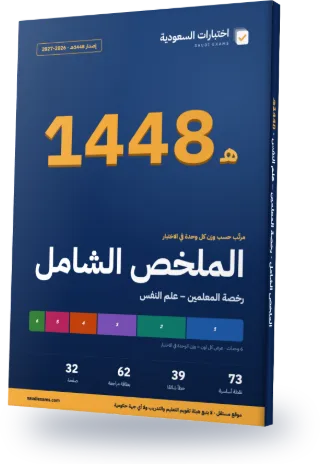
Teacher License – Psychology Complete Review Guide 2026–2027
Every exam topic in a 32-page Arabic PDF, ordered from the heaviest unit to the lightest. The first three chapters alone cover about 67% of the exam questions.
- 32Pages
- 73Key points
- 39Common mistakes
- 62Flashcards
Guide map
Each chapter is one exam unit, ordered by its weight in the real exam.
| Chapter | Unit | Weight | Exam questions | Key points |
|---|---|---|---|---|
| 1 | Applied psychology | 25% | 22 | 14 |
| 2 | Psychological measurement and research methods | 23% | 20 | 13 |
| 3 | Foundations and determinants of personality and behaviour | 19% | 16 | 12 |
| 4 | Personality and social psychology | 13% | 12 | 12 |
| 5 | General psychology | 12% | 11 | 12 |
| 6 | Teaching methods in psychology | 8% | 7 | 10 |
Chapter 1 in full: Applied psychology
25% of the exam, about 22 questions. These are its key points, as in the guide.
- Ellis's ABC: activating event (A), belief (B), emotional and behavioural consequence (C); treatment disputes irrational beliefs.
- Beck's negative cognitive triad in depression: negative views of the self, the world and the future.
- Systematic desensitisation (Wolpe): relaxation plus gradual exposure to the feared stimulus, used for phobias.
The rest of chapter 1, on this page
- Reality therapy (Glasser) focuses on responsibility and present behaviour; Gestalt therapy (Perls) on awareness of the here and now.
- Reinforcement schedules: intermittent reinforcement, especially variable ratio, makes behaviour harder to extinguish than continuous reinforcement.
- Bandura's observational learning: attention, retention, reproduction, motivation.
- Vygotsky's zone of proximal development: the gap between what a pupil does alone and with help; scaffolding is temporary support withdrawn bit by bit.
- Advance organisers (Ausubel) link new material to what pupils already know for meaningful learning; discovery learning comes from Bruner.
- Revised Bloom's taxonomy: remember, understand, apply, analyse, evaluate, create.
- Parts of a behavioural objective: the learner, a measurable action verb, the condition, and the standard of acceptable performance.
- Weiner's attribution theory: crediting success to effort (internal and controllable) motivates more than crediting luck.
- Gardner's multiple intelligences include linguistic, logical-mathematical, spatial, musical, bodily-kinaesthetic, interpersonal, intrapersonal and naturalist.
- Holland's vocational theory has six types: realistic, investigative, artistic, social, enterprising and conventional.
- Super sees career choice as a lifelong developmental process in which the vocational self-concept grows.
Common mistakes in this chapter
- Treating negative reinforcement as punishment: negative reinforcement removes something unpleasant to increase a behaviour; punishment aims to reduce it.
- Confusing rational emotive behaviour therapy (Albert Ellis, the ABC model) with cognitive therapy (Aaron Beck, the negative cognitive triad).
- Treating confidentiality as absolute: it can be broken when there is serious danger to the client or others, or by legal requirement, and clients are told this at the start.
- Writing an objective with an unmeasurable verb such as 'understand' or 'know'; use an observable verb such as 'list' or 'compare'.
- Mixing up Herzberg's hygiene factors (pay and conditions prevent dissatisfaction) with motivators (achievement, recognition and responsibility create satisfaction).
- Confusing formative assessment (during learning, to improve it) with summative assessment (at the end, to judge the result).
- Blurring counselling and therapy: counselling usually serves well-functioning people with developmental or situational problems; therapy addresses deeper disorders over a longer time.
The other chapters are in the full guide
One purchase · lifetime access · review guide included
7-day review plan
The chapters are spread over 6 days by weight so each day carries a similar load. Day 7 is a full exam.
Day 1 · 25% of the exam
Chapter 1: Applied psychology
Day 2 · 23% of the exam
Chapter 2: Psychological measurement and research methods
Day 3 · 19% of the exam
Chapter 3: Foundations and determinants of personality and behaviour
Day 4 · 13% of the exam
Chapter 4: Personality and social psychology
Day 5 · 12% of the exam
Chapter 5: General psychology
Day 6 · 8% of the exam
Chapter 6: Teaching methods in psychology
Day 7
Full mock exam: 88 questions in 120 minutes, then review the common mistakes in the units where you lost marks.
How many correct answers do you need?
- Practitioner level 50%44 correct out of 88
- Advanced level 70%62 correct out of 88
- Expert level 80%71 correct out of 88
Before you read: see your score today
10 free questions from the main units, no sign-up. Then you know which chapter to start with.
Try 10 free questions and see your levelA look at each chapter
The first three key points of each chapter, as they appear in the guide (in Arabic in the PDF).
Chapter 1: Applied psychology
- Ellis's ABC
- Beck's negative cognitive triad in depression
- Systematic desensitisation (Wolpe)
Chapter 2: Psychological measurement and research methods
- Ways to estimate reliability
- Types of validity
- Reliability is necessary for validity but not enough on its own.
Chapter 3: Foundations and determinants of personality and behaviour
- Object permanence, knowing an object still exists when out of sight, develops in the…
- Egocentrism and a lack of conservation mark the preoperational stage.
- Conservation, classification and seriation appear in the concrete stage; hypothetico-deductive thinking in the formal…
Chapter 4: Personality and social psychology
- The Big Five
- Eysenck's dimensions
- Cattell used factor analysis to identify 16 personality factors.
Chapter 5: General psychology
- The Psychology Teacher Standards are 20 standards in 6 domains, numbered 6.32.1 to 6.32.20;…
- Domain weights in the candidate guide
- Wundt set up the first experimental psychology laboratory in Leipzig in 1879, usually taken…
Chapter 6: Teaching methods in psychology
- Johnson and Johnson's elements of cooperative learning
- Think-Pair-Share
- Jigsaw
The full guide comes with lifetime access
The full guide (32 pages) is included with lifetime access to this exam, together with every question and full mock exam. Chapter 1 is free for everyone.
Questions about the guide
Is the guide free?
Chapter 1 is free to read on the guide page. The full guide comes with lifetime access to this exam; 7-day access does not include it.
Is it up to date for 2026–2027?
Yes. Unit weights and exam facts follow what the exam body last published, and the last check date is printed in the guide. If the standards change we update the file and buyers download the new version.
Does the guide have questions?
No. The guide covers key points and common mistakes; scoring, weak-area practice and full mock exams are on the site.
Can I read it on my phone?
Yes. A5 pages in a single column, with chapters linked from the contents.
- Pages
- 32
- Edition
- 1448 AH · 2026–2027
- Language
- Arabic
- Last updated
All Teacher Exams review guides
Back to Teachers' Professional License – Subject Test: Psychology
Buy this exam
Pick the access that lasts until your test date.
Included
- Timed supplementary practice sessions: 88 questions in 120 minutes
- 510 questions, every option explained with its source
- Practice that starts with your weakest units, plus a review of your mistakes
- Complete Review Guide 2026–2027 (PDF), with lifetime access only
Continue with your Google account and you go straight to the payment page.
You pay on the Waffo Pancake checkout page (in English). The amount is in US dollars and your bank converts it to riyals. One payment with no automatic renewal, by Visa, Mastercard (a mada card with either logo works too), Apple Pay or Google Pay. Your statement shows "WAFFO". Purchases are not refundable.