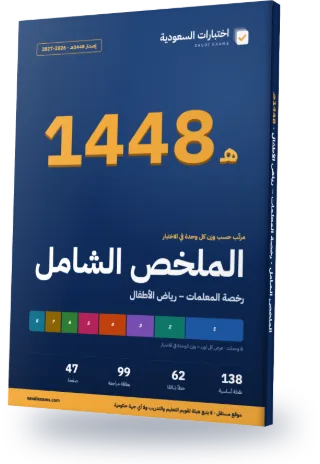
Teacher License – Kindergarten Complete Review Guide 2026–2027
Every exam topic in a 47-page Arabic PDF, ordered from the heaviest unit to the lightest. The first three chapters alone cover about 53% of the exam questions.
- 47Pages
- 138Key points
- 62Common mistakes
- 99Flashcards
Guide map
Each chapter is one exam unit, ordered by its weight in the real exam.
| Chapter | Unit | Weight | Exam questions | Key points |
|---|---|---|---|---|
| 1 | Domains of Development and Learning | 26% | 23 | 18 |
| 2 | Interaction and Guidance | 14% | 12 | 17 |
| 3 | Teaching and Learning | 13% | 12 | 17 |
| 4 | Learning Environment | 13% | 11 | 18 |
| 5 | Child Health and Safety | 10% | 9 | 18 |
| 6 | Assessment | 8% | 7 | 18 |
| 7 | Family and Community Partnership | 8% | 7 | 15 |
| 8 | Professional Development | 8% | 7 | 17 |
Chapter 1 in full: Domains of Development and Learning
26% of the exam, about 23 questions. These are its key points, as in the guide.
- Holistic, integrated development: a child's motor, emotional, social, language and cognitive aspects grow together and affect one another, so no area is developed in isolation (standard 1, indicator 2).
- Individual differences: the sequence of development is similar across children, but the pace differs, so the teacher respects each child's abilities and needs (standard 1, indicators 3 and 5).
- Factors that influence development: heredity and environment (family, nutrition, health, experiences), working together. A child inherits 23 chromosomes from each parent (standard 1, indicator 4).
The rest of chapter 1, on this page
- Piaget's stages: sensorimotor (0-2), preoperational (2-7), concrete operational (7-11), formal operational (from 11). Kindergarten children (3-6) are in the preoperational stage (standard 1, indicator 8).
- Vygotsky: the zone of proximal development is the gap between what a child does alone and what he does with help from someone more capable; scaffolding is temporary support the teacher withdraws gradually (standard 1, indicator 8).
- Erikson's stages: trust vs mistrust (0-1), autonomy vs shame and doubt (1-3), initiative vs guilt (3-6), industry vs inferiority (6-12) (standard 2, indicator 1).
- Maslow's hierarchy: physiological needs, then safety, then love and belonging, then esteem, then self-actualization. The lower need is met first (standard 1, indicator 5).
- Parten's stages of social play: unoccupied, onlooker, solitary, parallel (side by side without interaction, seen at about 2-3 years), associative, cooperative (standard 1, indicator 8).
- The responsive social smile is the first sign of social development in infancy and comes long before play with peers (standard 2, indicator 1).
- Friendship at ages 4-7 rests on sharing play and toys and enjoying them together. To strengthen cooperation, the teacher asks a child to describe a situation where he cooperated with others (standard 2, indicators 1 and 4).
- Protecting self-esteem: when a child colors in an unusual way, the teacher asks what he was thinking, which respects his work and encourages expression instead of immediate correction (standard 2, indicators 2 and 3).
- Directions of motor growth: head to toe, center (trunk) to limbs, general to specific; so gross muscles develop before fine muscles (standard 3, indicator 1).
- Gross-motor activities: running, jumping, climbing, throwing. Skills build in sequence: running comes before jumping, and standing or hopping on one foot supports balance (standard 3, indicators 1 and 3).
- Fine-motor activities: drawing, cutting, pasting, modeling clay and beading; the teacher uses art to develop them. Eye-hand coordination is sensory-motor coordination (standard 3, indicators 3 and 9).
- Three types of listening: attentive (focusing on what is heard), analytical (understanding and analyzing it), appreciative (enjoying and valuing it). Auditory perception of sounds is a base for reading (standard 4, indicators 10 and 11).
- To develop language: the teacher speaks Modern Standard Arabic as a model, reads aloud daily, exposes children to print, and offers writing for real purposes, such as placing writing tools in the dramatic play area (standard 4, indicators 5, 12, 14 and 15).
- Thinking levels: basic (memory, observation, classification, inference, prediction, explanation), higher (analysis, conclusion, evaluation, innovation), and complex (logical, critical, creative) (standard 5, indicators 8-10).
- Scientific inquiry and open questions: the child asks, predicts, tests, observes and explains. An open question example: «What did you notice about the ball that reached the ground first?» (standard 5, indicators 12 and 16).
Common mistakes in this chapter
- Mixing up parallel and cooperative play: in parallel play each child plays with his own toy beside others, in cooperative play they share roles toward a common goal.
- Believing the mother contributes more genetically than the father: each parent gives 23 chromosomes, so the statement is false.
- Confusing the levels of Maslow's hierarchy: a hungry, tired or dirty child is threatened first in physiological needs, which come before belonging or esteem.
- Treating individual differences as delay: normal variation in pace is not delay; developmental delay calls for observation, documentation and referral.
- Confusing recall with creation: memory, observation and classification are basic thinking skills, while analysis, evaluation and innovation are higher ones.
- Choosing a closed question over an open one: a yes/no or single-fact question does not build thinking, while an open question asks for a description, explanation or prediction.
- The teacher diagnosing: diagnosing a disability or delay belongs to specialists, and giving a child a diagnostic test requires the parent's written consent.
- Starting with a psychological explanation for a sudden physical symptom: for a behavior such as sudden bedwetting, the first step is to rule out organic causes (a medical check).
The other chapters are in the full guide
One purchase · lifetime access · review guide included
7-day review plan
The chapters are spread over 6 days by weight so each day carries a similar load. Day 7 is a full exam.
Day 1 · 26% of the exam
Chapter 1: Domains of Development and Learning
Day 2 · 14% of the exam
Chapter 2: Interaction and Guidance
Day 3 · 13% of the exam
Chapter 3: Teaching and Learning
Day 4 · 13% of the exam
Chapter 4: Learning Environment
Day 5 · 18% of the exam
Chapter 5: Child Health and Safety
Chapter 8: Professional DevelopmentDay 6 · 16% of the exam
Chapter 6: Assessment
Chapter 7: Family and Community PartnershipDay 7
Full mock exam: 88 questions in 120 minutes, then review the common mistakes in the units where you lost marks.
How many correct answers do you need?
- Practitioner level 50%44 correct out of 88
- Advanced level 70%62 correct out of 88
- Expert level 80%71 correct out of 88
Before you read: see your score today
10 free questions from the main units, no sign-up. Then you know which chapter to start with.
Try 10 free questions and see your levelA look at each chapter
The first three key points of each chapter, as they appear in the guide (in Arabic in the PDF).
Chapter 1: Domains of Development and Learning
- Holistic, integrated development
- Individual differences
- Factors that influence development
Chapter 2: Interaction and Guidance
- The teacher treats all children fairly and equally, shows respect to all, and values…
- She interacts in a way that makes her the main source of children's sense…
- She varies how she deals with children according to differences in abilities and developmental…
Chapter 3: Teaching and Learning
- Standard 6.22.7, Planning for teaching and learning, has 21 indicators; standard 6.22.8, Implementing learning…
- A behavioral objective describes what the child will do after learning and contains a…
- Measurable verbs
Chapter 4: Learning Environment
- The teacher designs the learning environment in light of educational theories and approaches (6.22.9…
- She applies self-directed learning principles in planning
- She plans the environment to support whole-child development
Chapter 5: Child Health and Safety
- Child security and safety is one standard (6.22.17) with 17 indicators. Child health and…
- The teacher sets safety rules with the children and checks that they follow them…
- She takes part in preparing and applying the building evacuation plan for emergencies and…
Chapter 6: Assessment
- Assessment tools are chosen so they capture the child's behavior in real situations such…
- Assessment methods must suit the children's developmental characteristics, culture and needs (6.22.13, indicator 2).
- Formal and informal methods are used together and regularly, not only at the end…
Chapter 7: Family and Community Partnership
- Standard 6.22.15, Partnership with families, has 16 indicators; standard 6.22.16, Partnership with the community…
- The teacher collects information on the child's family characteristics while respecting privacy, and keeps…
- The teacher respects family values and beliefs (indicator 3), treats all families with care…
Chapter 8: Professional Development
- The Professional Development unit is 8% of the test (about 7 questions), and each…
- Standard 6.22.19
- Standard 6.22.20
The full guide comes with lifetime access
The full guide (47 pages) is included with lifetime access to this exam, together with every question and full mock exam. Chapter 1 is free for everyone.
Questions about the guide
Is the guide free?
Chapter 1 is free to read on the guide page. The full guide comes with lifetime access to this exam; 7-day access does not include it.
Is it up to date for 2026–2027?
Yes. Unit weights and exam facts follow what the exam body last published, and the last check date is printed in the guide. If the standards change we update the file and buyers download the new version.
Does the guide have questions?
No. The guide covers key points and common mistakes; scoring, weak-area practice and full mock exams are on the site.
Can I read it on my phone?
Yes. A5 pages in a single column, with chapters linked from the contents.
- Pages
- 47
- Edition
- 1448 AH · 2026–2027
- Language
- Arabic
- Last updated
All Teacher Exams review guides
Back to Teachers' Professional License – Subject Test: Kindergarten
Buy this exam
Pick the access that lasts until your test date.
Included
- Full mock exams: 88 questions in 120 minutes, with a score for every unit
- 485 questions, every option explained with its source
- Practice that starts with your weakest units, plus a review of your mistakes
- Complete Review Guide 2026–2027 (PDF), with lifetime access only
Continue with your Google account and you go straight to the payment page.
You pay on the Waffo Pancake checkout page (in English). The amount is in US dollars and your bank converts it to riyals. One payment with no automatic renewal, by Visa, Mastercard (a mada card with either logo works too), Apple Pay or Google Pay. Your statement shows "WAFFO". Purchases are not refundable.