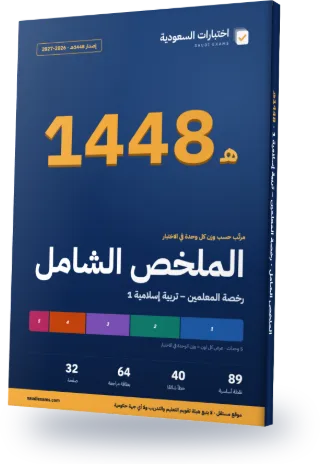
Teacher License – Islamic Education 1 Complete Review Guide 2026–2027
Every exam topic in a 32-page Arabic PDF, ordered from the heaviest unit to the lightest. The first three chapters alone cover about 72% of the exam questions.
- 32Pages
- 89Key points
- 40Common mistakes
- 64Flashcards
Guide map
Each chapter is one exam unit, ordered by its weight in the real exam.
| Chapter | Unit | Weight | Exam questions | Key points |
|---|---|---|---|---|
| 1 | Fiqh and Conduct | 28% | 25 | 18 |
| 2 | Creed ('Aqidah) | 23% | 20 | 18 |
| 3 | The Qur'an and Its Sciences | 21% | 18 | 18 |
| 4 | The Sunnah and Its Sciences | 18% | 16 | 17 |
| 5 | Teaching the Islamic Sciences | 10% | 9 | 18 |
Chapter 1 in full: Fiqh and Conduct
28% of the exam, about 25 questions. These are its key points, as in the guide.
- Ritual impurity is of two kinds: minor, which requires wudu, such as anything leaving the two passages or loss of reason through deep sleep or fainting; and major, which requires ghusl, such as janabah, menstruation and postnatal bleeding. (6.35.5.2)
- The obligatory acts of wudu, according to the Hanbali school adopted in the curricula: washing the face (including rinsing the mouth and nose), washing the arms to the elbows, wiping the whole head (including the ears), washing the feet to the ankles, order, and continuity. The basis is the verse of Al-Ma'idah: "When you rise for prayer, wash your faces…". (6.35.5.5)
- Tayammum is legislated when water is unavailable or its use is impossible because of illness or fear of harm: "…and find no water, then seek clean earth". Its form, according to the Hanbali school adopted in the curricula, is one strike of the palms on clean earth, then wiping the face and hands. (6.35.5.6)
The rest of chapter 1, on this page
- Wiping over socks is a concession. Its duration is one day and night for a resident and three days and nights for a traveller (narrated by Muslim). It requires putting them on while in a state of purity, and removing them or the end of the period ends it; janabah requires removing them and washing. (6.35.5.6)
- Pillars of prayer, according to the Hanbali school adopted in the curricula, include: standing for those able, the opening takbir, reciting Al-Fatihah, bowing, rising from it, prostration, sitting between the two prostrations, tranquillity in the pillars, the final tashahhud and sitting for it, and the two taslims. Prayer is invalid if a pillar is omitted deliberately. (6.35.5.7)
- The obligatory acts of prayer, according to the Hanbali school adopted in the curricula, are eight: the transition takbirs, saying "Sami'a Allahu liman hamidah" for the imam and the one praying alone, saying "Rabbana wa lakal hamd", "Subhana Rabbiyal 'Azim" in bowing, "Subhana Rabbiyal A'la" in prostration, "Rabbighfir li" between the prostrations, the first tashahhud, and sitting for it. Whoever omits one by mistake performs the prostration of forgetfulness. (6.35.5.7)
- Friday prayer is two rak'ahs preceded by two sermons and is held in congregation. Whoever catches a rak'ah with the imam completes it as Friday prayer, based on the authentic hadith "Whoever catches a rak'ah of the prayer has caught the prayer"; whoever catches less than a rak'ah, such as arriving in the final sitting, completes it as four rak'ahs of Dhuhr. (6.35.5.8)
- Zakat is obligatory under these conditions: Islam, freedom, full ownership of the nisab, and the passing of a lunar year on the wealth, except for crops and fruit. It is one-fortieth (2.5%) on gold, silver and trade goods; the nisab is 85 grams of gold and 595 grams of silver. (6.35.5.9)
- Zakat al-fitr is one sa' of food for every Muslim, young or old, male or female. It becomes due at sunset on the last day of Ramadan and is best given before the Eid prayer. Voluntary charity is recommended at any time. (6.35.5.9)
- What breaks the fast: eating and drinking deliberately, intercourse, menstruation and postnatal bleeding, and deliberate vomiting. Whoever eats or drinks forgetfully completes his fast (narrated by Muslim). The expiation for intercourse in a Ramadan day is freeing a slave, otherwise fasting two consecutive months, otherwise feeding sixty poor people, along with making up the day. (6.35.5.10)
- There are three types of nusk: tamattu' (umrah then hajj in the same year), ifrad (hajj only), and qiran (ihram for umrah and hajj together). The pillars of hajj, according to the Hanbali school adopted in the curricula, are ihram, standing at Arafah, tawaf al-ifadah, and sa'y. The pillars of umrah are ihram, tawaf and sa'y. (6.35.5.11)
- Obligatory acts of hajj, according to the Hanbali school adopted in the curricula: ihram from the miqat, staying at Arafah until sunset for those who stood by day, spending the nights at Muzdalifah and Mina, stoning the jamarat, shaving or trimming the hair, and the farewell tawaf. Whoever omits one owes a sacrifice. Hajj is obligatory once in a lifetime for those able: "And Allah has made it a duty for people to make pilgrimage to the House…" (3:97). (6.35.5.11)
- The default for foods is permissibility. Forbidden by agreement are carrion, blood and pork: "Prohibited to you are carrion, blood and the flesh of swine" (Al-Ma'idah 5:3), and intoxicants are forbidden. Animals scholars differ on, such as the hyena, are not placed with what is agreed. (6.35.6.1)
- The awrah is what must be covered. A man's awrah is between the navel and the knee. A free adult woman's awrah in prayer is her whole body except her face, according to the Hanbali school adopted in the curricula, and in front of unrelated men she must cover herself. Lowering the gaze is commanded: "Tell the believing men to lower their gaze" (24:30). (6.35.6.2)
- Hijab means a Muslim woman covering her body in front of men who are not her mahrams. Its basis is the verse: "and let them draw their headcovers over their chests" (An-Nur 24:31) and "to bring down over themselves some of their outer garments" (Al-Ahzab 33:59). It belongs to chastity and modesty and helps protect society. (6.35.6.3)
- Honouring parents is among the greatest duties: "And your Lord has decreed that you worship none but Him, and that you be kind to parents" (Al-Isra 17:23). Keeping family ties brings expanded provision: "Whoever wishes his provision to be expanded… let him keep his family ties" (narrated by Al-Bukhari), and one who cuts ties is warned. (6.35.6.6)
- Rulers have the right to be heard and obeyed in what is right: "Obey Allah and obey the Messenger and those in authority among you" (An-Nisa 4:59), and "Obedience is only in what is right" (agreed upon). Scholars are owed respect and referral to them, and Muslims in general are owed sincere advice and cooperation in righteousness. (6.35.6.7)
- Daily adhkar include the morning and evening remembrances, Ayat al-Kursi and the two surahs of refuge, sleep adhkar such as "In Your name, O Allah, I die and live", and the supplication when entering the toilet: "O Allah, I seek refuge in You from the male and female devils". On the merit of remembrance: "Verily, in the remembrance of Allah do hearts find rest" (Ar-Ra'd 13:28). (6.35.6.8)
Common mistakes in this chapter
- Mixing up pillar, obligatory act and sunnah in prayer: omitting a pillar deliberately invalidates it, omitting an obligatory act by mistake is made up with the prostration of forgetfulness, and omitting a sunnah act neither invalidates nor needs making up.
- Treating ghusl as required after every impurity. Minor impurity requires only wudu; janabah, menstruation and postnatal bleeding require ghusl.
- Assuming zakat applies to everything a Muslim owns. What is kept for personal use, such as one's own home and means of transport, carries no zakat; it is due on growing wealth or wealth held for growth once it reaches the nisab and a lunar year has passed.
- Confusing resident and traveller in the wiping period: a resident has one day and night, a traveller three days and nights.
- Thinking that eating forgetfully breaks the fast. Whoever eats or drinks forgetfully completes the fast; deliberate intercourse in a Ramadan day requires making up the day and the expiation.
- Confusing a pillar of hajj with an obligatory act: whoever omits a pillar has not completed hajj until he performs it, whoever omits an obligatory act owes a sacrifice. Passing the miqat without ihram means returning to it to enter ihram, otherwise a sacrifice is due.
- Confusing what is forbidden by agreement (carrion, blood, pork) with animals scholars differ on. A question on what is agreed forbidden points to carrion and pork.
- Treating character as mere social behaviour separate from religion. It is part of the perfection of faith and of the purposes of the message, and a reason for higher ranks in Paradise, so the most complete answer is the one combining these aspects.
The other chapters are in the full guide
One purchase · lifetime access · review guide included
7-day review plan
The chapters are spread over 6 days by weight so each day carries a similar load. Day 7 is a full exam.
Day 1 · 28% of the exam
Chapter 1: Fiqh and Conduct
Day 2 · 23% of the exam
Chapter 2: Creed ('Aqidah)
Day 3 · 21% of the exam
Chapter 3: The Qur'an and Its Sciences
Day 4 · 18% of the exam
Chapter 4: The Sunnah and Its Sciences
Day 5 · 10% of the exam
Chapter 5: Teaching the Islamic Sciences
Day 6
Full mock exam: 88 questions in 120 minutes, then review the common mistakes in the units where you lost marks.
How many correct answers do you need?
- Practitioner level 50%44 correct out of 88
- Advanced level 70%62 correct out of 88
- Expert level 80%71 correct out of 88
Before you read: see your score today
10 free questions from the main units, no sign-up. Then you know which chapter to start with.
Try 10 free questions and see your levelA look at each chapter
The first three key points of each chapter, as they appear in the guide (in Arabic in the PDF).
Chapter 1: Fiqh and Conduct
- Ritual impurity is of two kinds
- The obligatory acts of wudu, according to the Hanbali school adopted in the curricula…
- Tayammum is legislated when water is unavailable or its use is impossible because of…
Chapter 2: Creed ('Aqidah)
- Creed ('aqidah)
- Ahl al-Sunnah wal-Jama'ah
- Islam has five pillars
Chapter 3: The Qur'an and Its Sciences
- The last tenth of the Qur'an is parts 28, 29 and 30, from Surat…
- Allah commands measured recitation
- A clear error (lahn jali) is an obvious pronunciation fault that changes a letter…
Chapter 4: The Sunnah and Its Sciences
- The Sunnah
- He is Muhammad ibn Abdullah ibn Abd al-Muttalib ibn Hashim of Quraysh, born in…
- Revelation came to him at the age of forty; he migrated to Medina thirteen…
Chapter 5: Teaching the Islamic Sciences
- Diagnostic teaching in Quran
- A concept map puts the main concept in the center and branches sub-concepts from…
- Discovery method
The full guide comes with lifetime access
The full guide (32 pages) is included with lifetime access to this exam, together with every question and full mock exam. Chapter 1 is free for everyone.
Questions about the guide
Is the guide free?
Chapter 1 is free to read on the guide page. The full guide comes with lifetime access to this exam; 7-day access does not include it.
Is it up to date for 2026–2027?
Yes. Unit weights and exam facts follow what the exam body last published, and the last check date is printed in the guide. If the standards change we update the file and buyers download the new version.
Does the guide have questions?
No. The guide covers key points and common mistakes; scoring, weak-area practice and full mock exams are on the site.
Can I read it on my phone?
Yes. A5 pages in a single column, with chapters linked from the contents.
- Pages
- 32
- Edition
- 1448 AH · 2026–2027
- Language
- Arabic
- Last updated
All Teacher Exams review guides
Back to Teachers' Professional License – Subject Test: Islamic Education (1)
Buy this exam
Pick the access that lasts until your test date.
Included
- Full mock exams: 88 questions in 120 minutes, with a score for every unit
- 461 questions, every option explained with its source
- Practice that starts with your weakest units, plus a review of your mistakes
- Complete Review Guide 2026–2027 (PDF), with lifetime access only
Continue with your Google account and you go straight to the payment page.
You pay on the Waffo Pancake checkout page (in English). The amount is in US dollars and your bank converts it to riyals. One payment with no automatic renewal, by Visa, Mastercard (a mada card with either logo works too), Apple Pay or Google Pay. Your statement shows "WAFFO". Purchases are not refundable.