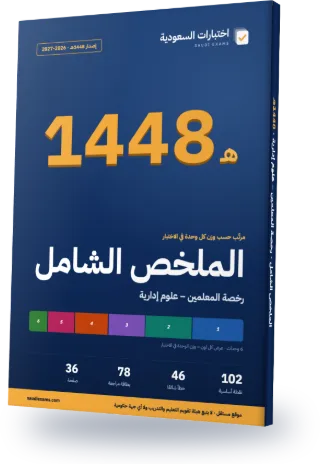
Teacher License – Administrative Sciences Complete Review Guide 2026–2027
Every exam topic in a 36-page Arabic PDF, ordered from the heaviest unit to the lightest. The first three chapters alone cover about 61% of the exam questions.
- 36Pages
- 102Key points
- 46Common mistakes
- 78Flashcards
Guide map
Each chapter is one exam unit, ordered by its weight in the real exam.
| Chapter | Unit | Weight | Exam questions | Key points |
|---|---|---|---|---|
| 1 | Economics | 23% | 17 | 18 |
| 2 | Marketing | 21% | 16 | 17 |
| 3 | Accounting | 17% | 13 | 16 |
| 4 | Management | 16% | 12 | 17 |
| 5 | Financial Management | 13% | 10 | 17 |
| 6 | Teaching Methods for Administrative Sciences | 9% | 7 | 17 |
Chapter 1 in full: Economics
23% of the exam, about 17 questions. These are its key points, as in the guide.
- Economics studies how limited resources are used to satisfy unlimited human wants. It divides into microeconomics (individuals, firms, markets) and macroeconomics (the economy as a whole).
- The four economic resources are land, labour, capital and enterprise, earning rent, wages, interest and profit respectively.
- The economic problem is the relative scarcity of resources against many wants. It forces choice and creates opportunity cost. Every system answers what, how and for whom to produce.
The rest of chapter 1, on this page
- In a capitalist system markets and prices decide and ownership is private; in a socialist system the state plans production and ownership is public; in a mixed system the private and public sectors coexist.
- Law of demand: other things equal, quantity demanded moves inversely with price. Law of supply: quantity supplied moves in the same direction as price.
- Determinants of demand: income, prices of substitutes and complements, tastes, number of buyers and expectations. Determinants of supply: production costs, technology, prices of other goods, number of sellers and expectations.
- Market equilibrium is the price at which quantity demanded equals quantity supplied. A price above it creates a surplus; a price below it creates a shortage.
- Price elasticity of demand = % change in quantity demanded ÷ % change in price. Demand is elastic if the absolute value exceeds 1, inelastic if below 1 and unit elastic if equal to 1.
- Factors behind elasticity of demand: availability of substitutes, necessity versus luxury, the share of income spent on the good, and the time period.
- Markets: perfect competition (many sellers, identical goods, free entry), monopoly (one seller, entry barriers), monopolistic competition (differentiated goods, free entry) and oligopoly (a few interdependent producers).
- National income is measured three ways: output (value added), income (sum of factor earnings) and expenditure (consumption + investment + government spending + net exports).
- GDP measures the final goods and services produced within a country's borders in a period; GNP measures the output of a country's citizens wherever they are.
- Types of unemployment: frictional, structural, cyclical and seasonal. Economic effects include lost output and lower incomes; social effects include poverty and family strain.
- Inflation is a general and sustained rise in the price level. Causes: demand-pull, cost-push and growth in the money supply. Price index = (sum of current-year prices ÷ sum of base-year prices) × 100.
- Contractionary fiscal policy (lower spending or higher taxes) fights inflation; expansionary policy (higher spending or lower taxes) fights recession and unemployment. Monetary policy is run by the central bank.
- Adam Smith's absolute advantage: a country specialises in the good it makes at lower cost. David Ricardo's comparative advantage: it specialises in the good with the lower opportunity cost.
- The balance of payments records all economic transactions between a country and the rest of the world in a period, with the current, capital and financial accounts. Exports are credits and imports are debits.
- International bodies: the World Trade Organization sets trade rules and settles disputes, the IMF addresses balance of payments problems and supports monetary stability, the World Bank finances development, and the Gulf Cooperation Council is an economic and political bloc of six states.
Common mistakes in this chapter
- Mixing up a change in quantity demanded with a change in demand: a change in the good's own price moves along the curve, while a change in income, tastes or other prices shifts the whole curve.
- The negative sign of price elasticity of demand: whether demand is elastic or inelastic is judged by the absolute value, not by the sign.
- Reading elasticity above 1 as inelastic: above 1 means elastic demand, below 1 means inelastic.
- Confusing frictional, structural and cyclical unemployment: frictional is movement between jobs, structural is a mismatch between skills and jobs, cyclical comes from a downturn.
- Confusing demand-pull and cost-push inflation: the first comes from higher total spending, the second from higher production costs such as wages and raw materials.
- Confusing fiscal and monetary tools: taxes and government spending are fiscal; interest rates, reserve requirements and open market operations are monetary.
- Confusing absolute and comparative advantage: comparative advantage rests on opportunity cost, and a country can gain by specialising in a good where it has no absolute advantage.
- Confusing a balance of payments deficit with a trade deficit: the trade balance covers goods only, while the balance of payments is wider and includes the current, capital and financial accounts.
The other chapters are in the full guide
One purchase · lifetime access · review guide included
7-day review plan
The chapters are spread over 6 days by weight so each day carries a similar load. Day 7 is a full exam.
Day 1 · 23% of the exam
Chapter 1: Economics
Day 2 · 21% of the exam
Chapter 2: Marketing
Day 3 · 17% of the exam
Chapter 3: Accounting
Day 4 · 16% of the exam
Chapter 4: Management
Day 5 · 13% of the exam
Chapter 5: Financial Management
Day 6 · 9% of the exam
Chapter 6: Teaching Methods for Administrative Sciences
Day 7
Full mock exam: 75 questions in 120 minutes, then review the common mistakes in the units where you lost marks.
How many correct answers do you need?
- Practitioner level 50%38 correct out of 75
- Advanced level 70%53 correct out of 75
- Expert level 80%60 correct out of 75
Before you read: see your score today
10 free questions from the main units, no sign-up. Then you know which chapter to start with.
Try 10 free questions and see your levelA look at each chapter
The first three key points of each chapter, as they appear in the guide (in Arabic in the PDF).
Chapter 1: Economics
- Economics studies how limited resources are used to satisfy unlimited human wants. It divides…
- The four economic resources are land, labour, capital and enterprise, earning rent, wages, interest…
- The economic problem is the relative scarcity of resources against many wants. It forces…
Chapter 2: Marketing
- Marketing
- Selling focuses on the product and closing the current deal; marketing focuses on the…
- The marketing mix has four elements (4P)
Chapter 3: Accounting
- Accounting is a system for identifying, measuring, recording and communicating a business's economic information…
- Branches of accounting include financial accounting, cost accounting, managerial accounting, auditing, tax accounting and…
- Internal users are management and staff. External users are investors, creditors, tax authorities and…
Chapter 4: Management
- Management
- Efficiency means using resources at the lowest possible cost. Effectiveness means reaching the intended…
- Main leadership theories
Chapter 5: Financial Management
- Financial planning
- Financial control
- Financing means obtaining funds from their sources. Investing means putting funds into assets or…
Chapter 6: Teaching Methods for Administrative Sciences
- Standard 15 has four indicators
- Standard 16 has three indicators
- Individual differences are the ways students vary in ability, readiness, interests, and the pace…
The full guide comes with lifetime access
The full guide (36 pages) is included with lifetime access to this exam, together with every question and full mock exam. Chapter 1 is free for everyone.
Questions about the guide
Is the guide free?
Chapter 1 is free to read on the guide page. The full guide comes with lifetime access to this exam; 7-day access does not include it.
Is it up to date for 2026–2027?
Yes. Unit weights and exam facts follow what the exam body last published, and the last check date is printed in the guide. If the standards change we update the file and buyers download the new version.
Does the guide have questions?
No. The guide covers key points and common mistakes; scoring, weak-area practice and full mock exams are on the site.
Can I read it on my phone?
Yes. A5 pages in a single column, with chapters linked from the contents.
- Pages
- 36
- Edition
- 1448 AH · 2026–2027
- Language
- Arabic
- Last updated
All Teacher Exams review guides
Back to Teachers' Professional License – Subject Test: Administrative Sciences
Buy this exam
Pick the access that lasts until your test date.
Included
- Full mock exams: 75 questions in 120 minutes, with a score for every unit
- 430 questions, every option explained with its source
- Practice that starts with your weakest units, plus a review of your mistakes
- Complete Review Guide 2026–2027 (PDF), with lifetime access only
Continue with your Google account and you go straight to the payment page.
You pay on the Waffo Pancake checkout page (in English). The amount is in US dollars and your bank converts it to riyals. One payment with no automatic renewal, by Visa, Mastercard (a mada card with either logo works too), Apple Pay or Google Pay. Your statement shows "WAFFO". Purchases are not refundable.