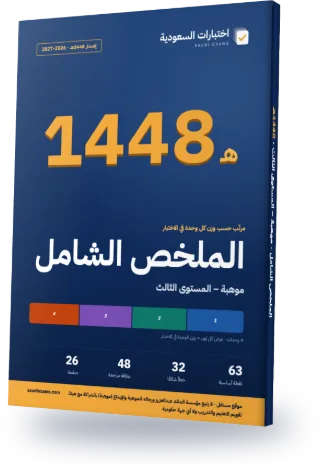
Mawhiba Level 3 Complete Review Guide 2026–2027
Every exam topic in a 26-page Arabic PDF, ordered from the heaviest unit to the lightest. The first three chapters alone cover about 75% of the exam questions.
- 26Pages
- 63Key points
- 32Common mistakes
- 48Flashcards
Guide map
Each chapter is one exam unit, ordered by its weight in the real exam.
| Chapter | Unit | Weight | Exam questions | Key points |
|---|---|---|---|---|
| 1 | Verbal Reasoning and Reading Comprehension | 25% | 30 | 15 |
| 2 | Mathematical and Spatial Reasoning | 25% | 30 | 15 |
| 3 | Scientific and Mechanical Reasoning | 25% | 30 | 17 |
| 4 | Mental Flexibility | 25% | 30 | 16 |
Chapter 1 in full: Verbal Reasoning and Reading Comprehension
25% of the exam, about 30 questions. These are its key points, as in the guide.
- Common analogy relations include tool and action (scissors : cutting), part and whole (wheel : car), cause and effect (neglect : failure), job and place (teacher : school), material and product (cotton : cloth), opposites (courage : cowardice) and degree (warm : hot).
- Level 3 brings abstract relations, such as a virtue and its excess: courage and recklessness, thrift and stinginess. Notice the direction: the first is a virtue and the second is an excess of it, and the order cannot be reversed.
- A reliable analogy method: write the sentence, test it on every option, drop the ones it does not fit, then compare what is left closely. If two remain, your sentence is too general, so narrow it.
The rest of chapter 1, on this page
- In sentence completion, contrast words (but, however, although, whereas) show that the second part opposes the first, while words like so, therefore and because show a cause or result moving in the same direction.
- With two blanks, start with the blank the context points to most clearly, remove the options that do not fit it, then test the other blank on what is left.
- In a contextual error, the wrong word usually runs against the meaning the rest of the sentence builds, as in "because the road was crowded he arrived "early"". Ask yourself whether the whole meaning would fit if you swapped that word for its opposite.
- A word's meaning in context can differ from its best-known meaning: "eye" in "the eye of a needle" is not the organ. Read the sentence before you judge the word.
- Words close in meaning differ in degree or use (thirsty, parched, dry). When asked for the closest meaning, choose the one nearest in both degree and use.
- In an odd-word-out question there may be several bases for grouping (kind, function, size, origin). Try more than one basis until you find the one that isolates a single word.
- Word classification rests on what the words share in meaning (fruits, measuring tools, feelings), not on the word's shape or letter count.
- A 180 to 260 word passage: read it once with attention and mark numbers, names and turning words (but, however). The main idea often appears in the first or last sentence.
- The main idea covers the whole passage, and the best title expresses it without narrowing to one part or widening beyond what is there.
- A "which cannot be inferred" question means three answers are supported by the passage. Check each one for a supporting sentence, and the one with none is the answer.
- For a word-meaning question about a passage, go back to the sentence it appears in and the ones around it, since the context fixes the meaning intended.
- Time: 168 minutes for 120 questions is about 1 minute 24 seconds per question on average. Short word questions need less and passage questions need more, so balance them.
Common mistakes in this chapter
- Reversing the pair order in an analogy: the relation "tool : action" differs from "action : tool", and a reversed option is placed among the choices on purpose.
- An option on the same topic with a different relation: two words from one field (doctor and hospital) do not mean the relation matches the pair you need.
- Picking the word that sounds impressive in a sentence completion. The right one is the word the logic demands, even if it is the plainest option.
- Ignoring the second blank: an option may fit the first blank alone and break the sentence once the second word goes in. Do not decide before testing both.
- Hunting for a spelling or grammar mistake in a contextual error question, when the wrong word is spelled correctly and only clashes with the meaning.
- An answer that is true in itself but not in the passage: an option that matches a fact you know, which the passage neither says nor supports.
- Mixing up the main idea and a detail: an option states something that appears in the passage but covers only a small part, while the main idea covers the whole text.
- Absolute words in the options (always, never, all): they often make an option stronger than the passage allows, which makes it wrong.
The other chapters are in the full guide
One purchase · lifetime access · review guide included
7-day review plan
The chapters are spread over 6 days by weight so each day carries a similar load. Day 7 is a full exam.
Day 1 · 25% of the exam
Chapter 1: Verbal Reasoning and Reading Comprehension
Day 2 · 25% of the exam
Chapter 2: Mathematical and Spatial Reasoning
Day 3 · 25% of the exam
Chapter 3: Scientific and Mechanical Reasoning
Day 4 · 25% of the exam
Chapter 4: Mental Flexibility
Day 5
Full mock exam: 120 questions in 168 minutes, then review the common mistakes in the units where you lost marks.
Before you read: see your score today
10 free questions from the main units, no sign-up. Then you know which chapter to start with.
Try 10 free questions and see your levelA look at each chapter
The first three key points of each chapter, as they appear in the guide (in Arabic in the PDF).
Chapter 1: Verbal Reasoning and Reading Comprehension
- Common analogy relations include tool and action (scissors
- Level 3 brings abstract relations, such as a virtue and its excess: courage and…
- A reliable analogy method
Chapter 2: Mathematical and Spatial Reasoning
- Solving a first-degree equation
- Percentages
- Probability = favourable cases ÷ all possible cases, and it lies between 0 and…
Chapter 3: Scientific and Mechanical Reasoning
- Density = mass ÷ volume. An object floats in a liquid if its density…
- The buoyant force equals the weight of the liquid displaced, so an object that…
- Pressure = force ÷ area. Reducing the area with the same force increases the…
Chapter 4: Mental Flexibility
- Common code rules
- In codes with more than one step (such as reversing then adding 1 to…
- In secret-word codes it is enough to match each secret word with its meaning…
The full guide comes with lifetime access
The full guide (26 pages) is included with lifetime access to this exam, together with every question and full mock exam. Chapter 1 is free for everyone.
Questions about the guide
Is the guide free?
Chapter 1 is free to read on the guide page. The full guide comes with lifetime access to this exam; 7-day access does not include it.
Is it up to date for 2026–2027?
Yes. Unit weights and exam facts follow what the exam body last published, and the last check date is printed in the guide. If the standards change we update the file and buyers download the new version.
Does the guide have questions?
No. The guide covers key points and common mistakes; scoring, weak-area practice and full mock exams are on the site.
Can I read it on my phone?
Yes. A5 pages in a single column, with chapters linked from the contents.
- Pages
- 26
- Edition
- 1448 AH · 2026–2027
- Language
- Arabic
- Last updated
Buy this exam
Pick the access that lasts until your test date.
Included
- Full mock exams: 120 questions in 168 minutes, with a score for every unit
- 627 questions, every option explained with its source
- Practice that starts with your weakest units, plus a review of your mistakes
- Complete Review Guide 2026–2027 (PDF), with lifetime access only
Continue with your Google account and you go straight to the payment page.
You pay on the Waffo Pancake checkout page (in English). The amount is in US dollars and your bank converts it to riyals. One payment with no automatic renewal, by Visa, Mastercard (a mada card with either logo works too), Apple Pay or Google Pay. Your statement shows "WAFFO". Purchases are not refundable.