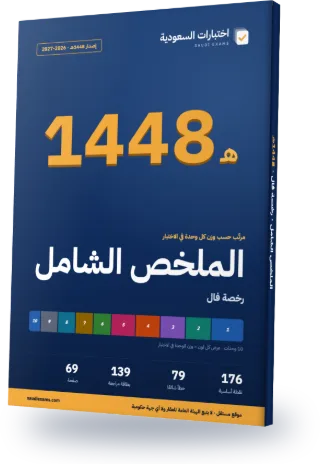
FAL License Complete Review Guide 2026–2027
Every exam topic in a 69-page Arabic PDF, ordered from the heaviest unit to the lightest. The first three chapters alone cover about 37% of the exam questions.
- 69Pages
- 176Key points
- 79Common mistakes
- 139Flashcards
Guide map
Each chapter is one exam unit, ordered by its weight in the real exam.
| Chapter | Unit | Weight | Exam questions | Key points |
|---|---|---|---|---|
| 1 | Laundering Stages, Risks and Red Flags | 14% | 5 | 18 |
| 2 | The Real Estate Brokerage Law and its Implementing Regulations | 11% | 4 | 18 |
| 3 | Digital Marketing, Campaigns and Performance Metrics | 11% | 4 | 17 |
| 4 | Money Laundering and Fraud: Concepts and Laws | 11% | 4 | 18 |
| 5 | Due Diligence, Reporting, Record-Keeping and Sanctions | 11% | 4 | 18 |
| 6 | Real Estate, the Market and the Broker's Role | 9% | 3 | 17 |
| 7 | Contracts, Ejar, Arbitration and Landlord–Tenant Rules | 9% | 3 | 18 |
| 8 | Real Estate Marketing Fundamentals, the Market and Pricing | 9% | 3 | 17 |
| 9 | Marketing Ethics, Direct Selling, Exhibitions and Off-Plan Marketing | 9% | 3 | 17 |
| 10 | Real Estate Advertising Rules and Electronic Platforms | 6% | 2 | 18 |
Chapter 1 in full: Laundering Stages, Risks and Red Flags
14% of the exam, about 5 questions. These are its key points, as in the guide.
- Money laundering: converting, transferring, concealing or disguising illicit funds to make them appear legitimate. It also covers acquiring, possessing or using them knowing their source, and attempting or taking part through agreement, assistance, incitement, facilitation or concealment (AML Law, Art. 2).
- Placement: bringing illicit funds into the financial system. Property examples: buying with cash from criminal proceeds, or using front companies owned by criminals to facilitate the purchase (REGA broker guide, p. 4).
- Structuring (smurfing): splitting large cash sums into smaller amounts to stay under reporting thresholds; it is the most common placement technique. Under-stating the price on the sale deed and paying the difference in cash is another way of bringing illicit cash in.
The rest of chapter 1, on this page
- Layering: hiding the source of funds through several complex transactions. Property examples: reselling a property bought with criminal proceeds quickly with no economic rationale, and transferring its ownership between related companies or individuals (REGA broker guide, p. 4).
- Integration: making funds look legitimate and usable and returning them to the economy in an apparently lawful way. Property examples: rental income from a property bought with criminal proceeds, bank loans secured on that property (REGA broker guide, p. 4), and investment in real estate development. It is the hardest stage to detect.
- Preventive measures by stage: at placement, identify the client, check they are not on a blacklist and match the address; at layering, score client risk, compare cash with normal activity and gather information on beneficiaries; at integration, keep checking blacklists, update risk ratings, match account turnover and verify the source of transferred funds.
- Loan-back scheme: the launderer lends his own illicit money to himself through an entity he controls, buys property with it and "repays" the loan, so the money looks like legitimate loan proceeds. Similar patterns in the guide: taking a mortgage through a front company with false data and repaying it with illicit funds, or repaying it from a third party's account.
- Why real estate? Per the REGA guide citing the FATF: high asset values that can absorb large sums at once, complex legal structures that can hide the owner, uneven transparency of ownership data, flexible valuation that allows artificial inflation or deflation, its role as a long-term store of value, and deals that can be done without supervised intermediaries (p. 6).
- Abuse patterns listed in the guide: complex loans or credit finance, using professionals such as lawyers and accountants to hide the parties, complex corporate structures (a legal person owned by another legal person), valuation manipulation, cash and other high-value instruments, renovating with illicit funds then reselling at a higher price, and buying commercial property out of proportion to the company's business (pp. 6–7).
- Legal risk: fines, criminal and civil prosecution, licence suspension or withdrawal and closure, and confiscation; its root cause is failing to apply KYC and due diligence. Scenario: an office closed a villa sale to a cash buyer without checking the source of funds; the buyer turned out to be a launderer, and the office was fined and its licence suspended.
- Reputational risk: the chance of negative publicity about the business, whether true or not, causing loss of trust among clients, investors, partners and staff. Scenario: social media reported that a brokerage marketed towers for a suspected launderer, and owners pulled their marketing contracts before any ruling.
- Operational risk: direct and indirect loss arising from weak internal controls and operating processes, including higher costs, more complex procedures, slower deals, and untrained or departing staff. Scenario: an office introduced a new compliance system without training its staff, so deals were delayed, costs rose and sales opportunities were lost.
- Financial risk: direct losses from fraud, falling revenue and frozen assets. Scenario: a brokerage's client account was frozen during an investigation into a suspicious deal that passed through it, cutting off its cash flow and revenue.
- Concentration risk: the business fails to see all the dealings of one client or a group of connected clients across its projects or offices, and relies too heavily on a few clients. Scenario: a company with three branches depended on a connected group of investors for most of its sales, no branch saw their total dealings, and when they were exposed the company suffered heavy losses.
- Detection gets harder the smaller the share of illicit money relative to legitimate flows, the deeper economic integration and the weaker the oversight of legitimate business; the better laundering imitates legitimate activity, the less likely it is to be found.
- Client indicators (REGA broker guide, p. 22): identity hard to verify or forged documents, agents used to hide identity, settling in cash or foreign currency without good reason, a property value out of line with the client's finances, not viewing the property or only seeing it online, a group of buyers with near-identical profiles, a sudden unexplained improvement in finances, and refusing to visit the Kingdom without good reason.
- Transaction indicators (REGA broker guide, pp. 22–23): a price far above or below market, an unknown third party appearing late, unusual speed or unjustified requests to rush, immediate resale at a different value, an unrelated third party paying costs, asking to hold a large sum in the broker's client account and then refunding it, sending sale or rent proceeds to a high-risk country, repeated deals on the same property with unexplained value changes, and a tenant trying to sell the rented property.
- Other property and funding indicators: a luxury property left empty and unmaintained, a quick resale at a heavy loss, funds from high-risk countries, and a last-minute switch of funding to an unknown third party. Once suspicion arises, staff file an internal report to the compliance officer, who reports to the General Directorate of Financial Investigation without delay, even if the deal did not go ahead.
Common mistakes in this chapter
- Confusing placement and layering when companies are involved: buying property through a front company to bring money in for the first time is placement in the guide's example, while passing funds or ownership along a chain of companies or related parties to blur the trail is layering. Look at the purpose, not the word "company".
- Picking placement as the hardest stage to detect is a common error: integration is the hardest because the money now looks like fully legitimate income, while placement is the easiest point of detection because cash is entering the system.
- Confiscation is a legal risk, whereas an asset freeze is classed as a financial risk; do not mix them up in risk-classification questions.
- Spending on a new compliance system lowers legal and reputational risk, but its direct result (higher costs, more complex procedures, slower deals) is an operational risk, not a financial or legal one.
- Reputational risk arises from negative publicity "whether true or not"; you do not need a proven violation to classify the scenario as reputational risk.
- In ratio questions: the smaller the share of illicit money relative to legitimate flows, the harder detection becomes, not the reverse; a little dirty money inside a large legitimate business blends in.
- Not all financing is a red flag: a loan from a known bank at a reasonable market rate is not an indicator, but complex loans, loans from unknown non-financial lenders or at non-market rates, or repaying a loan from a third party's account, are.
- An indicator is not proof: the guide says the list is not exhaustive and indicators are not always evidence of suspicion, so the right answer is to weigh the circumstances and report once suspicion arises, neither rejecting every client with one sign nor ignoring it.
The other chapters are in the full guide
One purchase · lifetime access · review guide included
7-day review plan
The chapters are spread over 6 days by weight so each day carries a similar load. Day 7 is a full exam.
Day 1 · 14% of the exam
Chapter 1: Laundering Stages, Risks and Red Flags
Day 2 · 20% of the exam
Chapter 2: The Real Estate Brokerage Law and its Implementing Regulations
Chapter 8: Real Estate Marketing Fundamentals, the Market and PricingDay 3 · 20% of the exam
Chapter 3: Digital Marketing, Campaigns and Performance Metrics
Chapter 9: Marketing Ethics, Direct Selling, Exhibitions and Off-Plan MarketingDay 4 · 17% of the exam
Chapter 4: Money Laundering and Fraud: Concepts and Laws
Chapter 10: Real Estate Advertising Rules and Electronic PlatformsDay 5 · 11% of the exam
Chapter 5: Due Diligence, Reporting, Record-Keeping and Sanctions
Day 6 · 17% of the exam
Chapter 6: Real Estate, the Market and the Broker's Role
Chapter 7: Contracts, Ejar, Arbitration and Landlord–Tenant RulesDay 7
Full mock exam: 35 questions in 45 minutes, then review the common mistakes in the units where you lost marks.
How many correct answers do you need?
- Pass mark 70%25 correct out of 35
Before you read: see your score today
10 free questions from the main units, no sign-up. Then you know which chapter to start with.
Try 10 free questions and see your levelA look at each chapter
The first three key points of each chapter, as they appear in the guide (in Arabic in the PDF).
Chapter 1: Laundering Stages, Risks and Red Flags
- Money laundering
- Placement
- Structuring (smurfing)
Chapter 2: The Real Estate Brokerage Law and its Implementing Regulations
- Real estate brokerage means mediating, for a commission, to complete a real estate deal…
- Licence conditions for an individual
- Licence conditions for an establishment
Chapter 3: Digital Marketing, Campaigns and Performance Metrics
- Click-through rate (CTR) = clicks ÷ impressions × 100. Example: 200 clicks from 10,000…
- Conversion rate (CVR) = desired actions (enquiry, booking) ÷ visits × 100. Example: 10…
- Cost per mille (CPM) = ad cost ÷ impressions × 1,000. Example: SAR 600…
Chapter 4: Money Laundering and Fraud: Concepts and Laws
- The Anti-Money Laundering Law was issued by Royal Decree M/20 dated 5/2/1439H, its Implementing…
- The 1447H (2026) amendment changed Articles 14, 15, 16, 18, 28, 33 and 50…
- Money laundering is converting, transferring, concealing or disguising the true nature of funds from…
Chapter 5: Due Diligence, Reporting, Record-Keeping and Sanctions
- Due diligence measures
- Data the broker verifies and records for an individual client: full name, national ID…
- Data for a corporate client
Chapter 6: Real Estate, the Market and the Broker's Role
- Real estate, like other goods, can be traded and sold for cash or exchanged…
- Characteristics of real estate
- The real estate market is local and decentralized, its information is incomplete, and supply…
Chapter 7: Contracts, Ejar, Arbitration and Landlord–Tenant Rules
- Jurists call the form "offer and acceptance" and lawyers call it "expression of will";…
- Conditions of the contracting parties
- Conditions of the subject matter
Chapter 8: Real Estate Marketing Fundamentals, the Market and Pricing
- Real estate marketing is a set of planning and forecasting activities that satisfy customer…
- Real estate marketing is classified by channel (traditional and digital), by objective (inbound, which…
- Market research is the process of planning, collecting and presenting information that helps marketers…
Chapter 9: Marketing Ethics, Direct Selling, Exhibitions and Off-Plan Marketing
- Real estate ads must be clear, accurate and credible
- Real estate marketing may not include data that contradicts reality or misrepresents the property…
- The broker must disclose in writing to the parties any potential conflict of interest…
Chapter 10: Real Estate Advertising Rules and Electronic Platforms
- The REGA Board of Directors approved the regulation by Resolution No. 35/2/M/26 dated 25/10/1447H…
- Real estate advertisement
- Advertiser
The full guide comes with lifetime access
The full guide (69 pages) is included with lifetime access to this exam, together with every question and full mock exam. Chapter 1 is free for everyone.
Questions about the guide
Is the guide free?
Chapter 1 is free to read on the guide page. The full guide comes with lifetime access to this exam; 7-day access does not include it.
Is it up to date for 2026–2027?
Yes. Unit weights and exam facts follow what the exam body last published, and the last check date is printed in the guide. If the standards change we update the file and buyers download the new version.
Does the guide have questions?
No. The guide covers key points and common mistakes; scoring, weak-area practice and full mock exams are on the site.
Can I read it on my phone?
Yes. A5 pages in a single column, with chapters linked from the contents.
- Pages
- 69
- Edition
- 1448 AH · 2026–2027
- Language
- Arabic
- Last updated
All Real Estate Exams review guides
Back to FAL Real Estate Brokerage and Marketing License Exam (Foundation Level)
Buy this exam
Pick the access that lasts until your test date.
Included
- Full mock exams: 35 questions in 45 minutes, with a score for every unit
- 602 questions, every option explained with its source
- Practice that starts with your weakest units, plus a review of your mistakes
- Complete Review Guide 2026–2027 (PDF), with lifetime access only
Continue with your Google account and you go straight to the payment page.
You pay on the Waffo Pancake checkout page (in English). The amount is in US dollars and your bank converts it to riyals. One payment with no automatic renewal, by Visa, Mastercard (a mada card with either logo works too), Apple Pay or Google Pay. Your statement shows "WAFFO". Purchases are not refundable.