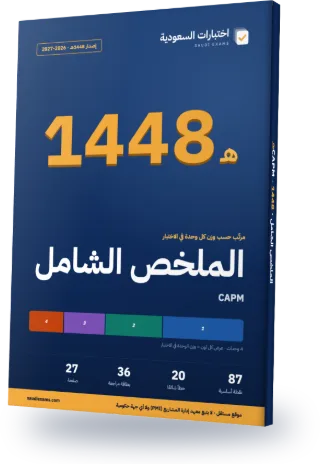
CAPM Complete Review Guide 2026–2027
Every exam topic in a 27-page Arabic PDF, ordered from the heaviest unit to the lightest. The first three chapters alone cover about 83% of the exam questions.
- 27Pages
- 87Key points
- 20Common mistakes
- 36Flashcards
Guide map
Each chapter is one exam unit, ordered by its weight in the real exam.
| Chapter | Unit | Weight | Exam questions | Key points |
|---|---|---|---|---|
| 1 | Project Management Fundamentals and Core Concepts | 36% | 54 | 20 |
| 2 | Business Analysis Frameworks | 27% | 40 | 19 |
| 3 | Agile Frameworks and Methodologies | 20% | 30 | 24 |
| 4 | Predictive, Plan-Based Methodologies | 17% | 26 | 24 |
Chapter 1 in full: Project Management Fundamentals and Core Concepts
36% of the exam, about 54 questions. These are its key points, as in the guide.
- Use the 2025 Code, sections 2–5, to check the duties illustrated by these exercises.
- A project is a temporary endeavor that creates a unique product, service or result. Its purpose and deliverables can remain valuable after the project ends. [PMI, What is a project?]
- Programs coordinate related projects for combined benefits; portfolios select a mix aligned with organizational priorities and resources. Size alone does not determine the category. [Weaver (2010), Defining the Differences, PMI-hosted author paper]
The rest of chapter 1, on this page
- A project life-cycle phase is a collection of logically related project activities that culminates in the completion of one or more deliverables. Project management process groups are different from project phases. [PMI, Project Life Cycle Phases]
- Predictive approaches suit well-defined, stable requirements. Iteration revisits work to refine it; increments add capability. Adaptive approaches support learning when requirements are uncertain or changing and feedback is available. [PMI, Project Management Approaches; Burgan & Burgan (2014), Project life cycle, historical author paper hosted by PMI]
- PMI ethical duties are organized around responsibility, respect, fairness and honesty. Applicability includes certification applicants as well as members, holders and volunteers. [PMI Code of Ethics 2025, sections 1.2,1.4]
- Take prompt corrective action on discovered errors, protect entrusted confidential information, and disclose qualification gaps before a stretch assignment so stakeholders can decide knowingly. [PMI Code of Ethics 2025, sections 2.2.3,2.2.5,2.2.6]
- Resource estimates must address skills, quantity, equipment and availability. Duration depends on work, resource capability and calendars; doubling people need not halve duration. [PMI Scheduling 2nd ed.2011, sections 3.2.1.4–5, PDF physical p42 (zero-based index 41)]
- A sponsor can provide business context, organizational support and escalation beyond delegated project authority. Clarify the actual governance and decisions rather than escalating every issue automatically. [Schibi & Lee (2015), Role / Vision / Governance, PMI-hosted author paper]
- Stakeholder analysis considers people affected as well as people with influence. Use their expectations and information needs to plan engagement, and revisit the analysis as circumstances change. [Smith (2000), Stakeholder analysis / Stakeholder Analysis Approach, historical author paper hosted by PMI]
- Closing includes acceptance evidence, procurement obligations, resource release and reusable lessons. Operations needs ownership, training and tools for a workable handover. [Aziz (2015), Project closing / The Orphan Product, historical author paper hosted by PMI]
- Risk concerns uncertainty with possible positive or negative effects. Separate causes, events and impacts. Identification and review continue throughout delivery. [Lukas & Clare (2011), Introduction / Mistakes 1–3,10, PMI-hosted author paper]
- The risk management plan describes the method; the risk register records specific risks, analysis, responses and responsibility. Triggers indicate when a planned response is needed; contingency actions specify what to do if the relevant event or condition occurs. [Lukas & Clare (2011), Risk Management Process / Mistakes 7–10, historical author paper hosted by PMI]
- An effective status meeting has a decision-focused agenda, time allocations, open-item review and actions with owners and dates. Handle routine information through reports where discussion adds no value. [PMI, How to Run a Better Status Meeting (2024), Agenda / Coverage]
- Affinity diagrams group related ideas. Nominal group technique uses silent idea generation, sharing, clarification and prioritization. A prioritization matrix compares options against agreed criteria. [Lora (2011), Keys to Effective Facilitation / NGT / Affinity / Prioritization Matrix, historical author paper hosted by PMI]
- A charter formally authorizes the project and resource authority at a high level. The manager may draft it, but an appropriately authorized initiator or sponsor must stand behind approval. A phase transition does not automatically require a new charter. [PMI, Project Charter (2026), What is / Start with authority / Keep alive]
- An assumption is taken as given for planning; a constraint sets a limit. Make each visible so the sponsor and team can check its effect rather than treating an unconfirmed premise as a guaranteed fact. [PMI, Project Charter (2026), Core elements]
- Leadership builds direction, trust and motivation; management organizes resources, budgets, responsibilities and controls. Project work needs a balance of both, and leadership does not arise from a title alone. [Saladis (2014), The Balance Between Leader and Manager, PMI-hosted author paper]
- Deliverables enable benefits but do not prove that benefits have been realized. Define the intended value, metrics, assumptions, timing, dependencies and accountable owners in a benefits realization plan. [PMI Benefits Realization Management Framework (2016), Glossary / Identify, PDF pp2–3]
- Benefits can continue after project closure. Transfer capabilities to operational owners, monitor actual results against targets and respond through the agreed tolerances and change process. [PMI BRM Framework (2016), Sustain, PDF p5]
Common mistakes in this chapter
- Disclosure alone does not authorize continued participation in a conflicted decision.
- A meeting ending on time does not prove its decision or follow-up was achieved.
- Risk responses include strategies besides mitigation. After a response is implemented, reassess the remaining exposure and continue monitoring where needed; implementation alone is not proof that a risk has disappeared.
- Available headcount is different from available qualified capacity.
The other chapters are in the full guide
One purchase · lifetime access · review guide included
7-day review plan
The chapters are spread over 6 days by weight so each day carries a similar load. Day 7 is a full exam.
Day 1 · 36% of the exam
Chapter 1: Project Management Fundamentals and Core Concepts
Day 2 · 27% of the exam
Chapter 2: Business Analysis Frameworks
Day 3 · 20% of the exam
Chapter 3: Agile Frameworks and Methodologies
Day 4 · 17% of the exam
Chapter 4: Predictive, Plan-Based Methodologies
Day 5
Full mock exam: 150 questions in 180 minutes, then review the common mistakes in the units where you lost marks.
Before you read: see your score today
10 free questions from the main units, no sign-up. Then you know which chapter to start with.
Try 10 free questions and see your levelA look at each chapter
The first three key points of each chapter, as they appear in the guide (in Arabic in the PDF).
Chapter 1: Project Management Fundamentals and Core Concepts
- Use the 2025 Code, sections 2–5, to check the duties illustrated by these exercises.
- A project is a temporary endeavor that creates a unique product, service or result…
- Programs coordinate related projects for combined benefits; portfolios select a mix aligned with organizational…
Chapter 2: Business Analysis Frameworks
- Interviews allow depth; surveys can reach many respondents with specific questions. Davis & Zweig…
- A workshop can help stakeholders resolve differences. Acceptance conditions should be observable and assessable…
- A traceability matrix connects requirements with deliverables; gaps need investigation. Blash & Blash (2015)…
Chapter 3: Agile Frameworks and Methodologies
- Use short learning cycles when uncertainty requires feedback. A team also needs authority to…
- The Product Owner orders the Product Backlog and remains accountable even when work is…
- Sprint Planning considers why the Sprint matters, what can be done and how to…
Chapter 4: Predictive, Plan-Based Methodologies
- CV = EV − AC; SV = EV − PV.
- A favorable SPI alone cannot establish the finish date; inspect the critical path.
- Choose predictive planning when scope is defined and uncertainty is manageable; changes still require…
The full guide comes with lifetime access
The full guide (27 pages) is included with lifetime access to this exam, together with every question and full mock exam. Chapter 1 is free for everyone.
Questions about the guide
Is the guide free?
Chapter 1 is free to read on the guide page. The full guide comes with lifetime access to this exam; 7-day access does not include it.
Is it up to date for 2026–2027?
Yes. Unit weights and exam facts follow what the exam body last published, and the last check date is printed in the guide. If the standards change we update the file and buyers download the new version.
Does the guide have questions?
No. The guide covers key points and common mistakes; scoring, weak-area practice and full mock exams are on the site.
Can I read it on my phone?
Yes. A5 pages in a single column, with chapters linked from the contents.
- Pages
- 27
- Edition
- 1448 AH · 2026–2027
- Language
- Arabic
- Last updated
Buy this exam
Pick the access that lasts until your test date.
Included
- Timed supplementary practice sessions: 150 questions in 180 minutes
- 785 questions, every option explained with its source
- Practice that starts with your weakest units, plus a review of your mistakes
- Complete Review Guide 2026–2027 (PDF), with lifetime access only
Continue with your Google account and you go straight to the payment page.
You pay on the Waffo Pancake checkout page (in English). The amount is in US dollars and your bank converts it to riyals. One payment with no automatic renewal, by Visa, Mastercard (a mada card with either logo works too), Apple Pay or Google Pay. Your statement shows "WAFFO". Purchases are not refundable.