SAAT
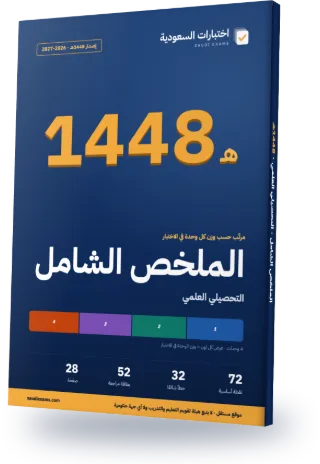
Tahsili (SAAT) Complete Review Guide 2026–2027
Every exam topic in a 28-page Arabic PDF, ordered from the heaviest unit to the lightest. The first three chapters alone cover about 75% of the exam questions.
- 28Pages
- 72Key points
- 32Common mistakes
- 52Flashcards
Guide map
Each chapter is one exam unit, ordered by its weight in the real exam.
| Chapter | Unit | Weight | Exam questions | Key points |
|---|---|---|---|---|
| 1 | Biology and Ecology | 25% | 28 | 18 |
| 2 | Chemistry | 25% | 28 | 18 |
| 3 | Physics | 25% | 27 | 18 |
| 4 | Mathematics | 25% | 27 | 18 |
Chapter 1 in full: Biology and Ecology
25% of the exam, about 28 questions. These are its key points, as in the guide.
- Taxonomic ranks from broadest to narrowest: domain, kingdom, phylum, class, order, family, genus, species.
- A scientific name has two parts: the genus capitalized, then the species in lower case, such as Homo sapiens.
- The three domains: Bacteria and Archaea, both prokaryotic, and Eukarya, which includes protists, fungi, plants and animals.
The rest of chapter 1, on this page
- Mitochondria carry out cellular respiration and make most of the ATP, chloroplasts carry out photosynthesis in plants, and ribosomes make proteins.
- Photosynthesis equation: \( 6CO_2 + 6H_2O \xrightarrow{\text{light}} C_6H_{12}O_6 + 6O_2 \).
- The light reactions occur in the thylakoid membranes and make ATP and NADPH and release oxygen; the Calvin cycle occurs in the stroma and builds glucose.
- Aerobic respiration: glycolysis in the cytoplasm (net 2 ATP), then the Krebs cycle in the mitochondrial matrix, then the electron transport chain in the inner membrane, for a total of about 30 to 32 ATP.
- Phases of mitosis in order: prophase, metaphase, anaphase, telophase.
- In meiosis, crossing over occurs in prophase I, and four haploid cells form that carry genetic variation.
- Mendel's first law (segregation): the two alleles separate when gametes form. A cross of Aa × Aa gives a 3 : 1 phenotypic ratio and a 1 : 2 : 1 genotypic ratio under complete dominance.
- Base pairing in DNA: A with T, and G with C. In RNA, U replaces T.
- Transcription makes mRNA from DNA in the nucleus; translation builds protein at the ribosome, and each three bases (a codon) code for one amino acid.
- PCR amplifies a chosen DNA segment, and gel electrophoresis separates fragments by size, so smaller fragments travel farther.
- In the circulatory system the left ventricle pumps oxygenated blood to the body through the aorta, and the right atrium receives deoxygenated blood from the body.
- Gas exchange in the lungs occurs by diffusion in the alveoli, and the kidney forms urine in nephrons through filtration, reabsorption and secretion.
- Double fertilization occurs in flowering plants: one sperm fertilizes the egg to form the zygote, and the other joins the two polar nuclei to form the endosperm.
- In a food chain, energy starts with producers, then primary, secondary and tertiary consumers, and only about 10% of the energy passes from one level to the next.
- Relationships between organisms: parasitism (one benefits, one is harmed), mutualism (both benefit), commensalism (one benefits, the other is unaffected), plus competition and predation.
Common mistakes in this chapter
- Diffusion versus osmosis: osmosis is the diffusion of water only, across a semipermeable membrane, from higher to lower water concentration.
- Passive transport needs no energy and follows the concentration gradient; active transport uses ATP and moves against it.
- Mixing up mitosis and meiosis: mitosis gives two identical diploid (2n) cells; meiosis gives four haploid (n) cells.
- Confusing genotype with phenotype, and dominant with recessive alleles: dominant does not necessarily mean most common.
- In RNA, uracil (U) replaces thymine (T); this appears often in transcription and translation questions.
- Confusing xylem with phloem: xylem carries water and minerals up from the roots; phloem carries sugars made by photosynthesis.
- Oxygenated blood: arteries usually carry blood away from the heart, but the pulmonary artery carries deoxygenated blood and the pulmonary vein carries oxygenated blood.
- In the 10% rule only about a tenth of the energy passes to the next level, not all of it; most of the rest is lost as heat.
The other chapters are in the full guide
One purchase · lifetime access · review guide included
7-day review plan
The chapters are spread over 6 days by weight so each day carries a similar load. Day 7 is a full exam.
Day 1 · 25% of the exam
Chapter 1: Biology and Ecology
Day 2 · 25% of the exam
Chapter 2: Chemistry
Day 3 · 25% of the exam
Chapter 3: Physics
Day 4 · 25% of the exam
Chapter 4: Mathematics
Day 5
Full mock exam: 110 questions in 125 minutes, then review the common mistakes in the units where you lost marks.
Before you read: see your score today
10 free questions from the main units, no sign-up. Then you know which chapter to start with.
Try 10 free questions and see your levelA look at each chapter
The first three key points of each chapter, as they appear in the guide (in Arabic in the PDF).
Chapter 1: Biology and Ecology
- Taxonomic ranks from broadest to narrowest
- A scientific name has two parts
- The three domains
Chapter 2: Chemistry
- Atomic number Z is the number of protons; mass number A is protons plus…
- Filling order
- Valence electrons of main-group elements
Chapter 3: Physics
- For constant acceleration
- Free fall has acceleration \( g = 10 \,\text{m/s}^2 \) downward; at the top…
- Projectile
Chapter 4: Mathematics
- Domain
- Inverse function
- Logarithms
The full guide comes with lifetime access
The full guide (28 pages) is included with lifetime access to this exam, together with every question and full mock exam. Chapter 1 is free for everyone.
Questions about the guide
Is the guide free?
Chapter 1 is free to read on the guide page. The full guide comes with lifetime access to this exam; 7-day access does not include it.
Is it up to date for 2026–2027?
Yes. Unit weights and exam facts follow what the exam body last published, and the last check date is printed in the guide. If the standards change we update the file and buyers download the new version.
Does the guide have questions?
No. The guide covers key points and common mistakes; scoring, weak-area practice and full mock exams are on the site.
Can I read it on my phone?
Yes. A5 pages in a single column, with chapters linked from the contents.
- Pages
- 28
- Edition
- 1448 AH · 2026–2027
- Language
- Arabic
- Last updated
All High School Exams review guides
Back to Standard Achievement Admission Test, Scientific (Tahsili, SAAT)
Buy this exam
Pick the access that lasts until your test date.
Included
- Full mock exams: 110 questions in 125 minutes, with a score for every unit
- 1333 questions, every option explained with its source
- Practice that starts with your weakest units, plus a review of your mistakes
- Complete Review Guide 2026–2027 (PDF), with lifetime access only
Continue with your Google account and you go straight to the payment page.
You pay on the Waffo Pancake checkout page (in English). The amount is in US dollars and your bank converts it to riyals. One payment with no automatic renewal, by Visa, Mastercard (a mada card with either logo works too), Apple Pay or Google Pay. Your statement shows "WAFFO". Purchases are not refundable.