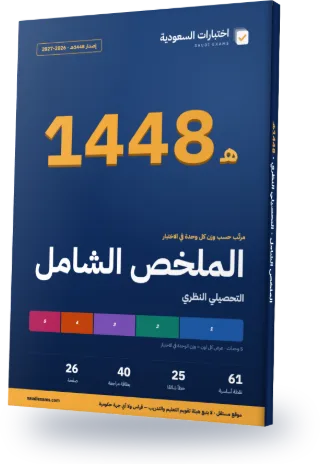
Tahsili Theoretical Complete Review Guide 2026–2027
Every exam topic in a 26-page Arabic PDF, ordered from the heaviest unit to the lightest. The first three chapters alone cover about 68% of the exam questions.
- 26Pages
- 61Key points
- 25Common mistakes
- 40Flashcards
Guide map
Each chapter is one exam unit, ordered by its weight in the real exam.
| Chapter | Unit | Weight | Exam questions | Key points |
|---|---|---|---|---|
| 1 | Arabic language | 28% | 34 | 12 |
| 2 | Islamic studies | 20% | 24 | 12 |
| 3 | Social studies | 20% | 24 | 12 |
| 4 | Principles of law | 16% | 19 | 11 |
| 5 | Digital technology | 16% | 19 | 14 |
Chapter 1 in full: Arabic language
28% of the exam, about 34 questions. These are its key points, as in the guide.
- In «شرحَ الباحثُ الفكرةَ», «الباحثُ» is the nominative subject and «الفكرةَ» the accusative object. In «شُرِحَتِ الفكرةُ», «الفكرةُ» becomes the nominative passive subject; its earlier case does not carry over.
- Separate fixed verb endings from inflection: «كتبْتُ» has fixed sukun; «لم يدعُ» is jussive through deletion of its final weak letter. In «لن يكتبوا», the nun disappears because this is one of the five verb forms.
- Start with «الجوُّ معتدلٌ». In «كان الجوُّ معتدلًا», the noun remains nominative and the predicate becomes accusative. In «إنَّ الجوَّ معتدلٌ», the noun is accusative and the predicate nominative. Identify the operator first.
The rest of chapter 1, on this page
- The adjective follows its noun: «قرأتُ تقريرًا واضحًا». A dual takes ya in the genitive: «للمهندسَيْنِ». The sound feminine plural takes kasra in the accusative: «كرّمتُ المعلماتِ». A broken plural changes the singular pattern, as كتاب becomes كتب.
- Context distinguishes constructions: «يا طالبَ العلمِ» has an accusative annexed vocative. In «إن احتجتَ فاسألْ», the imperative conditional response takes fa. A complete affirmative exception takes accusative: «حضر الزملاءُ إلا زميلًا».
- Connecting hamza drops in connected pronunciation, as in «اكتبْ»; cutting hamza remains, as in «أكتبُ». For medial hamza, compare its vowel with the preceding vowel: the kasra before hamza explains its seat in «ذِئْب». Usually, kasra outranks damma, then fatha, then sukun.
- Final hamza follows the preceding vowel: «مَلْجَأ» and «جُزْء». Add no extra alif in «مساءً». The tied ta in «حديقة» keeps its written form even when pronounced as ha in pause.
- In classical literature, connect imagery with setting and the poet’s role with society. Markets supported trade and literary exchange. A speech is prose addressed to an audience for persuasion or advice; rhythm alone does not make it metrical poetry.
- In modern literature, شعر التفعيلة retains metrical feet with flexible line length, unlike prose poetry. Short stories are typically more concentrated, novels more extended, and drama develops events through dialogue and scenes.
- Rhetoric combines well-formed language with suitability to the audience. Reports admit truth or falsehood; performative requests do not. In «ما حضر إلا خالدٌ», restriction falls on خالد. An imperative form may serve supplication rather than command.
- In «العلمُ نورٌ», both comparison terms remain but the particle and shared quality disappear: compressed simile. Metaphor omits one comparison term; «ابتسم الصباحُ» gives morning a human property. Indirect expression permits the literal sense while implying another.
- Do not classify by sound alone: wordplay requires different meanings, antithesis juxtaposes opposites, and مقابلة orders contrasting sets. Analyze the specified portion; one sentence can contain several devices without requiring every device to be named.
Common mistakes in this chapter
- The predicate of إن is nominative; a misprinted example cannot override the rule.
- عاد can be a full or copular verb; read its context.
- A paused ha sound does not change tied-ta spelling.
- Do not treat شعر التفعيلة as unmetered verse.
- Retaining both comparison terms differs from a metaphor omitting one.
The other chapters are in the full guide
One purchase · lifetime access · review guide included
7-day review plan
The chapters are spread over 6 days by weight so each day carries a similar load. Day 7 is a full exam.
Day 1 · 28% of the exam
Chapter 1: Arabic language
Day 2 · 20% of the exam
Chapter 2: Islamic studies
Day 3 · 20% of the exam
Chapter 3: Social studies
Day 4 · 16% of the exam
Chapter 4: Principles of law
Day 5 · 16% of the exam
Chapter 5: Digital technology
Day 6
Full mock exam: 120 questions in 125 minutes, then review the common mistakes in the units where you lost marks.
Before you read: see your score today
10 free questions from the main units, no sign-up. Then you know which chapter to start with.
Try 10 free questions and see your levelA look at each chapter
The first three key points of each chapter, as they appear in the guide (in Arabic in the PDF).
Chapter 1: Arabic language
- In «شرحَ الباحثُ الفكرةَ», «الباحثُ» is the nominative subject and «الفكرةَ» the accusative object…
- Separate fixed verb endings from inflection
- Start with «الجوُّ معتدلٌ». In «كان الجوُّ معتدلًا», the noun remains nominative and the…
Chapter 2: Islamic studies
- Lordship affirms God as creator, provider, and disposer of affairs. Worship concerns worship directed…
- «لا إله إلا الله» denies that anyone other than God deserves to be worshipped…
- The testimony of messengership entails believing prophetic reports, obeying commands, avoiding prohibitions, and following…
Chapter 3: Social studies
- Imam Muhammad ibn Saud founded the First Saudi State in 1727 CE, with Diriyah…
- The first state ended with Diriyah’s fall in 1818 CE. Imam Turki ibn Abdullah…
- European ocean voyages in the fifteenth and sixteenth centuries had interacting economic, religious, intellectual…
Chapter 4: Principles of law
- A legal rule is general and abstract, regulates conduct, and carries binding force and…
- Classify a sanction by purpose
- Customary manners, morality and law all influence conduct, but their binding force and sanctions…
Chapter 5: Digital technology
- Hardware comprises physical parts, such as boards, screens, and keyboards; software contains instructions. The…
- The CPU fetches, decodes, and executes instructions. Its ALU performs arithmetic and comparisons. Processing…
- RAM temporarily holds working data; volatile RAM loses its contents without power. Saving to…
The full guide comes with lifetime access
The full guide (26 pages) is included with lifetime access to this exam, together with every question and full mock exam. Chapter 1 is free for everyone.
Questions about the guide
Is the guide free?
Chapter 1 is free to read on the guide page. The full guide comes with lifetime access to this exam; 7-day access does not include it.
Is it up to date for 2026–2027?
Yes. Unit weights and exam facts follow what the exam body last published, and the last check date is printed in the guide. If the standards change we update the file and buyers download the new version.
Does the guide have questions?
No. The guide covers key points and common mistakes; scoring, weak-area practice and full mock exams are on the site.
Can I read it on my phone?
Yes. A5 pages in a single column, with chapters linked from the contents.
- Pages
- 26
- Edition
- 1448 AH · 2026–2027
- Language
- Arabic
- Last updated
Buy this exam
Pick the access that lasts until your test date.
Included
- Timed supplementary practice sessions: 120 questions in 125 minutes
- 500 questions, every option explained with its source
- Practice that starts with your weakest units, plus a review of your mistakes
- Complete Review Guide 2026–2027 (PDF), with lifetime access only
Continue with your Google account and you go straight to the payment page.
You pay on the Waffo Pancake checkout page (in English). The amount is in US dollars and your bank converts it to riyals. One payment with no automatic renewal, by Visa, Mastercard (a mada card with either logo works too), Apple Pay or Google Pay. Your statement shows "WAFFO". Purchases are not refundable.