KFUPM-TAHSILI
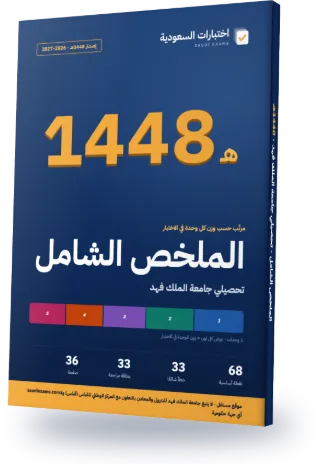
KFUPM Tahsili Complete Review Guide 2026–2027
Every exam topic in a 36-page Arabic PDF, ordered from the heaviest unit to the lightest. The first three chapters alone cover about 64% of the exam questions.
- 36Pages
- 62Key points
- 31Common mistakes
- 28Flashcards
Guide map
Each chapter is one exam unit, ordered by its weight in the real exam.
| Chapter | Unit | Weight | Exam questions | Key points |
|---|---|---|---|---|
| 1 | Physics | 22% | 24 | 8 |
| 2 | Mathematics | 22% | 24 | 14 |
| 3 | Skills | 20% | 22 | 12 |
| 4 | Biology | 18% | 20 | 14 |
| 5 | Chemistry | 18% | 20 | 14 |
Chapter 1 in full: Physics
22% of the exam, about 24 questions. These are its key points, as in the guide.
- Describe motion with a signed axis. Distance counts the whole path; displacement joins the endpoints. Average speed is total distance/total elapsed time, including rests. A delivery robot travels 60 m east then 20 m west in 20 s: speed averages 4 m/s, velocity averages 2 m/s east. For constant acceleration use v=u+at and v²=u²+2aΔx; the slope of a velocity–time graph is acceleration. In an ideal projectile, horizontal velocity is constant while vertical acceleration is −g; at the top only the vertical velocity is zero.
- Choose the object before drawing its free-body diagram; show external forces acting on that object. Add components before applying ΣF=ma. A 4 kg trolley pulled by 18 N against 6 N resistance accelerates at (18−6)/4=3 m/s². Weight is mg, whereas mass is measured in kg. Static friction adjusts up to its limiting value; it is not always μsN. Newton’s third-law partners act on different bodies. Circular motion needs inward net force mv²/r even at constant speed; terminal falling speed means drag balances weight in the usual model.
- For a constant force, W=Fs cosθ; a perpendicular force does no work. Net work changes kinetic energy K=½mv². Near Earth, gravitational potential changes by mgΔh and a spring stores ½kx². Mechanical energy K+U is conserved when net nonconservative work is zero. With g=10 m/s², a frictionless slide dropping 1.8 m from rest gives v=√(2gh)=6 m/s. Power is energy transferred/time: lifting 30 kg by 2 m in 3 s needs 200 W of useful power. Efficiency is useful output/input; electrical energy may be counted in kWh.
The rest of chapter 1, on this page
- Momentum p=mv is a vector; impulse FavgΔt=Δp requires signed velocities. A 0.1 kg ball reversing from +8 to −6 m/s receives impulse −1.4 N·s, not −0.2 N·s. Total momentum is conserved when external impulse is negligible. Elastic collisions also conserve kinetic energy; equal masses exchange velocities in a one-dimensional elastic collision. Objects that stick share one final velocity: a 3 kg cart at 4 m/s sticking to a stationary 1 kg cart moves at 3 m/s. A uniform rod has its center of mass at its midpoint by symmetry.
- For objects orbiting the same planet in circular orbits, T² is proportional to r³. Measure r from the planet’s centre. Increasing r by a factor of four increases the orbital period by a factor of eight.
- A lever in equilibrium has zero net torque about its pivot. For perpendicular forces of 9 N at 0.40 m and 12 N at 0.30 m on opposite sides, the clockwise and counterclockwise torque magnitudes are both 3.6 N·m if both forces point downward.
- Temperature differences have the same numerical size in K and °C, but absolute temperature is T(K)=T(°C)+273.15; ideal-gas average translational kinetic energy is proportional to K. Without phase change, Q=mcΔT. In an insulated mixture, heat lost equals heat gained, including any container specified. During melting at fixed pressure, Q=mLf changes phase rather than temperature. Conduction rate is kAΔT/d, convection moves fluid, and radiation crosses vacuum. Example: 0.25 kg of water with c=4200 J/(kg·K) warmed by 8 K absorbs 8400 J.
- From longer to shorter wavelengths, the spectrum runs from radio waves through microwaves, infrared, visible light, ultraviolet and X-rays to gamma rays. In vacuum a shorter wavelength corresponds to a higher frequency.
Common mistakes in this chapter
- Include rest time in average speed; subtract opposite displacements, not path lengths.
- Use net force and net work. Third-law partners belong to different objects; absence of friction alone does not guarantee constant mechanical energy.
- A rebound reverses the velocity sign. Sticking conserves momentum in an isolated collision, but does not conserve kinetic energy.
- Convert cm² by 10⁻⁴ and cm³ by 10⁻⁶. Use kelvin for absolute-temperature ratios and Q=mL on a phase-change plateau.
- Use the same positive rotation direction for all torques. A force acting through the axis has zero torque.
The other chapters are in the full guide
One purchase · lifetime access · review guide included
7-day review plan
The chapters are spread over 6 days by weight so each day carries a similar load. Day 7 is a full exam.
Day 1 · 22% of the exam
Chapter 1: Physics
Day 2 · 22% of the exam
Chapter 2: Mathematics
Day 3 · 20% of the exam
Chapter 3: Skills
Day 4 · 18% of the exam
Chapter 4: Biology
Day 5 · 18% of the exam
Chapter 5: Chemistry
Day 6
Full mock exam: 110 questions in 125 minutes, then review the common mistakes in the units where you lost marks.
Before you read: see your score today
10 free questions from the main units, no sign-up. Then you know which chapter to start with.
Try 10 free questions and see your levelA look at each chapter
The first three key points of each chapter, as they appear in the guide (in Arabic in the PDF).
Chapter 1: Physics
- Describe motion with a signed axis. Distance counts the whole path; displacement joins the…
- Choose the object before drawing its free-body diagram; show external forces acting on that…
- For a constant force, W=Fs cosθ; a perpendicular force does no work. Net work…
Chapter 2: Mathematics
- A function assigns exactly one output to each allowed input; different inputs may share…
- For a line y=mx+b, slope m=(y2−y1)/(x2−x1) and b is the output at x=0. A…
- Use algebraic structure before lengthy expansion
Chapter 3: Skills
- Evidence check
- A sample must match the population being discussed. Asking only classmates who volunteer may…
- Read graph axes, intervals, legends and units before comparing heights. A bar chart with…
Chapter 4: Biology
- Cell structure predicts function
- The membrane is a fluid lipid bilayer containing proteins. Facilitated diffusion moves down a…
- DNA replicates before division. Mitosis separates sister chromatids and ordinarily preserves ploidy. Meiosis I…
Chapter 5: Chemistry
- Atomic bookkeeping
- Electron structure explains periodic trends. Each orbital holds at most two opposite-spin electrons; a…
- Bonding and names
The full guide comes with lifetime access
The full guide (36 pages) is included with lifetime access to this exam, together with every question and full mock exam. Chapter 1 is free for everyone.
Questions about the guide
Is the guide free?
Chapter 1 is free to read on the guide page. The full guide comes with lifetime access to this exam; 7-day access does not include it.
Is it up to date for 2026–2027?
Yes. Unit weights and exam facts follow what the exam body last published, and the last check date is printed in the guide. If the standards change we update the file and buyers download the new version.
Does the guide have questions?
No. The guide covers key points and common mistakes; scoring, weak-area practice and full mock exams are on the site.
Can I read it on my phone?
Yes. A5 pages in a single column, with chapters linked from the contents.
- Pages
- 36
- Edition
- 1448 AH · 2026–2027
- Language
- Arabic
- Last updated
Buy this exam
Pick the access that lasts until your test date.
Included
- Timed supplementary practice sessions: 110 questions in 125 minutes
- 500 questions, every option explained with its source
- Practice that starts with your weakest units, plus a review of your mistakes
- Complete Review Guide 2026–2027 (PDF), with lifetime access only
Continue with your Google account and you go straight to the payment page.
You pay on the Waffo Pancake checkout page (in English). The amount is in US dollars and your bank converts it to riyals. One payment with no automatic renewal, by Visa, Mastercard (a mada card with either logo works too), Apple Pay or Google Pay. Your statement shows "WAFFO". Purchases are not refundable.