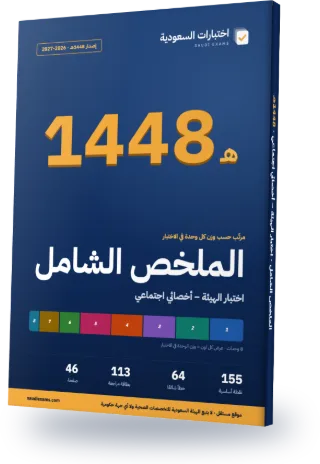
SCFHS Social Worker Complete Review Guide 2026–2027
Every exam topic in a 46-page Arabic PDF, ordered from the heaviest unit to the lightest. The first three chapters alone cover about 45% of the exam questions.
- 46Pages
- 155Key points
- 64Common mistakes
- 113Flashcards
Guide map
Each chapter is one exam unit, ordered by its weight in the real exam.
| Chapter | Unit | Weight | Exam questions | Key points |
|---|---|---|---|---|
| 1 | Human development, diversity and behaviour in the environment | 15% | 23 | 20 |
| 2 | Professional relationship, values and ethics | 15% | 23 | 18 |
| 3 | Patient and family problems | 15% | 22 | 20 |
| 4 | Mental health and addiction | 15% | 22 | 20 |
| 5 | Social work skills | 15% | 22 | 20 |
| 6 | Family violence | 10% | 15 | 19 |
| 7 | Marital and family therapy | 10% | 15 | 20 |
| 8 | Social measurement | 5% | 8 | 18 |
Chapter 1 in full: Human development, diversity and behaviour in the environment
15% of the exam, about 23 questions. These are its key points, as in the guide.
- Erikson's early crises: trust vs mistrust (infancy), autonomy vs shame and doubt (toddler), initiative vs guilt (preschool), industry vs inferiority (school age).
- Later crises: identity vs role confusion (adolescence), intimacy vs isolation (young adulthood), generativity vs stagnation (midlife), integrity vs despair (old age).
- Piaget: sensorimotor (0–2 years, object permanence), preoperational (2–7, egocentrism, animism), concrete operational (7–11, logic tied to concrete things), formal operational (11+, hypothetical thinking).
The rest of chapter 1, on this page
- Kohlberg's three levels: preconventional (avoiding punishment, self-interest), conventional (law and order), postconventional (universal principles and rights).
- Stranger anxiety appears around 8 months; separation anxiety is common from about 8 to 18 months. A hospitalised child moves through protest, despair and detachment; quiet withdrawal is a warning sign, not calm.
- Ainsworth's styles: secure (upset at separation, soothed on return), anxious-ambivalent (clings and resists), avoidant (ignores), and disorganized (contradictory behaviour linked to abuse, neglect or severe parental depression).
- Maslow from the base: physiological, safety, belonging and love, esteem, self-actualisation. A homeless patient needs housing and food before work on self-confidence.
- Vygotsky's zone of proximal development: what a child does with help but not alone; Bandura's learning by observation and modelling (a child imitates the violence he sees).
- Ageing theories: activity (keeping activities and roles raises satisfaction), disengagement (mutual withdrawal), continuity (keeping earlier life patterns). Reviewing life with acceptance signals integrity.
- Marcia's statuses: foreclosure (commitment without exploration), moratorium (exploring, no commitment), diffusion, achievement. Elkind's personal fable ('it won't happen to me') and imaginary audience belong to adolescence.
- NASW cultural competence needs awareness of one's own values and biases, knowledge of clients' cultures and cross-cultural skills; cultural humility adds asking the client about his culture.
- Prejudice is a prior attitude, discrimination is the resulting behaviour, stereotyping is rigid generalisation, ethnocentrism judges other cultures by your own. Goffman's stigma is an attribute that discredits its bearer.
- Intersectionality: overlapping identities (divorced, expatriate, disabled) multiply disadvantage. Empowerment helps people gain control of their lives; advocacy defends clients' rights.
- Acculturation is change from continuous contact with another culture. Culture-shock phases: honeymoon, frustration or crisis, adjustment, acceptance.
- With an interpreter: speak and look at the patient, use a qualified interpreter (not a child or relative), and use standardised translated scales, not a self-made translation. The culturagram explores the background of immigrant families.
- Bronfenbrenner: microsystem (immediate settings like family, school), mesosystem (links between them), exosystem (settings that affect the person without his participation), macrosystem (values, policies, culture), chronosystem (timing and transitions).
- Systems concepts: homeostasis (tendency to stay stable), equifinality (different starts, same outcome), multifinality (same start, different outcomes), negative feedback keeps balance and positive feedback amplifies deviation, closed boundaries isolate a system.
- Pincus and Minahan's four systems: change agent, client, target, action. Germain and Gitterman: goodness of fit between needs and environmental resources, habitat (physical setting), niche (role in the community).
- The eco-map (Hartman) shows a family's links to outside systems: a thick line is strong, dashed is weak, a line crossed by hash marks (////) is stressful. The genogram shows family structure across generations.
- Roles: broker links clients to resources, mediator helps two disputing parties reach agreement without taking sides, advocate defends client rights, enabler builds client capacity. Instrumental support is practical help, unlike emotional support.
Common mistakes in this chapter
- Mixing the adolescent crisis (identity vs role confusion) with early adulthood (intimacy vs isolation) and midlife (generativity vs stagnation).
- Attributing animism to concrete operations; it belongs to the preoperational stage (about 2 to 7 years).
- Calling anxious-ambivalent attachment avoidant; in avoidant attachment the child ignores the parent on return.
- Confusing assimilation (giving up the original culture) with integration (keeping it while joining the new society).
- Writing 'strange customs' or 'uncooperative' in the file; this is ethnocentric, the correct step is to describe behaviour and its context.
- Using a child or relative as interpreter for sensitive topics; use a qualified interpreter and speak to the patient, not the interpreter.
- Confusing the exosystem (a setting the person is not in but that affects him, like a mother's workplace) with the mesosystem (links between his immediate settings, like home and school).
- Mixing client system and target system in Pincus and Minahan; the target system is whoever must change, not necessarily the client.
The other chapters are in the full guide
One purchase · lifetime access · review guide included
7-day review plan
The chapters are spread over 6 days by weight so each day carries a similar load. Day 7 is a full exam.
Day 1 · 20% of the exam
Chapter 1: Human development, diversity and behaviour in the environment
Chapter 8: Social measurementDay 2 · 15% of the exam
Chapter 2: Professional relationship, values and ethics
Day 3 · 15% of the exam
Chapter 3: Patient and family problems
Day 4 · 15% of the exam
Chapter 4: Mental health and addiction
Day 5 · 15% of the exam
Chapter 5: Social work skills
Day 6 · 20% of the exam
Chapter 6: Family violence
Chapter 7: Marital and family therapyDay 7
Full mock exam: 150 questions in 180 minutes, then review the common mistakes in the units where you lost marks.
How many correct answers do you need?
- Pass mark 60%90 correct out of 150
Before you read: see your score today
10 free questions from the main units, no sign-up. Then you know which chapter to start with.
Try 10 free questions and see your levelA look at each chapter
The first three key points of each chapter, as they appear in the guide (in Arabic in the PDF).
Chapter 1: Human development, diversity and behaviour in the environment
- Erikson's early crises
- Later crises
- Piaget
Chapter 2: Professional relationship, values and ethics
- A professional relationship is purposeful, time-limited and client-centred, unlike friendship. It ends with early…
- Individualisation
- The contract is the agreement on goals, roles, responsibilities and duration. Resistance is client…
Chapter 3: Patient and family problems
- Richmond's casework
- Gather information from several sources (patient, family, medical file, team) and clarify discrepancies calmly…
- Perlman
Chapter 4: Mental health and addiction
- DSM-5-TR major depressive episode
- Mania lasts at least a week (or any length if hospitalised), with reduced need…
- Schizophrenia
Chapter 5: Social work skills
- An open question invites an expanded answer ('tell me about...'); a closed one needs…
- Interview phases
- Reflection of feeling states the emotion beneath the client's words ('you seem frustrated and…
Chapter 6: Family violence
- Physical abuse is deliberate injury. Psychological abuse is insult, threat and humiliation (such as…
- Neglect is a caregiver's failure to meet basic needs (food, medicine, hygiene, supervision), such…
- Economic or financial abuse
Chapter 7: Marital and family therapy
- Family systems theory
- Bowen
- The genogram (McGoldrick) draws family structure and patterns across three generations, such as recurring…
Chapter 8: Social measurement
- Nominal classifies without order (marital status), ordinal ranks without equal intervals (Likert items), interval…
- A Likert scale uses typically five response points from strongly agree to strongly disagree…
- Reliability is consistency on repeated measurement; test-retest repeats the scale on the same group…
The full guide comes with lifetime access
The full guide (46 pages) is included with lifetime access to this exam, together with every question and full mock exam. Chapter 1 is free for everyone.
Questions about the guide
Is the guide free?
Chapter 1 is free to read on the guide page. The full guide comes with lifetime access to this exam; 7-day access does not include it.
Is it up to date for 2026–2027?
Yes. Unit weights and exam facts follow what the exam body last published, and the last check date is printed in the guide. If the standards change we update the file and buyers download the new version.
Does the guide have questions?
No. The guide covers key points and common mistakes; scoring, weak-area practice and full mock exams are on the site.
Can I read it on my phone?
Yes. A5 pages in a single column, with chapters linked from the contents.
- Pages
- 46
- Edition
- 1448 AH · 2026–2027
- Language
- Arabic
- Last updated
All Health Exams review guides
Back to SCFHS Classification Exam – Social Service Specialist
Buy this exam
Pick the access that lasts until your test date.
Included
- Full mock exams: 150 questions in 180 minutes, with a score for every unit
- 750 questions, every option explained with its source
- Practice that starts with your weakest units, plus a review of your mistakes
- Complete Review Guide 2026–2027 (PDF), with lifetime access only
Continue with your Google account and you go straight to the payment page.
You pay on the Waffo Pancake checkout page (in English). The amount is in US dollars and your bank converts it to riyals. One payment with no automatic renewal, by Visa, Mastercard (a mada card with either logo works too), Apple Pay or Google Pay. Your statement shows "WAFFO". Purchases are not refundable.