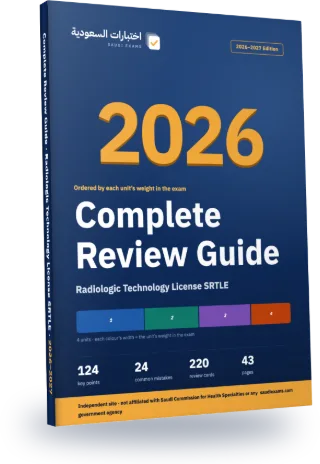
Radiologic Technology License SRTLE Complete Review Guide 2026–2027
Every exam topic in a 43-page Arabic PDF, ordered from the heaviest unit to the lightest. The first three chapters alone cover about 80% of the exam questions.
- 43Pages
- 124Key points
- 24Common mistakes
- 220Flashcards
Guide map
Each chapter is one exam unit, ordered by its weight in the real exam.
| Chapter | Unit | Weight | Exam questions | Key points |
|---|---|---|---|---|
| 1 | Protocol Management | 30% | 60 | 31 |
| 2 | Health and Safety | 25% | 50 | 31 |
| 3 | Operation of Equipment | 25% | 50 | 31 |
| 4 | Professional Practice | 20% | 40 | 31 |
Chapter 1 in full: Protocol Management
30% of the exam, about 60 questions. These are its key points, as in the guide.
- In anatomical position the patient faces forward with palms forward; sagittal, coronal and axial planes divide the body left-right, front-back and top-bottom. Source: Lampignano & Kendrick, Bontrager's Textbook of Radiographic Positioning and Related Anatomy, 10th ed.
- Projection names follow the beam path (PA = posterior to anterior); position names describe the patient (for example left lateral, LPO). Source: Lampignano & Kendrick, Bontrager's Textbook of Radiographic Positioning and Related Anatomy, 10th ed.
- PA chest at 180 cm SID on full inspiration reduces heart magnification; a good inspiration shows about 10 posterior ribs above the diaphragm. Source: Lampignano & Kendrick, Bontrager's Textbook of Radiographic Positioning and Related Anatomy, 10th ed.
The rest of chapter 1, on this page
- Erect positioning shows air-fluid levels; a decubitus view with a horizontal beam is used when the patient cannot stand. Source: Lampignano & Kendrick, Bontrager's Textbook of Radiographic Positioning and Related Anatomy, 10th ed.
- Two projections at right angles are the minimum for most bones; include the joint nearest the injury for long bones, ideally both joints. Source: Lampignano & Kendrick, Bontrager's Textbook of Radiographic Positioning and Related Anatomy, 10th ed.
- Scaphoid fractures are best shown with a PA wrist in ulnar deviation; a negative first film with clinical suspicion needs follow-up. Source: Lampignano & Kendrick, Bontrager's Textbook of Radiographic Positioning and Related Anatomy, 10th ed.
- Suspected cervical spine injury: do not move the neck; obtain a cross-table lateral or CT first, following trauma protocol. Source: Lampignano & Kendrick, Bontrager's Textbook of Radiographic Positioning and Related Anatomy, 10th ed.
- Normal adult vital signs: pulse 60–100/min, respiration 12–20/min, blood pressure around 120/80 mmHg, temperature about 37 °C, SpO2 ≥ 95%. Source: Torres, Dutton & Linn-Watson, Patient Care in Imaging Technology, 9th ed.
- Before iodinated contrast check allergy history, renal function in at-risk patients, metformin use and hydration. Source: ACR Manual on Contrast Media.
- Barium studies are contraindicated when perforation is suspected; water-soluble iodinated contrast is used instead. Source: ACR Manual on Contrast Media.
- Upper GI studies need fasting (usually from midnight); barium enema needs bowel preparation. Source: Lampignano & Kendrick, Bontrager's Textbook of Radiographic Positioning and Related Anatomy, 10th ed.
- A hysterosalpingogram is scheduled after menstruation and before ovulation (about days 7–10) to avoid an early pregnancy. Source: Lampignano & Kendrick, Bontrager's Textbook of Radiographic Positioning and Related Anatomy, 10th ed.
- Pelvic ultrasound through the abdomen needs a full bladder; transvaginal scanning needs an empty bladder. Source: Adler & Carlton, Introduction to Radiologic and Imaging Sciences and Patient Care, 6th ed.
- Gallbladder ultrasound needs fasting for about 6–8 hours so the gallbladder is distended. Source: Adler & Carlton, Introduction to Radiologic and Imaging Sciences and Patient Care, 6th ed.
- Standard screening mammography uses CC and MLO views; adequate compression reduces dose, motion and overlap. Source: Lampignano & Kendrick, Bontrager's Textbook of Radiographic Positioning and Related Anatomy, 10th ed.
- A stroke CT protocol starts with non-contrast head CT to exclude haemorrhage, often followed by CT angiography and perfusion. Source: Seeram, Computed Tomography, 4th ed.
- CT pulmonary angiography times the bolus to the pulmonary arteries using bolus tracking; arterial and portal venous phases are timed differently for the abdomen. Source: Seeram, Computed Tomography, 4th ed.
- MRI with gadolinium checks renal function in at-risk patients because of nephrogenic systemic fibrosis risk with older agents. Source: ACR Manual on Contrast Media.
- Cardiac MRI uses ECG gating to freeze cardiac motion; respiratory motion is controlled with breath-holds or navigators. Source: Westbrook, Roth & Talbot, MRI in Practice, 5th ed.
- Fluoroscopy dose is reduced with pulsed fluoroscopy, last-image hold, collimation and keeping the image intensifier or detector close to the patient. Source: Adler & Carlton, Introduction to Radiologic and Imaging Sciences and Patient Care, 6th ed.
- The common femoral artery is the usual arterial access; manual pressure or a closure device is used after sheath removal. Source: Kandarpa, Machan & Durham, Handbook of Interventional Radiologic Procedures
- After angiography check the puncture site, distal pulses and vital signs, and keep the leg straight as instructed. Source: Kandarpa, Machan & Durham, Handbook of Interventional Radiologic Procedures
- Coagulation (INR, platelets) and anticoagulant use are checked before biopsies and arterial procedures. Source: Kandarpa, Machan & Durham, Handbook of Interventional Radiologic Procedures
- Tc-99m MDP bone scans image about 2–4 hours after injection; the patient is hydrated and voids before imaging. Source: Cherry, Sorenson & Phelps, Physics in Nuclear Medicine, 4th ed.
- F-18 FDG PET requires fasting and controlled blood glucose; the patient rests quietly during uptake to limit muscle uptake. Source: Cherry, Sorenson & Phelps, Physics in Nuclear Medicine, 4th ed.
- Common radiopharmaceuticals: Tc-99m MAA for lung perfusion, Tc-99m sestamibi for myocardial perfusion, I-131 for thyroid therapy. Source: Cherry, Sorenson & Phelps, Physics in Nuclear Medicine, 4th ed.
- Low-osmolar and iso-osmolar non-ionic iodinated agents have fewer reactions than older high-osmolar ionic agents. Source: ACR Manual on Contrast Media.
- Adrenaline (epinephrine) is first-line for anaphylaxis; atropine treats symptomatic bradycardia; diphenhydramine treats hives. Source: ACR Manual on Contrast Media.
- Sedated patients are monitored with pulse oximetry and observed until discharge criteria are met. Source: Torres, Dutton & Linn-Watson, Patient Care in Imaging Technology, 9th ed.
- Oxygen is a drug: it is given at the prescribed rate, and cylinders are never taken into the MR room unless MR-safe. Source: Torres, Dutton & Linn-Watson, Patient Care in Imaging Technology, 9th ed.
- Recognise shock early: falling blood pressure, rising pulse, pallor and cold clammy skin; lay the patient flat and call for help. Source: AHA Guidelines for CPR and ECC.
Common mistakes in this chapter
- Never use barium when perforation is suspected.
- Transabdominal pelvic US needs a full bladder; transvaginal needs an empty one.
- Do not move the neck before cervical spine injury is excluded.
- Stroke CT starts without contrast.
- Projection names describe the beam path, not the side touching the detector.
- High blood glucose degrades FDG PET.
The other chapters are in the full guide
One purchase · lifetime access · review guide included
7-day review plan
The chapters are spread over 6 days by weight so each day carries a similar load. Day 7 is a full exam.
Day 1 · 30% of the exam
Chapter 1: Protocol Management
Day 2 · 25% of the exam
Chapter 2: Health and Safety
Day 3 · 25% of the exam
Chapter 3: Operation of Equipment
Day 4 · 20% of the exam
Chapter 4: Professional Practice
Day 5
Full mock exam: 200 questions in 240 minutes, then review the common mistakes in the units where you lost marks.
Before you read: see your score today
10 free questions from the main units, no sign-up. Then you know which chapter to start with.
Try 10 free questions and see your levelA look at each chapter
The first three key points of each chapter, as they appear in the guide (in Arabic in the PDF).
Chapter 1: Protocol Management
- In anatomical position the patient faces forward with palms forward; sagittal, coronal and axial…
- Projection names follow the beam path (PA = posterior to anterior); position names describe…
- PA chest at 180 cm SID on full inspiration reduces heart magnification; a good…
Chapter 2: Health and Safety
- The chain of infection links agent, reservoir, portal of exit, mode of transmission, portal…
- Standard precautions apply to every patient
- Perform hand hygiene at the WHO five moments
Chapter 3: Operation of Equipment
- X-rays are produced when high-speed electrons from the cathode strike the tungsten anode; about…
- Bremsstrahlung gives the continuous spectrum and most diagnostic X-rays; characteristic radiation appears at discrete…
- kVp controls beam energy and penetration and strongly affects subject contrast; mAs controls the…
Chapter 4: Professional Practice
- The four core principles are autonomy, beneficence, non-maleficence and justice; most dilemmas in imaging…
- A technologist works within the scope of practice set by regulation, credential and local…
- Ethics codes require honesty in records
The full guide comes with lifetime access
The full guide (43 pages) is included with lifetime access to this exam, together with every question and full mock exam. Chapter 1 is free for everyone.
Questions about the guide
Is the guide free?
Chapter 1 is free to read on the guide page. The full guide comes with lifetime access to this exam; 7-day access does not include it.
Is it up to date for 2026–2027?
Yes. Unit weights and exam facts follow what the exam body last published, and the last check date is printed in the guide. If the standards change we update the file and buyers download the new version.
Does the guide have questions?
No. The guide covers key points and common mistakes; scoring, weak-area practice and full mock exams are on the site.
Can I read it on my phone?
Yes. A5 pages in a single column, with chapters linked from the contents.
- Pages
- 43
- Edition
- 1448 AH · 2026–2027
- Language
- Arabic
- Last updated
All Health Exams review guides
Back to Saudi Radiologic Technology Licensure Examination (SRTLE)
Buy this exam
Pick the access that lasts until your test date.
Included
- Full mock exams: 200 questions in 240 minutes, with a score for every unit
- 500 questions, every option explained with its source
- Practice that starts with your weakest units, plus a review of your mistakes
- Complete Review Guide 2026–2027 (PDF), with lifetime access only
Continue with your Google account and you go straight to the payment page.
You pay on the Waffo Pancake checkout page (in English). The amount is in US dollars and your bank converts it to riyals. One payment with no automatic renewal, by Visa, Mastercard (a mada card with either logo works too), Apple Pay or Google Pay. Your statement shows "WAFFO". Purchases are not refundable.