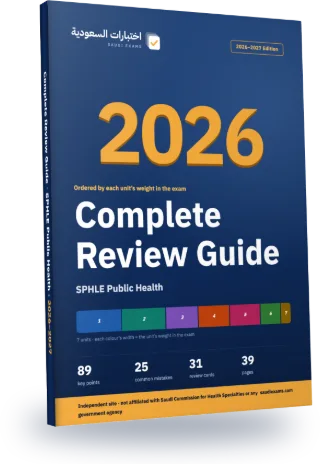
SPHLE Public Health Complete Review Guide 2026–2027
Every exam topic in a 39-page Arabic PDF, ordered from the heaviest unit to the lightest. The first three chapters alone cover about 55% of the exam questions.
- 39Pages
- 89Key points
- 25Common mistakes
- 31Flashcards
Guide map
Each chapter is one exam unit, ordered by its weight in the real exam.
| Chapter | Unit | Weight | Exam questions | Key points |
|---|---|---|---|---|
| 1 | Fundamentals of Public Health | 20% | 40 | 12 |
| 2 | Epidemiology | 20% | 40 | 16 |
| 3 | Environmental and Occupational Health | 15% | 30 | 12 |
| 4 | Health Policy, Management, and Economics | 15% | 30 | 14 |
| 5 | Social and Behavioral Sciences, Health Communication, and Health Promotion | 15% | 30 | 13 |
| 6 | Biostatistics and Data Science | 10% | 20 | 10 |
| 7 | Foundations of Biological and Life Sciences | 5% | 10 | 12 |
Chapter 1 in full: Fundamentals of Public Health
20% of the exam, about 40 questions. These are its key points, as in the guide.
- Public health considers populations and conditions for health. The essential-services framework connects monitoring, investigation, communication, partnerships, policy, access, workforce, and infrastructure. Source: CDC, Goals.
- Equity is not established by identical offers alone: removing barriers can require particular attention to disadvantaged groups. See WHO, Health equity.
- The social gradient is not limited to contrasting the poorest group with everyone else; health generally improves with socioeconomic position. WHO, Overview.
The rest of chapter 1, on this page
- Determinants include living and working conditions, education, housing, and distribution of power and resources; care access alone does not explain every gap. WHO, Overview and Health equity.
- Hajj illustrates seasonal priorities combining infection, heat, food, and continuing care for existing conditions. MOH-Weqaya announcement, 6 May 2026, Page Content.
- NCDs are a global concern across ages and countries; response combines risk reduction, detection, treatment, and palliation. WHO NCD, People at risk and Prevention and control.
- The IHR coordinate cross-border risk response while requiring proportionate measures and avoiding unnecessary interference with travel and trade. WHO IHR, Implementation.
- Needs assessment combines outcomes, determinants, and resources from multiple sources with community participation; findings then guide allocation. CDC CHA, definition and Benefits.
- Use an open process and objective criteria to prioritize, considering impact, resources, and available effective interventions. CDC CHI Focus, Key Concepts.
- Inputs are resources; activities are actions; outputs are products of action; outcomes are intended changes in people or systems. CDC Step 2, Developing a Logic Model.
- Formative evaluation examines fit and acceptability before full rollout; process evaluation examines delivery; outcome evaluation examines goal attainment; impact evaluation compares with what would happen without the program. CDC Step 3, Determine the Type of Evaluation.
- Define evaluation questions, then indicators, sources, and the analysis plan, considering validity, reliability, and confidentiality. More data do not compensate for irrelevance. CDC Step 4, Choose Appropriate Methods and Identify Relevant Indicators.
Common mistakes in this chapter
- Formally equal services do not prove equitable effective opportunity.
- Webpage date is not necessarily the data year or framework edition.
- Activity counts are insufficient evidence of health outcomes.
The other chapters are in the full guide
One purchase · lifetime access · review guide included
7-day review plan
The chapters are spread over 6 days by weight so each day carries a similar load. Day 7 is a full exam.
Day 1 · 20% of the exam
Chapter 1: Fundamentals of Public Health
Day 2 · 20% of the exam
Chapter 2: Epidemiology
Day 3 · 15% of the exam
Chapter 3: Environmental and Occupational Health
Day 4 · 15% of the exam
Chapter 4: Health Policy, Management, and Economics
Day 5 · 15% of the exam
Chapter 5: Social and Behavioral Sciences, Health Communication, and Health Promotion
Day 6 · 15% of the exam
Chapter 6: Biostatistics and Data Science
Chapter 7: Foundations of Biological and Life SciencesDay 7
Full mock exam: 200 questions in 240 minutes, then review the common mistakes in the units where you lost marks.
Before you read: see your score today
10 free questions from the main units, no sign-up. Then you know which chapter to start with.
Try 10 free questions and see your levelA look at each chapter
The first three key points of each chapter, as they appear in the guide (in Arabic in the PDF).
Chapter 1: Fundamentals of Public Health
- Public health considers populations and conditions for health. The essential-services framework connects monitoring, investigation…
- Equity is not established by identical offers alone
- The social gradient is not limited to contrasting the poorest group with everyone else;…
Chapter 2: Epidemiology
- Experimental studies assign intervention; observational studies observe exposure. Cohorts group by exposure and trace…
- A component cause contributes to a pathway; a sufficient cause is a completed pathway;…
- Natural history distinguishes exposure, subclinical onset, symptoms, and outcome. Primary prevention aims to prevent…
Chapter 3: Environmental and Occupational Health
- Emergency risk management combines prevention, preparedness, readiness, response, and recovery rather than only post-disaster…
- Disaster management needs cross-sector cooperation, the whole health system, community participation, vulnerable-group rights, and…
- Floods involve drowning, trauma, electricity, chemicals, mental effects, and disrupted water, food, and services;…
Chapter 4: Health Policy, Management, and Economics
- Separate the transformation model from claims of completed implementation. MOH distinguishes regulation/supervision from financing/provision…
- A health cluster is a multilevel facility network with population health, detection, prevention, and…
- SFDA regulates and monitors imported and local food, medicines, and devices, including safety and…
Chapter 5: Social and Behavioral Sciences, Health Communication, and Health Promotion
- Health Belief Model
- Stages of Change
- Theory of Planned Behavior links intention to attitude, subjective norm, and perceived control. Attitude…
Chapter 6: Biostatistics and Data Science
- Nominal variables have unordered categories, such as blood group; ordinal categories are ordered, such…
- A frequency table links categories and counts. Before analysis inspect impossible values, missingness, duplicates…
- The mean is sum/count; the median is the ordered middle; the mode occurs most…
Chapter 7: Foundations of Biological and Life Sciences
- Host genes can influence responses to infection, medicines, and behaviors; susceptibility does not mean…
- A DNA-sequence change differs from altered gene expression; environment can affect gene activity without…
- Inherited changes pass through germ cells; somatic changes are not passed to children through…
The full guide comes with lifetime access
The full guide (39 pages) is included with lifetime access to this exam, together with every question and full mock exam. Chapter 1 is free for everyone.
Questions about the guide
Is the guide free?
Chapter 1 is free to read on the guide page. The full guide comes with lifetime access to this exam; 7-day access does not include it.
Is it up to date for 2026–2027?
Yes. Unit weights and exam facts follow what the exam body last published, and the last check date is printed in the guide. If the standards change we update the file and buyers download the new version.
Does the guide have questions?
No. The guide covers key points and common mistakes; scoring, weak-area practice and full mock exams are on the site.
Can I read it on my phone?
Yes. A5 pages in a single column, with chapters linked from the contents.
- Pages
- 39
- Edition
- 1448 AH · 2026–2027
- Language
- Arabic
- Last updated
Buy this exam
Pick the access that lasts until your test date.
Included
- Full mock exams: 200 questions in 240 minutes, with a score for every unit
- 502 questions, every option explained with its source
- Practice that starts with your weakest units, plus a review of your mistakes
- Complete Review Guide 2026–2027 (PDF), with lifetime access only
Continue with your Google account and you go straight to the payment page.
You pay on the Waffo Pancake checkout page (in English). The amount is in US dollars and your bank converts it to riyals. One payment with no automatic renewal, by Visa, Mastercard (a mada card with either logo works too), Apple Pay or Google Pay. Your statement shows "WAFFO". Purchases are not refundable.