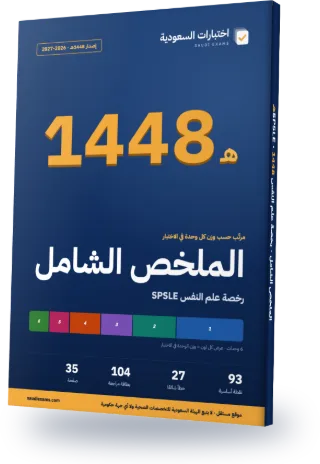
Psychology License SPSLE Complete Review Guide 2026–2027
Every exam topic in a 35-page Arabic PDF, ordered from the heaviest unit to the lightest. The first three chapters alone cover about 65% of the exam questions.
- 35Pages
- 93Key points
- 27Common mistakes
- 104Flashcards
Guide map
Each chapter is one exam unit, ordered by its weight in the real exam.
| Chapter | Unit | Weight | Exam questions | Key points |
|---|---|---|---|---|
| 1 | Assessment and clinical decision making | 30% | 60 | 22 |
| 2 | Treatment, intervention, and prevention | 20% | 40 | 10 |
| 3 | Biological, social, and cognitive-affective bases of behavior | 15% | 30 | 31 |
| 4 | Psychopathology | 15% | 30 | 10 |
| 5 | Growth and lifespan development | 10% | 20 | 10 |
| 6 | Ethics and professionalism | 10% | 20 | 10 |
Chapter 1 in full: Assessment and clinical decision making
30% of the exam, about 60 questions. These are its key points, as in the guide.
- Define the referral decision before choosing assessment methods. — Guideline 1, pp.9–10.
- Assessment integrates interviews, observations, records and appropriate measures; disagreements may reflect context or method and need investigation. — Guideline 7, p.17.
- Case conceptualization links findings to an explanation and recommendations. Separate observations, supported inferences and tentative hypotheses. — Guideline 1, pp.10–11.
The rest of chapter 1, on this page
- Competence depends on purpose, population and setting as well as instrument familiarity. Seek training or referral when the question exceeds expertise. — Guidelines 1–4.
- Explain assessment purpose, possible outcomes and recipients in understandable language. Feedback should communicate meaning and limitations. — Guidelines 1 and 3.
- Consider language, literacy, sensory and motor access. Adaptations and departures from standard conditions may limit interpretation and should be documented. — Guidelines 8–12.
- Check scoring and administration errors before constructing clinical explanations. Floor and ceiling effects limit differentiation at score extremes. — Guideline 8.
- Poor performance can reflect multiple influences. A validity concern does not by itself establish intentional deception. — Guideline 8, pp.17–18.
- Online versions need evidence of suitable adaptation. Connection failures, distractions or coaching can alter what remote scores mean. — Guideline 15.
- A positive suicide screen is followed by safety assessment. Assess current thoughts, timing, planning, access, past behavior, symptoms, stressors and usable supports. — Assess the patient.
- Current suicidal thoughts with inability to remain safe require active supervision and urgent emergency evaluation. Routine testing must not delay care. — Frequency of suicidal thoughts; Determine disposition.
- A collaborative safety plan specifies coping actions, contacts and steps to reduce access to dangerous items. A promise not to self-harm is not a substitute. — Make a safety plan.
- Protective beliefs and supports inform assessment without proving zero risk. Review safety and follow-up needs as circumstances change. — Social Support; Determine disposition.
- Developmental assessment combines early history, multiple settings and relevant cognitive, communication and adaptive functions. Strengths guide supports. — How is ASD diagnosed?
- For attention concerns, clarify childhood history, persistence, cross-setting impairment and possible sleep, mood, anxiety or medical contributors. — How is ADHD diagnosed?
- Mood assessment uses the course across time, not only today’s state. Ask about past mood elevation and coordinate medical review when appropriate. — How is bipolar disorder diagnosed?
- Psychotic experiences have several possible causes. Evaluate changes from baseline, relevant medical or substance factors, safety and functional needs. — What causes psychosis?
- Personality-related diagnoses require history and a clinical evaluation. Trait scores, adversity or family history alone do not establish a disorder. — Causes; Diagnosis.
- Cohort designs proceed from exposure to outcome; case–control sampling starts from outcome status. Cross-sectional observations may leave temporal order unclear. — Types of Analytic Studies.
- RR compares risks; OR compares odds. Analyze the design actually used, including matching and appropriate denominators. — Measures of Association; Matching.
- Confidence intervals express uncertainty, not freedom from bias. Statistical significance alone does not establish causation or clinical importance. — Confidence Intervals; Epidemiologic Interpretation.
- Confounding can distort associations; effect modification describes differing associations across groups. Specify analysis plans and missing-data handling before interpretation. — Confounding; Effect Modification; Planning.
Common mistakes in this chapter
- A screening result is not a complete diagnosis or disposition.
- A symptom or score alone does not prove a cause.
- Poor performance does not automatically prove deliberate deception.
- A protective factor does not guarantee safety.
- Statistical significance is not clinical importance or causation.
The other chapters are in the full guide
One purchase · lifetime access · review guide included
7-day review plan
The chapters are spread over 6 days by weight so each day carries a similar load. Day 7 is a full exam.
Day 1 · 30% of the exam
Chapter 1: Assessment and clinical decision making
Day 2 · 20% of the exam
Chapter 2: Treatment, intervention, and prevention
Day 3 · 15% of the exam
Chapter 3: Biological, social, and cognitive-affective bases of behavior
Day 4 · 15% of the exam
Chapter 4: Psychopathology
Day 5 · 10% of the exam
Chapter 5: Growth and lifespan development
Day 6 · 10% of the exam
Chapter 6: Ethics and professionalism
Day 7
Full mock exam: 200 questions in 240 minutes, then review the common mistakes in the units where you lost marks.
Before you read: see your score today
10 free questions from the main units, no sign-up. Then you know which chapter to start with.
Try 10 free questions and see your levelA look at each chapter
The first three key points of each chapter, as they appear in the guide (in Arabic in the PDF).
Chapter 1: Assessment and clinical decision making
- Define the referral decision before choosing assessment methods. — Guideline 1, pp.9–10.
- Assessment integrates interviews, observations, records and appropriate measures; disagreements may reflect context or method…
- Case conceptualization links findings to an explanation and recommendations. Separate observations, supported inferences and…
Chapter 2: Treatment, intervention, and prevention
- CBT examines links between situations, interpretations, feelings and behavior. Questioning an interpretation is different…
- ERP combines safe exposure to an obsession-related cue with prevention of the habitual ritual…
- Trauma-focused work may include safe engagement with memories and revising inaccurate blame. Address ongoing…
Chapter 3: Biological, social, and cognitive-affective bases of behavior
- Neurons receive many inputs at dendrites, carry action potentials along axons and communicate chemically…
- Myelin supports fast axonal conduction. Glial support and neuronal signaling are complementary, not interchangeable…
- Reflex circuits can rapidly couple sensory input and motor output. Complex behavior requires integration…
Chapter 4: Psychopathology
- Depression can involve loss of pleasure, low mood, cognitive or somatic complaints and impaired…
- Manic activation may include racing thoughts, increased activity, fast speech and reduced need for…
- Hallucinations concern perception without a corresponding external stimulus; delusions concern fixed false beliefs in…
Chapter 5: Growth and lifespan development
- Piaget
- Assimilation places experience in an existing schema; accommodation changes a schema. Cognitive egocentrism concerns…
- Erikson links infancy with trust, toddlerhood with autonomy, preschool years with initiative and school…
Chapter 6: Ethics and professionalism
- Valid consent involves understandable information, comprehension and a voluntary decision. A signature alone is…
- Discuss confidentiality and its relevant limits before foreseeable uses of information. Sharing with family…
- Recording requires a clear purpose and suitable consent; attendance is not automatic permission. Remote…
The full guide comes with lifetime access
The full guide (35 pages) is included with lifetime access to this exam, together with every question and full mock exam. Chapter 1 is free for everyone.
Questions about the guide
Is the guide free?
Chapter 1 is free to read on the guide page. The full guide comes with lifetime access to this exam; 7-day access does not include it.
Is it up to date for 2026–2027?
Yes. Unit weights and exam facts follow what the exam body last published, and the last check date is printed in the guide. If the standards change we update the file and buyers download the new version.
Does the guide have questions?
No. The guide covers key points and common mistakes; scoring, weak-area practice and full mock exams are on the site.
Can I read it on my phone?
Yes. A5 pages in a single column, with chapters linked from the contents.
- Pages
- 35
- Edition
- 1448 AH · 2026–2027
- Language
- Arabic
- Last updated
Buy this exam
Pick the access that lasts until your test date.
Included
- Full mock exams: 200 questions in 240 minutes, with a score for every unit
- 500 questions, every option explained with its source
- Practice that starts with your weakest units, plus a review of your mistakes
- Complete Review Guide 2026–2027 (PDF), with lifetime access only
Continue with your Google account and you go straight to the payment page.
You pay on the Waffo Pancake checkout page (in English). The amount is in US dollars and your bank converts it to riyals. One payment with no automatic renewal, by Visa, Mastercard (a mada card with either logo works too), Apple Pay or Google Pay. Your statement shows "WAFFO". Purchases are not refundable.