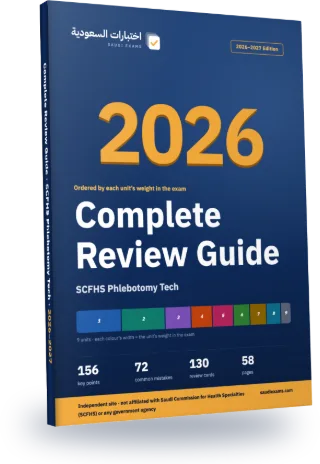
SCFHS Phlebotomy Tech Complete Review Guide 2026–2027
Every exam topic in a 58-page Arabic PDF, ordered from the heaviest unit to the lightest. The first three chapters alone cover about 52% of the exam questions.
- 58Pages
- 156Key points
- 72Common mistakes
- 130Flashcards
Guide map
Each chapter is one exam unit, ordered by its weight in the real exam.
| Chapter | Unit | Weight | Exam questions | Key points |
|---|---|---|---|---|
| 1 | Clinical Skills Phlebotomy: Adult/Geriatric | 20% | 30 | 20 |
| 2 | Clinical Skills Phlebotomy: Paediatrics | 20% | 30 | 18 |
| 3 | Complications of Phlebotomy | 12% | 18 | 16 |
| 4 | Human Anatomy and Physiology | 10% | 15 | 20 |
| 5 | Safety, Quality and Risk Management | 10% | 15 | 17 |
| 6 | Special Collections | 8% | 12 | 16 |
| 7 | Blood Donor Collections | 8% | 12 | 16 |
| 8 | Microbiology and Infection Control | 7% | 11 | 17 |
| 9 | Communication, Ethics and Professionalism | 5% | 7 | 16 |
Chapter 1 in full: Clinical Skills Phlebotomy: Adult/Geriatric
20% of the exam, about 30 questions. These are its key points, as in the guide.
- Use at least two identifiers (name plus date of birth or record number) matched to the wristband and requisition at the bedside. Gently wake a sleeping patient before identification. The patient may ask to see your ID badge.
- The requisition lists the tests and patient details; check it before collecting. If fasting is required, ask about the last meal. A fasting lipid profile needs 9–12 hours, and a patient fasting 14 hours may faint, so seat or lay the patient down.
- Prepare tubes, needle, holder, antiseptic, gauze and sharps container before applying the tourniquet. Outpatients sit in a chair with armrests; a bedridden patient's arm is extended downward in a straight line, supported.
The rest of chapter 1, on this page
- The routine adult needle is 21 gauge. A butterfly set is for small or fragile veins such as hand veins in older adults, inserted at about 10–15 degrees.
- Anchor the vein with the thumb below the site and clean with 70% alcohol, allowing it to dry. Avoid the palmar wrist; a foot vein requires physician approval per facility policy.
- Older adults have thinner skin and fragile veins that roll, so anchor firmly. Patients on anticoagulants need longer pressure. For a patient with dementia, explain simply and involve the nurse or guardian.
- CLSI GP41 order: 1 blood culture, 2 light-blue citrate, 3 serum red or gold, 4 green heparin, 5 lavender EDTA, 6 grey fluoride/oxalate. Its purpose is to prevent additive carryover.
- With a butterfly, a discard tube is drawn first if citrate is the first tube; no discard is needed if a blood culture precedes the citrate. The grey top comes last.
- Carryover examples: EDTA before serum raises K and lowers Ca (and ALP); heparin before citrate prolongs PT and aPTT. Transferring EDTA blood into a serum tube produces a falsely high potassium such as 7 mmol/L.
- Fill tubes to the stated volume to keep the blood-to-additive ratio. Citrate is 9:1, a half-full citrate tube is rejected and recollected, and too little blood is called QNS (quantity not sufficient).
- Mix by gentle inversion, not shaking: citrate 3–4 times, EDTA 8–10 times. Under-mixing causes microclots; vigorous mixing causes haemolysis.
- Draw errors: wet alcohol or fist pumping causes haemolysis or high K. Keep the arm downward to prevent reflux from the tube. A tube that will not fill with the needle correctly in the vein usually has lost its vacuum. Check the expiry date.
- If there is a flash but no flow and the vein is felt beside the needle, withdraw slightly and redirect gently. After two failed attempts ask a trained colleague. Withdraw the needle after the last tube is removed, then apply pressure.
- A plain red glass tube yields serum. Silica particles are the clot activator in plastic red and gold (SST) tubes, and the gel forms a barrier between serum and cells after centrifugation.
- A gold SST stands upright for about 30 minutes to clot, then is centrifuged capped and balanced. Upright clotting is faster and gives less haemolysis.
- Green tops hold lithium or sodium heparin, with light green having a gel. They are used for plasma ammonia and STAT chemistry, but not for a lithium level. Gel tubes are unsuitable for some drug levels.
- Lavender EDTA is for CBC and HbA1c; pink EDTA is for blood bank (type and crossmatch). Grey sodium fluoride suits glucose because it inhibits glycolysis. Royal blue is for trace elements such as lead and zinc.
- In unseparated blood at room temperature, glucose falls about 5–7% per hour without fluoride. Delay in separating serum raises potassium because it leaks from the cells.
- Special samples: cold agglutinins are kept at 37 °C; ACTH, PTH and often ammonia are transported chilled and processed promptly; a blood alcohol test needs a non-alcohol antiseptic; cortisol is highest in the early morning.
- Label at the bedside after the draw with two identifiers, date and time, and collector's initials. Transport specimens upright in a sealed biohazard bag, and collect STAT requests from the emergency department first.
Common mistakes in this chapter
- Do not rely on the bed number or on asking 'Are you Mr X?'. Have the patient state name and date of birth, and if the date of birth differs from the wristband, do not draw until it is resolved.
- A patient is eating and fasting glucose is ordered: do not draw, and notify the nurse to reschedule, rather than drawing and noting 'non-fasting'.
- Never draw above an IV infusion site: a sample above a dextrose infusion gives a very high glucose and must be recollected from the other arm.
- Fist pumping during the draw falsely raises potassium, as does delayed separation of serum or refrigerating an unspun sample.
- A sharp electric-shock pain down the arm suggests nerve involvement: remove the needle immediately; do not continue or probe.
- EDTA drawn before serum affects results as falsely high potassium and low calcium, not the reverse.
- Never pour blood from one tube into another. When using a syringe, transfer with a safety device in the order of draw.
- Do not give a patient his results; they come from the ordering clinician. If the patient refuses, respect the refusal, inform the nurse or clinician and document.
The other chapters are in the full guide
One purchase · lifetime access · review guide included
7-day review plan
The chapters are spread over 6 days by weight so each day carries a similar load. Day 7 is a full exam.
Day 1 · 20% of the exam
Chapter 1: Clinical Skills Phlebotomy: Adult/Geriatric
Day 2 · 20% of the exam
Chapter 2: Clinical Skills Phlebotomy: Paediatrics
Day 3 · 12% of the exam
Chapter 3: Complications of Phlebotomy
Day 4 · 17% of the exam
Chapter 4: Human Anatomy and Physiology
Chapter 8: Microbiology and Infection ControlDay 5 · 15% of the exam
Chapter 5: Safety, Quality and Risk Management
Chapter 9: Communication, Ethics and ProfessionalismDay 6 · 16% of the exam
Chapter 6: Special Collections
Chapter 7: Blood Donor CollectionsDay 7
Full mock exam: 150 questions in 180 minutes, then review the common mistakes in the units where you lost marks.
How many correct answers do you need?
- Pass mark 55%83 correct out of 150
Before you read: see your score today
10 free questions from the main units, no sign-up. Then you know which chapter to start with.
Try 10 free questions and see your levelA look at each chapter
The first three key points of each chapter, as they appear in the guide (in Arabic in the PDF).
Chapter 1: Clinical Skills Phlebotomy: Adult/Geriatric
- Use at least two identifiers (name plus date of birth or record number) matched…
- The requisition lists the tests and patient details; check it before collecting. If fasting…
- Prepare tubes, needle, holder, antiseptic, gauze and sharps container before applying the tourniquet. Outpatients…
Chapter 2: Clinical Skills Phlebotomy: Paediatrics
- A depth-controlled safety heel incision device is the correct tool. Maximum depth for an…
- Puncture site
- Hold the foot firmly with the heel below heart level. Wipe away the first…
Chapter 3: Complications of Phlebotomy
- Haematoma is commoner with fragile elderly veins. Treat with firm pressure then a cold…
- To reduce pain, let the alcohol dry before insertion. Inserting bevel down causes more…
- Syncope
Chapter 4: Human Anatomy and Physiology
- Arteries carry blood away from the heart and have the thickest muscular walls and…
- A vessel wall has three layers
- The superior and inferior venae cavae return blood to the right atrium. The left…
Chapter 5: Safety, Quality and Risk Management
- A sharps container must be puncture-resistant, leak-proof and labelled biohazard. Place it within arm's…
- A container with a permanently locked lid at the fill line is ready for…
- Most injuries occur between use and disposal, so safety devices are activated immediately after…
Chapter 6: Special Collections
- Adults need two or more sets (one set = aerobic plus anaerobic bottle), 8–10…
- Use chlorhexidine in alcohol with a longer contact time and no re-palpation, and wipe…
- The quality benchmark for blood culture contamination is below 3%. Label the bottle itself…
Chapter 7: Blood Donor Collections
- The usual minimum weight for whole blood donation is 50 kg; minimum age is…
- Informed consent means the donor understands the process and risks and agrees voluntarily. A…
- Defer a donor who has a fever on the day of donation, pregnant women…
Chapter 8: Microbiology and Infection Control
- The chain of infection has six links
- Hand hygiene targets the mode of transmission link. Aseptic skin preparation before puncture targets…
- The WHO five moments are
Chapter 9: Communication, Ethics and Professionalism
- Implied consent is inferred from the patient's behaviour, such as extending an arm after…
- A patient has the right to refuse. The refusal is respected, the nurse or…
- Confidentiality
The full guide comes with lifetime access
The full guide (58 pages) is included with lifetime access to this exam, together with every question and full mock exam. Chapter 1 is free for everyone.
Questions about the guide
Is the guide free?
Chapter 1 is free to read on the guide page. The full guide comes with lifetime access to this exam; 7-day access does not include it.
Is it up to date for 2026–2027?
Yes. Unit weights and exam facts follow what the exam body last published, and the last check date is printed in the guide. If the standards change we update the file and buyers download the new version.
Does the guide have questions?
No. The guide covers key points and common mistakes; scoring, weak-area practice and full mock exams are on the site.
Can I read it on my phone?
Yes. A5 pages in a single column, with chapters linked from the contents.
- Pages
- 58
- Edition
- 1448 AH · 2026–2027
- Language
- Arabic
- Last updated
Buy this exam
Pick the access that lasts until your test date.
Included
- Full mock exams: 150 questions in 180 minutes, with a score for every unit
- 752 questions, every option explained with its source
- Practice that starts with your weakest units, plus a review of your mistakes
- Complete Review Guide 2026–2027 (PDF), with lifetime access only
Continue with your Google account and you go straight to the payment page.
You pay on the Waffo Pancake checkout page (in English). The amount is in US dollars and your bank converts it to riyals. One payment with no automatic renewal, by Visa, Mastercard (a mada card with either logo works too), Apple Pay or Google Pay. Your statement shows "WAFFO". Purchases are not refundable.