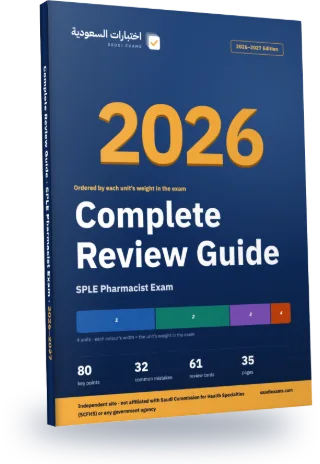
SPLE Pharmacist Exam Complete Review Guide 2026–2027
Every exam topic in a 35-page Arabic PDF, ordered from the heaviest unit to the lightest. The first three chapters alone cover about 90% of the exam questions.
- 35Pages
- 80Key points
- 32Common mistakes
- 61Flashcards
Guide map
Each chapter is one exam unit, ordered by its weight in the real exam.
| Chapter | Unit | Weight | Exam questions | Key points |
|---|---|---|---|---|
| 1 | Pharmaceutical Sciences | 35% | 70 | 20 |
| 2 | Clinical Sciences | 35% | 70 | 20 |
| 3 | Social, Behavioral and Administrative Sciences | 20% | 40 | 20 |
| 4 | Basic Biomedical Sciences | 10% | 20 | 20 |
Chapter 1 in full: Pharmaceutical Sciences
35% of the exam, about 70 questions. These are its key points, as in the guide.
- Ionization: a weak acid is mostly unionized in acidic pH and a weak base in basic pH. Only the unionized form crosses lipid membranes. Henderson-Hasselbalch for an acid: pH = pKa + log([A⁻]/[HA]); at pH = pKa half the drug is ionized. So alkalinizing urine speeds excretion of weak acids such as salicylates, and acidifying it speeds excretion of weak bases such as amphetamine.
- Phase I metabolism is oxidation by cytochrome P450, reduction and hydrolysis, and adds a functional group. Phase II is conjugation with glucuronide, sulfate, acetyl, glutathione or methyl groups and makes the product more water-soluble.
- Prodrugs are activated in the body: enalapril to enalaprilat, clopidogrel by CYP2C19, codeine to morphine by CYP2D6. A genetically poor-metabolizer enzyme reduces the effect.
The rest of chapter 1, on this page
- Structure-activity relationships (SAR): a small structural change can alter receptor affinity or metabolism. Enantiomers can differ in activity: S-warfarin is more potent than R, and esomeprazole is the S-enantiomer of omeprazole. Lipinski's rule of five predicts oral absorption: molecular weight under 500 and logP under 5.
- Drug development: preclinical work, investigational new drug (IND) application, Phase I (safety and kinetics in healthy volunteers), Phase II (efficacy and dose in patients), Phase III (large confirmatory trials), new drug application (NDA), then Phase IV postmarketing surveillance.
- Pharmacodynamics: a full agonist gives the maximal response, a partial agonist less, an inverse agonist lowers basal activity. A competitive antagonist raises EC50 and leaves Emax unchanged. Therapeutic index = TD50 ÷ ED50 and reflects the safety margin.
- Receptor types: G-protein-coupled (Gs raises cAMP, Gi lowers it, Gq raises IP3 and DAG), ligand-gated ion channels, tyrosine-kinase receptors such as insulin, and intracellular nuclear receptors such as steroids.
- Interactions: common CYP3A4 inhibitors include ketoconazole, clarithromycin and grapefruit juice; inducers include rifampin, carbamazepine, phenytoin and St John's wort. P-glycoprotein interactions and pharmacodynamic interactions, such as additive sedation, also occur.
- Well-known teratogens: warfarin, ACE inhibitors and angiotensin receptor blockers, isotretinoin, valproate, methotrexate, thalidomide and tetracyclines.
- Antidotes: N-acetylcysteine for acetaminophen, naloxone for opioids, flumazenil for benzodiazepines, vitamin K for warfarin, protamine for heparin, atropine with pralidoxime for organophosphates, fomepizole for methanol and ethylene glycol, deferoxamine for iron, digoxin-specific Fab fragments for digoxin.
- Pharmacognosy: a crude drug is the plant or animal material as found, a semi-purified product is an extract, and a purified product is a single pure compound. Major classes: alkaloids such as morphine, atropine and quinine; glycosides such as digoxin from Digitalis; terpenes such as artemisinin from Artemisia annua; paclitaxel from Taxus.
- Supplements: St John's wort induces CYP3A4 and can cause serotonin syndrome with antidepressants; ginkgo raises bleeding risk with warfarin; kava is linked to liver toxicity; high-dose vitamin B6 causes neuropathy. The fat-soluble vitamins are A, D, E and K, and high-dose vitamin A is teratogenic.
- Dosage forms: tablets (disintegration then dissolution), hard and soft capsules, solutions, suspensions (shake before use) and emulsions (oil-in-water or water-in-oil), and semisolids such as ointments, creams and gels. The Noyes-Whitney equation shows dissolution rate rises with surface area and solubility. Enteric coating protects against stomach acid.
- BCS: Class I high solubility, high permeability; Class II low solubility, high permeability; Class III high solubility, low permeability; Class IV both low. Controlled-release systems include matrix and osmotic pump designs, and transdermal patches include nitroglycerin, fentanyl and nicotine.
- Stability: hydrolysis affects esters and amides such as aspirin and procaine; oxidation affects epinephrine and ascorbic acid and is limited by antioxidants; photolysis needs light-resistant containers. The Arrhenius equation links temperature to degradation rate. t90 for zero order = 0.1 × C₀ ÷ k; for first order = 0.105 ÷ k.
- Routes: intravenous bioavailability is 100%, sublingual avoids first-pass hepatic metabolism, oral is subject to it, and rectal partly avoids it. For high-extraction drugs such as propranolol and lidocaine, clearance depends on hepatic blood flow.
- Kinetic equations: k = 0.693 ÷ t½; CL = k × Vd; loading dose = Css × Vd ÷ F; maintenance dose rate = CL × Css ÷ F; steady state takes about 4–5 half-lives. F = (AUC oral × IV dose) ÷ (AUC IV × oral dose). Cockcroft-Gault: (140 − age) × weight ÷ (72 × serum creatinine), multiplied by 0.85 for women.
- Nonlinear (Michaelis-Menten) kinetics: enzymes saturate at high doses, half-life lengthens and levels rise disproportionately, as with phenytoin, ethanol and high-dose aspirin. Bioequivalence: the 90% confidence interval of the AUC and Cmax ratios must fall within 80–125%.
- Sterile compounding: work is done in an ISO Class 5 environment (laminar airflow hood or biological safety cabinet) inside an ISO Class 7 buffer room with an ISO Class 8 anteroom. Sterilizing filters are 0.22 micron; sterility testing uses membrane filtration or direct inoculation. Hazardous drugs (USP <800>) are prepared in a Class II biological safety cabinet with closed-system transfer devices. Every product is labelled with a beyond-use date (BUD).
- Calculations: percent w/v means grams per 100 mL; 1:1000 = 0.1% = 1 mg/mL. Dilution: C₁V₁ = C₂V₂. mEq = mg × valence ÷ molecular weight. 1 kg = 2.2 lb; 1 teaspoon = 5 mL. Body surface area (m²) = square root of (height in cm × weight in kg ÷ 3600). Isotonic sodium chloride is 0.9%.
Common mistakes in this chapter
- Confusing a competitive antagonist (curve shifts right, Emax unchanged) with a noncompetitive one (Emax falls)
- Confusing potency (EC50) with efficacy (Emax): the more potent drug is not necessarily the more efficacious one
- Forgetting that clearance and Vd are the independent variables and half-life depends on them: t½ = 0.693 × Vd ÷ CL
- Assuming all drugs follow first-order kinetics: phenytoin and ethanol saturate, so levels rise more than the dose does
- Mixing up CYP inducers (rifampin, carbamazepine), which lower the other drug's level, with inhibitors (ketoconazole, clarithromycin), which raise it
- Confusing ratio strength with percent strength: 1:1000 is 0.1%, or 1 mg/mL, not 1%
- Mixing up USP <797> (sterile), <795> (nonsterile) and <800> (hazardous drugs)
- Believing extended-release tablets can be crushed: crushing releases the whole dose at once
The other chapters are in the full guide
One purchase · lifetime access · review guide included
7-day review plan
The chapters are spread over 6 days by weight so each day carries a similar load. Day 7 is a full exam.
Day 1 · 35% of the exam
Chapter 1: Pharmaceutical Sciences
Day 2 · 35% of the exam
Chapter 2: Clinical Sciences
Day 3 · 20% of the exam
Chapter 3: Social, Behavioral and Administrative Sciences
Day 4 · 10% of the exam
Chapter 4: Basic Biomedical Sciences
Day 5
Full mock exam: 200 questions in 240 minutes, then review the common mistakes in the units where you lost marks.
Before you read: see your score today
10 free questions from the main units, no sign-up. Then you know which chapter to start with.
Try 10 free questions and see your levelA look at each chapter
The first three key points of each chapter, as they appear in the guide (in Arabic in the PDF).
Chapter 1: Pharmaceutical Sciences
- Ionization
- Phase I metabolism is oxidation by cytochrome P450, reduction and hydrolysis, and adds a…
- Prodrugs are activated in the body
Chapter 2: Clinical Sciences
- Evidence hierarchy
- Biostatistics
- Core equations
Chapter 3: Social, Behavioral and Administrative Sciences
- Levels of prevention
- Levels of care
- Incidence = new cases ÷ population at risk over a period. Prevalence = all…
Chapter 4: Basic Biomedical Sciences
- Homeostasis is the maintenance of a stable internal environment through negative feedback loops that…
- Cardiac output = heart rate × stroke volume. Mean arterial pressure ≈ diastolic +…
- The kidney cleans blood by glomerular filtration followed by reabsorption and secretion. The normal…
The full guide comes with lifetime access
The full guide (35 pages) is included with lifetime access to this exam, together with every question and full mock exam. Chapter 1 is free for everyone.
Questions about the guide
Is the guide free?
Chapter 1 is free to read on the guide page. The full guide comes with lifetime access to this exam; 7-day access does not include it.
Is it up to date for 2026–2027?
Yes. Unit weights and exam facts follow what the exam body last published, and the last check date is printed in the guide. If the standards change we update the file and buyers download the new version.
Does the guide have questions?
No. The guide covers key points and common mistakes; scoring, weak-area practice and full mock exams are on the site.
Can I read it on my phone?
Yes. A5 pages in a single column, with chapters linked from the contents.
- Pages
- 35
- Edition
- 1448 AH · 2026–2027
- Language
- Arabic
- Last updated
Buy this exam
Pick the access that lasts until your test date.
Included
- Full mock exams: 200 questions in 240 minutes, with a score for every unit
- 1032 questions, every option explained with its source
- Practice that starts with your weakest units, plus a review of your mistakes
- Complete Review Guide 2026–2027 (PDF), with lifetime access only
Continue with your Google account and you go straight to the payment page.
You pay on the Waffo Pancake checkout page (in English). The amount is in US dollars and your bank converts it to riyals. One payment with no automatic renewal, by Visa, Mastercard (a mada card with either logo works too), Apple Pay or Google Pay. Your statement shows "WAFFO". Purchases are not refundable.