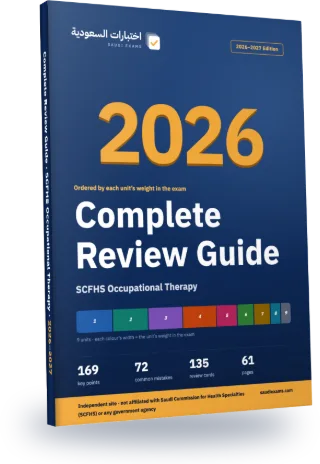
SCFHS Occupational Therapy Complete Review Guide 2026–2027
Every exam topic in a 61-page Arabic PDF, ordered from the heaviest unit to the lightest. The first three chapters alone cover about 48% of the exam questions.
- 61Pages
- 169Key points
- 72Common mistakes
- 135Flashcards
Guide map
Each chapter is one exam unit, ordered by its weight in the real exam.
| Chapter | Unit | Weight | Exam questions | Key points |
|---|---|---|---|---|
| 1 | Neurological Conditions | 16% | 24 | 20 |
| 2 | Physical Disabilities | 16% | 24 | 20 |
| 3 | Developmental Disabilities | 16% | 24 | 20 |
| 4 | Hand Dysfunctions | 16% | 24 | 20 |
| 5 | Occupational Therapy Models of Practice | 10% | 15 | 19 |
| 6 | Mental Health | 8% | 12 | 19 |
| 7 | Community Based Services and Assistive Technology | 8% | 12 | 19 |
| 8 | Occupational Health and Patient Safety | 5% | 8 | 16 |
| 9 | Evidence Based Practice | 5% | 7 | 16 |
Chapter 1 in full: Neurological Conditions
16% of the exam, about 24 questions. These are its key points, as in the guide.
- Rancho levels: I no response, II generalized, III localized, IV confused-agitated, V confused-inappropriate, VI confused-appropriate, VII automatic-appropriate, VIII purposeful-appropriate.
- Glasgow Coma Scale: 3 to 8 severe, 9 to 12 moderate, 13 to 15 mild injury.
- The Galveston Orientation and Amnesia Test (GOAT) is repeated daily; 75 or more on two consecutive days marks the end of post-traumatic amnesia.
The rest of chapter 1, on this page
- Brunnstrom stages: 1 flaccid, 2 spasticity begins with minimal synergy, 3 voluntary synergy with peak spasticity, 4 movement out of synergy as spasticity declines, 5 complex movement independent of synergy, 6 isolated joint movement.
- Constraint-induced movement therapy (CIMT) usually requires about 20° of active wrist extension and 10° of finger extension.
- Unilateral neglect is treated with visual scanning anchored on the neglected side; pusher syndrome uses a visual vertical reference and reaching toward the stronger side.
- The flaccid shoulder after stroke is supported on a lap tray or arm trough in good alignment, and the arm is never pulled, to avoid subluxation.
- Cord levels: C4 has no functional arm movement and uses a power chair with sip-and-puff or head control; C5 moves shoulder and elbow and needs a mobile arm support and universal cuff for feeding; C6 extends the wrist and uses tenodesis.
- C7 has triceps and can do depression push-ups for transfers and pressure relief; C8 brings functional finger flexion; a person with complete T10 paraplegia can be independent in self-care and transfers.
- AIS: A complete, B sensory-only incomplete with sacral sparing, C motor incomplete with fewer than half of key muscles below the level at grade 3 or more, D at least half at grade 3 or more, E normal. The motor level is the lowest key muscle at grade 3 or more with those above normal.
- Autonomic dysreflexia occurs at T6 and above: pounding headache and hypertension; sit the patient up, loosen clothing and check bladder and bowel.
- Parkinson disease: resting pill-rolling tremor that lessens with movement, rigidity, bradykinesia; micrographia is treated with large-amplitude writing on targets, and freezing of gait is broken with visual cues such as a line on the floor.
- Hoehn and Yahr: 1 unilateral, 2 bilateral without balance impairment, 3 bilateral with postural instability, 4 severe disability but still walking, 5 wheelchair or bed bound. Schedule demanding tasks in the medication 'on' period.
- Multiple sclerosis: fatigue is key and is managed by energy conservation (sitting, avoiding heat, scheduled rests). The Uhthoff phenomenon is a temporary worsening in heat. The MFIS measures the impact of fatigue.
- ALS affects motor neurons and sensation is spared; plan equipment early (power chair with head support) and use eye-gaze communication devices in advanced disease.
- The remedial approach aims to restore the cognitive skill itself; the adaptive approach modifies the environment and task and trains the carer. Toglia's multicontext approach trains awareness and one strategy across varied tasks.
- Assessments: MoCA is more sensitive than MMSE for mild impairment; EFPT observes real tasks; LOTCA is a cognitive-perceptual battery; BIT tests neglect; AMPS rates motor and process skill quality; Fugl-Meyer measures upper-limb motor recovery.
- Modified Ashworth: 0 no increase, 1 slight catch, 1+ catch then minimal resistance through less than half the range, 2 marked increase through most of the range, 3 considerable increase, 4 rigid. Rigidity is resistance independent of speed in both directions.
- NDT uses key-point handling and weight-bearing on the affected side; Rood uses neutral warmth and slow stroking to inhibit tone; the PNF D2 flexion pattern combines shoulder flexion, abduction and external rotation.
- Serial casting gives prolonged low-load stretch to reduce contracture; after botulinum toxin, combine stretch, orthoses and functional training while tone is low. A resting orthosis holds slight wrist extension, slight finger flexion and an abducted thumb.
Common mistakes in this chapter
- Ideomotor apraxia (fails on command but performs automatically) differs from ideational apraxia (errors in sequencing and using objects in a multistep task).
- Right-hemisphere stroke gives neglect, impulsivity and poor insight; left-hemisphere stroke more often gives slow, cautious behaviour and language difficulty.
- In one-handed dressing, the affected arm goes in first and comes out last.
- In autonomic dysreflexia, do not lay the patient flat: sit him up, lower the legs, loosen tight clothing, then check the catheter and bowel.
- For orthostatic hypotension after a cervical injury, tilt the chair back and elevate the legs rather than keeping the patient upright.
- Parkinson tremor is worse at rest and lessens with purposeful movement; the intention tremor of MS gets worse as the hand nears the target.
- Modified Ashworth 1+ is a catch followed by minimal resistance through less than half the range, not the whole range.
- A screen such as the MMSE can look normal despite executive problems; observe a real task (EFPT) or use the MoCA.
The other chapters are in the full guide
One purchase · lifetime access · review guide included
7-day review plan
The chapters are spread over 6 days by weight so each day carries a similar load. Day 7 is a full exam.
Day 1 · 16% of the exam
Chapter 1: Neurological Conditions
Day 2 · 16% of the exam
Chapter 2: Physical Disabilities
Day 3 · 16% of the exam
Chapter 3: Developmental Disabilities
Day 4 · 16% of the exam
Chapter 4: Hand Dysfunctions
Day 5 · 20% of the exam
Chapter 5: Occupational Therapy Models of Practice
Chapter 8: Occupational Health and Patient Safety
Chapter 9: Evidence Based PracticeDay 6 · 16% of the exam
Chapter 6: Mental Health
Chapter 7: Community Based Services and Assistive TechnologyDay 7
Full mock exam: 150 questions in 180 minutes, then review the common mistakes in the units where you lost marks.
How many correct answers do you need?
- Pass mark 60%90 correct out of 150
Before you read: see your score today
10 free questions from the main units, no sign-up. Then you know which chapter to start with.
Try 10 free questions and see your levelA look at each chapter
The first three key points of each chapter, as they appear in the guide (in Arabic in the PDF).
Chapter 1: Neurological Conditions
- Rancho levels
- Glasgow Coma Scale
- The Galveston Orientation and Amnesia Test (GOAT) is repeated daily; 75 or more on…
Chapter 2: Physical Disabilities
- After posterior hip replacement
- After the anterior approach, avoid hip extension combined with external rotation. For a car…
- Toe-touch weight bearing means contact for balance only, with no weight. Active motion of…
Chapter 3: Developmental Disabilities
- Development runs head to toe (cephalocaudal) and near to far (proximodistal). Head lag on…
- Hand-to-hand transfer about 5 to 6 months, sitting alone 6 to 8 months, searching…
- At 2 to 3 years
Chapter 4: Hand Dysfunctions
- The median nerve supplies the thenar muscles (APB, opponens, part of FPB) and lumbricals…
- FDS test
- Jamar
Chapter 5: Occupational Therapy Models of Practice
- MOHO
- MOHO tools
- PEO
Chapter 6: Mental Health
- Anhedonia is a core feature of depression. Negative symptoms of schizophrenia: avolition, alogia and…
- PTSD
- Allen levels
Chapter 7: Community Based Services and Assistive Technology
- Armrest height = seat to elbow at 90° plus about 2.5 cm. A pelvic…
- Anti-tippers prevent backward tipping. An ultralight chair is more efficient and spares the shoulders…
- Air cushion
Chapter 8: Occupational Health and Patient Safety
- Office posture
- Laptop use
- MSD risk factors
Chapter 9: Evidence Based Practice
- For intervention questions
- An RCT allocates groups by chance, balancing known and unknown factors. Intention-to-treat analyses everyone…
- A prospective cohort follows a group forward to see who develops the outcome; case-control…
The full guide comes with lifetime access
The full guide (61 pages) is included with lifetime access to this exam, together with every question and full mock exam. Chapter 1 is free for everyone.
Questions about the guide
Is the guide free?
Chapter 1 is free to read on the guide page. The full guide comes with lifetime access to this exam; 7-day access does not include it.
Is it up to date for 2026–2027?
Yes. Unit weights and exam facts follow what the exam body last published, and the last check date is printed in the guide. If the standards change we update the file and buyers download the new version.
Does the guide have questions?
No. The guide covers key points and common mistakes; scoring, weak-area practice and full mock exams are on the site.
Can I read it on my phone?
Yes. A5 pages in a single column, with chapters linked from the contents.
- Pages
- 61
- Edition
- 1448 AH · 2026–2027
- Language
- Arabic
- Last updated
All Health Exams review guides
Back to SCFHS Saudi Licensure Examination – Occupational Therapy Specialist
Buy this exam
Pick the access that lasts until your test date.
Included
- Full mock exams: 150 questions in 180 minutes, with a score for every unit
- 750 questions, every option explained with its source
- Practice that starts with your weakest units, plus a review of your mistakes
- Complete Review Guide 2026–2027 (PDF), with lifetime access only
Continue with your Google account and you go straight to the payment page.
You pay on the Waffo Pancake checkout page (in English). The amount is in US dollars and your bank converts it to riyals. One payment with no automatic renewal, by Visa, Mastercard (a mada card with either logo works too), Apple Pay or Google Pay. Your statement shows "WAFFO". Purchases are not refundable.