SNLE
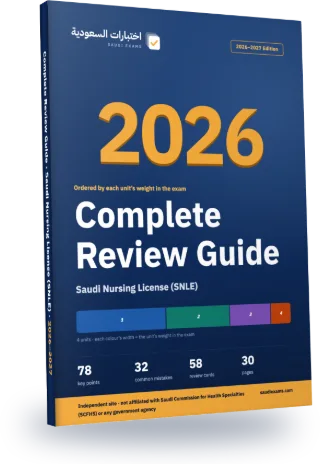
Saudi Nursing License (SNLE) Complete Review Guide 2026–2027
Every exam topic in a 30-page Arabic PDF, ordered from the heaviest unit to the lightest. The first three chapters alone cover about 90% of the exam questions.
- 30Pages
- 78Key points
- 32Common mistakes
- 58Flashcards
Guide map
Each chapter is one exam unit, ordered by its weight in the real exam.
| Chapter | Unit | Weight | Exam questions | Key points |
|---|---|---|---|---|
| 1 | Adult Nursing | 40% | 80 | 19 |
| 2 | Maternal-Child Nursing | 30% | 60 | 19 |
| 3 | Nursing Fundamentals | 20% | 40 | 20 |
| 4 | Nursing Management and Leadership | 10% | 20 | 20 |
Chapter 1 in full: Adult Nursing
40% of the exam, about 80 questions. These are its key points, as in the guide.
- Priorities: ABC, then Maslow (physiological, then safety), then the most acute threat, with unstable patients before stable ones.
- Angina eases with rest or nitroglycerin. MI pain does not. Nitroglycerin goes under the tongue and needs caution when blood pressure is low.
- Left heart failure causes pulmonary congestion (dyspnea, frothy cough). Right heart failure causes peripheral edema, hepatomegaly and jugular distension. Best position: head raised (Fowler).
The rest of chapter 1, on this page
- Hypertension: focus on correct measurement (patient seated and rested, arm at heart level, correct cuff size) and on its complications (stroke, heart failure, kidney failure).
- Ischemic stroke: FAST signs (face, arm, speech, time). The window for clot-dissolving treatment is short, so record when symptoms started. Check swallowing before any food.
- Asthma is reversible narrowing, while COPD is linked to smoking and mostly irreversible. Give the rapid bronchodilator first in an acute asthma attack.
- Arterial blood gases: pH 7.35 to 7.45, PaCO2 35 to 45, HCO3 22 to 26 mEq/L. Respiratory acidosis: low pH and high CO2. Metabolic acidosis: low pH and low HCO3.
- Normal fasting glucose is about 70 to 99 mg/dL. Hypoglycemia is below 70. For an alert patient: 15 g fast carbohydrate, then recheck in 15 minutes (the 15-15 rule).
- Chronic kidney disease: restrict potassium, phosphorus, sodium and fluids as ordered. For hemodialysis access, check thrill and bruit and never take blood pressure or draw blood from that arm.
- Before surgery: fast as instructed, consent signed before sedatives, document vital signs and allergies. After surgery: assess airway, breathing, circulation, pain and wound.
- Postoperative complications: atelectasis (first 48 hours) is treated with deep breathing and coughing. Deep vein thrombosis is prevented with movement, stockings and anticoagulants. Wound dehiscence or evisceration: cover with a sterile saline-moist dressing and call the surgeon.
- Burns: the Rule of Nines estimates surface area, and electrical burns need cardiac monitoring. The first priority in burns is the airway (inhalation injury).
- Adult resuscitation: check safety and response, call for help, check pulse for no more than 10 seconds, start compressions at once, and pause only for rhythm analysis or the shock. Resume compressions right after the shock.
- Glasgow Coma Scale: eye 4, verbal 5, motor 6, total 3 to 15. A score of 8 or less means the airway is at risk.
- Levels of prevention: primary (immunization, education) prevents disease, secondary (early screening such as mammography) detects it early, tertiary (rehabilitation) limits disability.
- Chain of infection: pathogen, reservoir, portal of exit, mode of transmission, portal of entry, susceptible host. The best break is hand hygiene, then standard precautions, then isolation by transmission route (contact, droplet, airborne).
- Disaster triage: red is immediate and likely to survive with care, yellow is delayed, green is minor, black is deceased or expectant. Treat airway and breathing threats before minor injuries.
- Therapeutic communication means active listening, open-ended questions and reflecting feelings. Avoid empty reassurance and quick advice.
- Lithium: keep fluid and salt intake steady and monitor blood levels. The therapeutic range is about 0.6 to 1.2 mEq/L. Toxicity shows as coarse tremor, vomiting, diarrhea and confusion.
Common mistakes in this chapter
- Pain is not the priority by default. The life-threatening problem comes first: airway, then breathing, then circulation.
- Waiting for low blood pressure to identify shock. It is a late sign. Tachycardia, low urine output and altered consciousness appear earlier.
- Giving high-flow oxygen to every COPD patient. These patients need low-flow oxygen with saturation monitoring, because their drive to breathe can fall.
- Mixing up hypoglycemia and DKA. Cool, clammy skin with shaking means low glucose. Dry, warm skin with deep rapid breathing means high glucose.
- Forgetting that the first checks after surgery are airway, breathing and bleeding, not pain or diet. If a dressing soaks through, reinforce it and call. Do not remove it.
- Shocking asystole or pulseless electrical activity. Neither is shockable. Shock only ventricular fibrillation and pulseless ventricular tachycardia.
- Arguing with a psychotic patient about hallucinations. Acknowledge the feeling, say you do not hear what they hear, and redirect to reality.
- Believing that asking a depressed patient about suicide plants the idea. Asking directly is correct and is part of assessment.
The other chapters are in the full guide
One purchase · lifetime access · review guide included
7-day review plan
The chapters are spread over 6 days by weight so each day carries a similar load. Day 7 is a full exam.
Day 1 · 40% of the exam
Chapter 1: Adult Nursing
Day 2 · 30% of the exam
Chapter 2: Maternal-Child Nursing
Day 3 · 20% of the exam
Chapter 3: Nursing Fundamentals
Day 4 · 10% of the exam
Chapter 4: Nursing Management and Leadership
Day 5
Full mock exam: 200 questions in 240 minutes, then review the common mistakes in the units where you lost marks.
Before you read: see your score today
10 free questions from the main units, no sign-up. Then you know which chapter to start with.
Try 10 free questions and see your levelA look at each chapter
The first three key points of each chapter, as they appear in the guide (in Arabic in the PDF).
Chapter 1: Adult Nursing
- Priorities
- Angina eases with rest or nitroglycerin. MI pain does not. Nitroglycerin goes under the…
- Left heart failure causes pulmonary congestion (dyspnea, frothy cough). Right heart failure causes peripheral…
Chapter 2: Maternal-Child Nursing
- Naegele's rule for the due date
- Pregnancy terms
- Stages of labor
Chapter 3: Nursing Fundamentals
- Standard precautions apply to every patient
- WHO five moments of hand hygiene
- Airborne
Chapter 4: Nursing Management and Leadership
- Delegation
- UAP perform routine tasks for stable patients
- The RN keeps assessment, planning, initial teaching, and care of unstable or complex patients.
The full guide comes with lifetime access
The full guide (30 pages) is included with lifetime access to this exam, together with every question and full mock exam. Chapter 1 is free for everyone.
Questions about the guide
Is the guide free?
Chapter 1 is free to read on the guide page. The full guide comes with lifetime access to this exam; 7-day access does not include it.
Is it up to date for 2026–2027?
Yes. Unit weights and exam facts follow what the exam body last published, and the last check date is printed in the guide. If the standards change we update the file and buyers download the new version.
Does the guide have questions?
No. The guide covers key points and common mistakes; scoring, weak-area practice and full mock exams are on the site.
Can I read it on my phone?
Yes. A5 pages in a single column, with chapters linked from the contents.
- Pages
- 30
- Edition
- 1448 AH · 2026–2027
- Language
- Arabic
- Last updated
Buy this exam
Pick the access that lasts until your test date.
Included
- Full mock exams: 200 questions in 240 minutes, with a score for every unit
- 1044 questions, every option explained with its source
- Practice that starts with your weakest units, plus a review of your mistakes
- Complete Review Guide 2026–2027 (PDF), with lifetime access only
Continue with your Google account and you go straight to the payment page.
You pay on the Waffo Pancake checkout page (in English). The amount is in US dollars and your bank converts it to riyals. One payment with no automatic renewal, by Visa, Mastercard (a mada card with either logo works too), Apple Pay or Google Pay. Your statement shows "WAFFO". Purchases are not refundable.