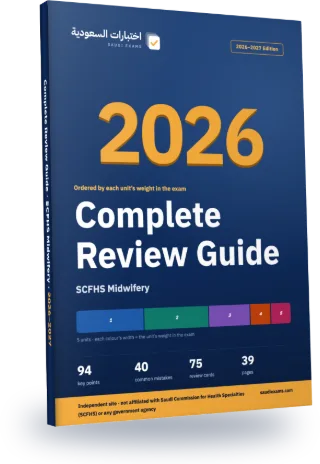
SCFHS Midwifery Complete Review Guide 2026–2027
Every exam topic in a 39-page Arabic PDF, ordered from the heaviest unit to the lightest. The first three chapters alone cover about 80% of the exam questions.
- 39Pages
- 94Key points
- 40Common mistakes
- 75Flashcards
Guide map
Each chapter is one exam unit, ordered by its weight in the real exam.
| Chapter | Unit | Weight | Exam questions | Key points |
|---|---|---|---|---|
| 1 | Pregnancy (Low and High Risk) | 30% | 45 | 20 |
| 2 | Labor and Obstetrics Emergencies | 30% | 45 | 19 |
| 3 | Postpartum and Newborn | 20% | 30 | 18 |
| 4 | Pre-pregnancy and Family Planning | 10% | 15 | 20 |
| 5 | Gynecology | 10% | 15 | 17 |
Chapter 1 in full: Pregnancy (Low and High Risk)
30% of the exam, about 45 questions. These are its key points, as in the guide.
- WHO (2016) recommends at least 8 antenatal contacts, with the first before 12 weeks.
- Naegele's rule for EDD: first day of last period + 7 days − 3 months (28-day cycle). The most accurate dating is first-trimester crown–rump length (CRL) on ultrasound.
- Symphysis–fundal height (SFH) between 24 and 36 weeks roughly equals gestation in weeks ± 2 cm; the fundus is palpable just above the symphysis at 12 weeks and at the umbilicus at about 20 weeks.
The rest of chapter 1, on this page
- Anaemia in pregnancy: haemoglobin below 11 g/dL. WHO recommends 30–60 mg elemental iron daily with folic acid 400 micrograms.
- Booking tests: ABO and RhD group with antibody screen, haemoglobin, HBsAg, syphilis, HIV and urine for asymptomatic bacteriuria (treated with antibiotics).
- Anti-D: routine prophylaxis at 28 weeks for RhD-negative women, then within 72 hours of birth if the baby is RhD-positive or after any sensitising event. The Kleihauer–Betke test quantifies fetomaternal haemorrhage to adjust the dose.
- First-trimester combined screening for Down syndrome uses nuchal translucency (NT), β-hCG and PAPP-A. Diagnostic tests are chorionic villus sampling (CVS) and amniocentesis. The detailed anomaly scan is at 18–22 weeks.
- Tdap vaccine in every pregnancy (ideally 27–36 weeks) protects the newborn from pertussis. Group B streptococcus (GBS) carriers receive IV penicillin in labour.
- Hypertension is 140/90 or more; severe is 160/110 or more. Pre-eclampsia is new hypertension after 20 weeks with proteinuria (protein:creatinine ratio 30 mg/mmol or more) or organ dysfunction. Eclampsia is seizures in pre-eclampsia with no other cause.
- Low-dose aspirin (75–150 mg daily) from 12 weeks until birth for women with a high-risk factor: chronic hypertension, previous pre-eclampsia, diabetes, renal disease or autoimmune disease.
- First-line oral antihypertensive in pregnancy is labetalol; alternatives are nifedipine and methyldopa. Delivery is the definitive treatment of pre-eclampsia.
- Magnesium sulfate: 4 g IV loading over 5–20 minutes then a maintenance infusion. Monitor patellar reflex, respiratory rate (below 12/min means stop) and urine output. Antidote: calcium gluconate 10%, 10 mL IV.
- HELLP syndrome: haemolysis, elevated liver enzymes, low platelets. Right upper quadrant or epigastric pain in pre-eclampsia suggests liver involvement. Postnatal BP often peaks on days 3–6.
- GDM test: 75 g OGTT at 24–28 weeks. WHO 2013 criteria: fasting 5.1–6.9, 1 hour 10.0 or more, 2 hours 8.5–11.0 mmol/L. First-line management is diet and exercise, then metformin or insulin.
- Fetal effects of diabetes: macrosomia, shoulder dystocia, polyhydramnios and neonatal hypoglycaemia. Women with GDM are tested 6–13 weeks postpartum. Women with pre-existing diabetes take folic acid 5 mg.
- Antepartum haemorrhage (APH) is vaginal bleeding after 24 weeks. Placenta praevia: painless, bright red. Abruption: pain and a woody uterus; risks include hypertension, trauma and smoking; complications include DIC and Couvelaire uterus. No digital vaginal examination until praevia is excluded.
- Preterm birth is before 37 completed weeks. Betamethasone 12 mg IM twice 24 hours apart; magnesium sulfate before 30–32 weeks for neuroprotection. Preterm prelabour rupture of membranes (PPROM) is treated with erythromycin. Chorioamnionitis signs: maternal fever, fetal tachycardia and uterine tenderness.
- Ectopic pregnancy: amenorrhoea, abdominal pain and vaginal bleeding; the commonest site is the ampulla of the fallopian tube. Methotrexate suits stable, unruptured cases. Molar pregnancy: very high hCG, uterus large for dates and a snowstorm scan.
- Small for gestational age (SGA): estimated weight below the 10th centile. Absent end-diastolic flow in the umbilical artery means severe placental insufficiency. Post-term is beyond 42 weeks; induction is offered at 41+0 to 42+0 weeks.
- Obstetric cholestasis: itching of palms and soles without rash with raised bile acids. Breech at 36 weeks: offer external cephalic version (ECV) if no contraindication; a transverse lie at term in labour needs caesarean. Rubella causes congenital cataract, deafness and heart defects.
Common mistakes in this chapter
- Post-term means beyond 42 completed weeks, while induction is offered from 41+0 to 42+0 weeks; do not mix the two figures.
- Pre-eclampsia appears after 20 weeks; chronic hypertension predates pregnancy or appears before 20 weeks; gestational hypertension has no proteinuria or organ dysfunction.
- The first sign of magnesium toxicity is loss of the patellar reflex, then respiratory rate below 12/min; stop the infusion then, without waiting for respiratory arrest.
- ACE inhibitors are contraindicated in pregnancy; labetalol, nifedipine and methyldopa are acceptable, with labetalol the usual first-line oral choice.
- Anti-D is for non-sensitised RhD-negative women, within 72 hours of a sensitising event or birth; it does not help a woman who already has anti-D antibodies.
- Praevia bleeds painlessly; abruption bleeds with pain and a woody uterus, and the bleeding may be concealed so the mother looks worse than the visible loss suggests.
- Steroids are for fetal lung maturity; magnesium sulfate before very preterm birth (under 30–32 weeks) is for fetal neuroprotection, not to stop labour.
- Shoulder-tip pain with suspected ectopic pregnancy means blood irritating the diaphragm (intraperitoneal bleeding), a dangerous sign, not a shoulder problem.
The other chapters are in the full guide
One purchase · lifetime access · review guide included
7-day review plan
The chapters are spread over 6 days by weight so each day carries a similar load. Day 7 is a full exam.
Day 1 · 30% of the exam
Chapter 1: Pregnancy (Low and High Risk)
Day 2 · 30% of the exam
Chapter 2: Labor and Obstetrics Emergencies
Day 3 · 20% of the exam
Chapter 3: Postpartum and Newborn
Day 4 · 10% of the exam
Chapter 4: Pre-pregnancy and Family Planning
Day 5 · 10% of the exam
Chapter 5: Gynecology
Day 6
Full mock exam: 150 questions in 180 minutes, then review the common mistakes in the units where you lost marks.
How many correct answers do you need?
- Pass mark 60%90 correct out of 150
Before you read: see your score today
10 free questions from the main units, no sign-up. Then you know which chapter to start with.
Try 10 free questions and see your levelA look at each chapter
The first three key points of each chapter, as they appear in the guide (in Arabic in the PDF).
Chapter 1: Pregnancy (Low and High Risk)
- WHO (2016) recommends at least 8 antenatal contacts, with the first before 12 weeks.
- Naegele's rule for EDD
- Symphysis–fundal height (SFH) between 24 and 36 weeks roughly equals gestation in weeks ±…
Chapter 2: Labor and Obstetrics Emergencies
- The active first stage starts at 5 cm (WHO 2018). In the latent phase…
- Intermittent auscultation in low-risk labour
- Cardinal movements
Chapter 3: Postpartum and Newborn
- The puerperium lasts about 6 weeks. The fundus is at about the umbilicus on…
- WHO postnatal contacts
- Postnatal warning signs
Chapter 4: Pre-pregnancy and Family Planning
- Folic acid 400 micrograms daily starts before conception and continues to 12 weeks, because…
- Folic acid 5 mg daily is for a previous NTD pregnancy, pre-existing diabetes, BMI…
- Healthy preconception BMI is 18.5 to 24.9 kg/m². Underweight (for example 17) is linked…
Chapter 5: Gynecology
- Bacterial vaginosis
- Chlamydia trachomatis is the commonest bacterial STI; treat with doxycycline for 7 days, or…
- Gonorrhoea is treated with IM ceftriaxone. Primary syphilis
The full guide comes with lifetime access
The full guide (39 pages) is included with lifetime access to this exam, together with every question and full mock exam. Chapter 1 is free for everyone.
Questions about the guide
Is the guide free?
Chapter 1 is free to read on the guide page. The full guide comes with lifetime access to this exam; 7-day access does not include it.
Is it up to date for 2026–2027?
Yes. Unit weights and exam facts follow what the exam body last published, and the last check date is printed in the guide. If the standards change we update the file and buyers download the new version.
Does the guide have questions?
No. The guide covers key points and common mistakes; scoring, weak-area practice and full mock exams are on the site.
Can I read it on my phone?
Yes. A5 pages in a single column, with chapters linked from the contents.
- Pages
- 39
- Edition
- 1448 AH · 2026–2027
- Language
- Arabic
- Last updated
Buy this exam
Pick the access that lasts until your test date.
Included
- Full mock exams: 150 questions in 180 minutes, with a score for every unit
- 750 questions, every option explained with its source
- Practice that starts with your weakest units, plus a review of your mistakes
- Complete Review Guide 2026–2027 (PDF), with lifetime access only
Continue with your Google account and you go straight to the payment page.
You pay on the Waffo Pancake checkout page (in English). The amount is in US dollars and your bank converts it to riyals. One payment with no automatic renewal, by Visa, Mastercard (a mada card with either logo works too), Apple Pay or Google Pay. Your statement shows "WAFFO". Purchases are not refundable.