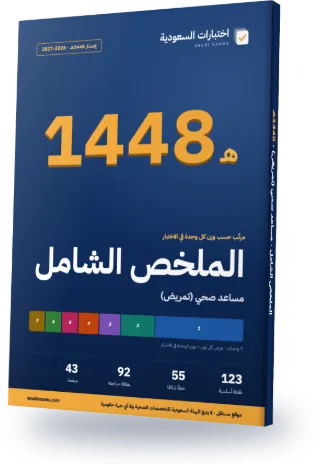
Health Assistant (Nursing) Complete Review Guide 2026–2027
Every exam topic in a 43-page Arabic PDF, ordered from the heaviest unit to the lightest. The first three chapters alone cover about 66% of the exam questions.
- 43Pages
- 123Key points
- 55Common mistakes
- 92Flashcards
Guide map
Each chapter is one exam unit, ordered by its weight in the real exam.
| Chapter | Unit | Weight | Exam questions | Key points |
|---|---|---|---|---|
| 1 | Patient Care | 40% | 60 | 18 |
| 2 | Assistance in Diagnostic Procedures | 16% | 24 | 18 |
| 3 | Professionalism and Medical Ethics | 10% | 15 | 17 |
| 4 | Patient and Environmental Safety | 10% | 15 | 18 |
| 5 | Professional Communication | 8% | 12 | 17 |
| 6 | Medical Terminology | 8% | 12 | 18 |
| 7 | Infection Control | 8% | 12 | 17 |
Chapter 1 in full: Patient Care
40% of the exam, about 60 questions. These are its key points, as in the guide.
- Normal oral temperature is 36.5–37.5 °C, and fever is 38.0 °C or higher. Conversion: °F = °C × 9/5 + 32, so 37 °C equals 98.6 °F.
- Adult pulse is 60–100 beats/min and respirations are 12–20/min. A newborn has a pulse of 120–160 and respirations of 30–60.
- A regular radial pulse is counted for 30 seconds and doubled, an irregular one for a full minute. Respirations are counted without telling the patient, so the pattern does not change.
The rest of chapter 1, on this page
- Normal blood pressure is below 120/80 mmHg. Elevated: 120–129 with diastolic below 80. Stage 1: 130–139 or 80–89. Stage 2: 140/90 or higher (AHA 2017).
- Normal SpO2 is 95–100%. Nail polish and cold fingers can give a falsely low reading, so remove the polish or warm the hand before measuring.
- BMI = weight (kg) ÷ height (m) squared. 18.5–24.9 is normal, 25–29.9 overweight, 30 or more obese. Weigh the patient at the same time, on the same scale, in light clothing.
- When making a bed: hold linen away from your uniform, never shake it, pull it wrinkle-free, and put soiled linen in a designated bag. Leave the bed at its lowest level with the call light within reach.
- Bathing order: face first (water only around the eyes), then arms, chest, abdomen, legs, back, and the perineum last. Expose only one body part at a time.
- An unconscious patient is placed on their side for mouth care to avoid aspiration. Dentures are cleaned with cool water and stored in a labeled container with water.
- Positions: Fowler 45–60°, semi-Fowler 30–45°, high Fowler 60–90°. Sims is left side-lying, Trendelenburg has the head lower than the body.
- A bedridden patient is turned at least every 2 hours. The head of the bed stays at 30° or lower unless the patient is eating, to reduce sliding and friction, and the patient is lifted, not dragged, when moved.
- Braden scale: the lower the score, the higher the pressure injury risk, and 18 or below means at risk. Stage 1 is intact skin with redness that does not blanch. Check the sacrum, heels, hips and elbows.
- For transfers use a gait belt and good body mechanics: feet apart, knees bent, load close to the body, lifting with the legs and not the back. Lock the bed and wheelchair wheels before the transfer.
- Units: 1 oz = 30 mL, 1 cup = 240 mL, 1 tsp = 5 mL, 1 tbsp = 15 mL. Normal urine output is at least 30 mL/hour. A catheter bag stays below bladder level and never touches the floor.
- The patient sits upright while eating and for about 30 minutes afterward. A patient with swallowing difficulty needs food textures as directed by the responsible nurse. NPO means no food or drink by mouth.
- The five rights of medication: right patient, drug, dose, route and time, plus documentation. Check allergies, and stay until the patient swallows an oral dose. Any medication error is reported at once.
- Wound infection signs: redness, warmth, swelling, increasing pain, pus or foul odor, and fever. Clean from the cleanest area to the most contaminated, and change wet or soiled dressings as instructed.
- After surgery: encourage deep breathing and coughing with the incision supported by a pillow, early movement, and watch vital signs, pain, bleeding and drainage. With children: raise crib sides, place infants to sleep on their back, and never leave them on a raised surface.
Common mistakes in this chapter
- Axillary temperature is about 0.5 °C below oral, and rectal or tympanic is about 0.5 °C above. Do not compare readings from different sites without adjusting.
- The 6-second × 10 shortcut works only for a regular pulse. An irregular pulse is counted for a full minute, and an apical pulse is always counted for a full minute.
- A cuff that is too small gives a falsely high reading and one that is too large gives a falsely low reading. Never measure on an arm with an IV, a dialysis fistula, or on the mastectomy side.
- Clean the eye from the inner corner outward with a clean part of the cloth for each stroke, and clean the perineum front to back. The reverse spreads germs.
- Do not mix up the positions: Fowler is sitting at 45–60 degrees, Sims is lying on the left side for enemas and rectal examination, and semi-Fowler is 30–45 degrees.
- Never massage reddened bony prominences, since it increases damage. Redness that does not blanch under light pressure is stage 1 pressure injury and is reported.
- In intake counts, soup, ice cream and gelatin count as fluid, and ice counts as about half its volume. Output includes urine, vomit, liquid stool and wound drainage.
- Never leave medication at the bedside, give it from an unlabeled container, or identify the patient by bed number. Use the name plus date of birth or file number.
The other chapters are in the full guide
One purchase · lifetime access · review guide included
7-day review plan
The chapters are spread over 6 days by weight so each day carries a similar load. Day 7 is a full exam.
Day 1 · 40% of the exam
Chapter 1: Patient Care
Day 2 · 16% of the exam
Chapter 2: Assistance in Diagnostic Procedures
Day 3 · 10% of the exam
Chapter 3: Professionalism and Medical Ethics
Day 4 · 10% of the exam
Chapter 4: Patient and Environmental Safety
Day 5 · 16% of the exam
Chapter 5: Professional Communication
Chapter 7: Infection ControlDay 6 · 8% of the exam
Chapter 6: Medical Terminology
Day 7
Full mock exam: 150 questions in 180 minutes, then review the common mistakes in the units where you lost marks.
How many correct answers do you need?
- Pass mark 50%75 correct out of 150
Before you read: see your score today
10 free questions from the main units, no sign-up. Then you know which chapter to start with.
Try 10 free questions and see your levelA look at each chapter
The first three key points of each chapter, as they appear in the guide (in Arabic in the PDF).
Chapter 1: Patient Care
- Normal oral temperature is 36.5–37.5 °C, and fever is 38.0 °C or higher. Conversion…
- Adult pulse is 60–100 beats/min and respirations are 12–20/min. A newborn has a pulse…
- A regular radial pulse is counted for 30 seconds and doubled, an irregular one…
Chapter 2: Assistance in Diagnostic Procedures
- Before any specimen
- Midstream clean-catch sample
- 24-hour urine
Chapter 3: Professionalism and Medical Ethics
- Autonomy
- Beneficence
- Justice
Chapter 4: Patient and Environmental Safety
- Before any procedure, medication, blood product or specimen
- Fall risk factors
- After a patient falls
Chapter 5: Professional Communication
- Therapeutic communication is purposeful and patient-centered, built on respect, empathy, honesty and privacy.
- Active listening
- Helpful techniques
Chapter 6: Medical Terminology
- A medical term is built from a root (the core meaning), a prefix at…
- Prefixes
- More prefixes
Chapter 7: Infection Control
- The chain of infection has six links
- Hand hygiene is the single most important way to prevent infection spreading in health…
- The five moments
The full guide comes with lifetime access
The full guide (43 pages) is included with lifetime access to this exam, together with every question and full mock exam. Chapter 1 is free for everyone.
Questions about the guide
Is the guide free?
Chapter 1 is free to read on the guide page. The full guide comes with lifetime access to this exam; 7-day access does not include it.
Is it up to date for 2026–2027?
Yes. Unit weights and exam facts follow what the exam body last published, and the last check date is printed in the guide. If the standards change we update the file and buyers download the new version.
Does the guide have questions?
No. The guide covers key points and common mistakes; scoring, weak-area practice and full mock exams are on the site.
Can I read it on my phone?
Yes. A5 pages in a single column, with chapters linked from the contents.
- Pages
- 43
- Edition
- 1448 AH · 2026–2027
- Language
- Arabic
- Last updated
All Health Exams review guides
Back to Saudi Licensure Exam for Health Assistant (Nursing), SCFHS
Buy this exam
Pick the access that lasts until your test date.
Included
- Full mock exams: 150 questions in 180 minutes, with a score for every unit
- 802 questions, every option explained with its source
- Practice that starts with your weakest units, plus a review of your mistakes
- Complete Review Guide 2026–2027 (PDF), with lifetime access only
Continue with your Google account and you go straight to the payment page.
You pay on the Waffo Pancake checkout page (in English). The amount is in US dollars and your bank converts it to riyals. One payment with no automatic renewal, by Visa, Mastercard (a mada card with either logo works too), Apple Pay or Google Pay. Your statement shows "WAFFO". Purchases are not refundable.