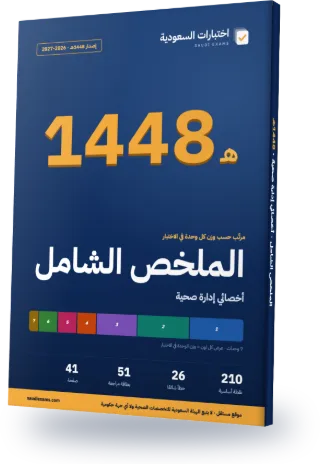
Health Administration Complete Review Guide 2026–2027
Every exam topic in a 41-page Arabic PDF, ordered from the heaviest unit to the lightest. The first three chapters alone cover about 67% of the exam questions.
- 41Pages
- 210Key points
- 26Common mistakes
- 51Flashcards
Guide map
Each chapter is one exam unit, ordered by its weight in the real exam.
| Chapter | Unit | Weight | Exam questions | Key points |
|---|---|---|---|---|
| 1 | Health Systems | 24% | 36 | 48 |
| 2 | General Management | 24% | 36 | 20 |
| 3 | Human Resources | 19% | 29 | 20 |
| 4 | Financing and Health Insurance | 9% | 14 | 44 |
| 5 | Health Information Systems | 9% | 14 | 48 |
| 6 | Quality Management and Patient Safety | 9% | 14 | 15 |
| 7 | Saudi Model of Care | 5% | 7 | 15 |
Chapter 1 in full: Health Systems
24% of the exam, about 36 questions. These are its key points, as in the guide.
- Service delivery: This block concerns delivering interventions and is one of the six components. WHO, Health system building blocks: six-component list.
- Financing alone cannot achieve coverage without other system components: Coverage progress requires coordinated components, including the workforce. WHO, Key messages: coordinated action across pillars.
- The main entry point and ongoing care site for most problems: This combines first contact with ongoing care across the life course. WHO, Q9, physical page 3.)/csy/ipchs/framework_q-a.pdf.
The rest of chapter 1, on this page
- Governance, financing, intersectoral action and social determinants: PHC organizes the wider system, not service delivery alone. WHO, Q9, physical page 3: distinction between primary care and PHC.)/csy/ipchs/framework_q-a.pdf.
- Absence of unfair differences between groups that can be avoided or remedied: The definition concerns fairness and remediability, not absolute sameness. WHO, Overview: definition.
- Promotion, prevention, treatment, rehabilitation and palliation across life: Coverage includes the essential service continuum across the life course. WHO, Overview: continuum of essential services.)
- Build understanding: Generating reliable intelligence on actors, performance and context defines this behavior. WHO; Strategic framework, Build understanding, printed pp15–16.
- Foster relations: Building and sustaining partnerships complements formal governance tools. WHO; Strategic framework, Foster relations, printed pp15–16.
- Enable stakeholders: Formal tools and powers make role implementation possible. WHO; Strategic framework, Enable stakeholders, printed pp15–16.
- Aligning structures with policy objectives: The organizational design and culture must fit the policy goal. WHO; Strategic framework, Align structures, printed pp15–16.
- Holding public and private actors accountable to the population: The framework connects trust with accountability of all actors for their actions. WHO; Strategic framework, Nurture trust, printed pp15–16.
- Goals, roles, policy instruments and performance-monitoring arrangements: The framework combines direction, roles, implementation tools and monitoring. WHO; Strategic framework, Deliver strategy, printed pp15–16.
- The whole system, including public and private actors: Stewardship covers the system rather than only government-owned services. WHO; Strategic framework: stewardship of the whole health system, printed p15.
- Ensuring effective implementation and impact and addressing market failures: These purposes are identified within governance work. WHO; Impact: accountability and oversight mechanisms.
- No; secondary care may be delivered outside hospitals: The level concerns specialist service function, not the building alone. WHO, ICD reference guide 2.23.1: clinical care.
- Tertiary care: This fits highly specialized consultative care with advanced capabilities. WHO, ICD reference guide 2.23.1: tertiary care.
- Yes; referral may be to the same or a higher level: The definition does not restrict referral to upward movement. WHO, Overview: definition of referral.
- Counter-referral: This is return for follow-up after care at a specialist level. WHO, Referral glossary: counter-referral definition.
- Access to specialist care when needed with resource efficiency: The concept balances needed care with reducing wasteful activity. WHO, Overview: purpose and waste reduction.
- Linking services to delivery platforms and clarifying benefits: A package helps organize linkages, planning and benefits. WHO, Definition of UHC package; power of packages and implementation.
- Because impact requires actual implementation: Writing a package defines intent; implementation turns it into services for people. WHO, Service planning: implementation is key.
- Appropriate training and emotional support with attention to personal needs: The framework recognizes both caregiver capability and personal needs. WHO, Q16, physical page 5: carers.)/csy/ipchs/framework_q-a.pdf.
- Social gradient in health: The gradient links socioeconomic position with health levels. WHO, Overview: social gradient.
- Services for everyone with greater support where disadvantage is greater: This combines universality with a response scaled to need. WHO, In practice: universal action proportionate to disadvantage.
- Physical inaccessibility of the facility: Appointment availability does not remove a building-access barrier. WHO, Health-system barriers: inaccessible facilities.
- Organizational health literacy: The organization enables access to, understanding and use of information. WHO, Key facts and why improve health literacy: organizational structures.
- Regional inequality in digital infrastructure: Infrastructure gaps can distribute innovation benefits unequally. WHO, Opening findings: regional infrastructure inequalities.
- Including their needs in the existing system with adapted services: Temporary parallel emergency responses may be needed, but long-term integration is preferred. WHO, How care should be organized: mainstreaming and emergency exception.
- Understanding overlapping exclusion factors shaping gaps: Discrimination factors may intersect and require responses that consider them together. WHO, Fundamental principles: intersecting discrimination.
- Accurate, clear information about the condition and options: The page identifies such information as a basis for informed decisions. Ministry of Health, Patient rights: information and informed decisions.
- A clear process for concerns and appropriate responses while preserving dignity: The right includes submitting complaints and receiving responses through a clear process. Ministry of Health, Patient rights: complaints and objections.
- Because an informed decision should be free from pressure or discrimination: The page describes informed choice as approval or refusal without pressure. Ministry of Health, Patient rights: informed approval or refusal without pressure.
- It is not consent to a medical procedure: The guide explicitly says silence is not consent. Ministry of Health, Saudi Guidelines for Informed Consent 2019, Types, physical p12.
- Its link to a specific intervention with sufficient information: Special consent concerns a specified intervention such as surgery, anesthesia or transfusion. Ministry of Health, Saudi Guidelines 2019, Definitions 1–2, physical p9.
- Benefits without exaggeration, harms without understatement or overstatement, and alternatives: This balance supports realistic understanding of the procedure. Ministry of Health, Saudi Guidelines 2019, Definition 25, physical p10.
- Party identities, date/time, procedure, risks and alternatives: These elements link consent to the person, procedure and explanation. Ministry of Health, Saudi Guidelines 2019, Documentation governance, physical p21.
- Checking understanding rather than relying only on a signature: The guide identifies failure to ensure understanding as an error beyond paperwork. Ministry of Health, Saudi Guidelines 2019, Common team mistakes, physical p48.
- Preparing for, managing and learning from disturbances: The concept covers before, during and after disruption. WHO/European Observatory; Definition of health-system resilience.
- Preparedness: Stage one concerns vulnerability and readiness before a shock. WHO/European Observatory; Section 2.1, shock cycle, printed p41 / physical p55.
- Shock onset and alert: Stage two focuses on timely identification of onset and nature. WHO/European Observatory; Section 2.1, stage 2, printed p41 / physical p55.
- Shock impact and management: Stage three covers absorption, adaptation and transformation during impact. WHO/European Observatory; Section 2.1, stage 3, printed p41 / physical p55.
- Recovery and learning: Recovery considers the legacy and changes left by the shock. WHO/European Observatory; Section 2.1, stage 4, printed p41 / physical p55.
- Absorptive capacity: It means sustaining the service level with the same resources despite the shock. WHO/European Observatory; Section 2.1, responsive capacities, printed p42 / physical p56.
- Adaptive capacity: Organizational adjustment with changed resources is the defining distinction. WHO/European Observatory; Section 2.1, adaptive capacity, printed p42 / physical p56.
- Transformative capacity: Transformation concerns system structure and how it functions. WHO/European Observatory; Section 2.1, transformative capacity, printed p42 / physical p56.
- Monitoring population health, risks and service utilization: The function covers these domains rather than only individual cases. WHO/European Observatory; Unified EPHF list: public health surveillance and monitoring.
- Health protection: This function includes protection against these environmental and occupational threats. WHO/European Observatory; Unified EPHF list: health protection.
- Supporting health security, UHC and resilience together: WHO describes conceptual and operational links between these goals. WHO/European Observatory; EPHF overview: health security, UHC and resilience.
Common mistakes in this chapter
- Care level is not established by building name alone: secondary care can be outside hospitals and primary care inside them. WHO ICD guide §2.23.1.
- A national average does not establish fair distribution: examine groups and barriers. WHO Health equity/Data and evidence.
- Connectivity does not establish ability to use the service. WHO Europe digital equity findings 2026.
- A signature alone does not replace explanation, understanding and voluntariness. Saudi consent guide 2019, conditions/common errors.
The other chapters are in the full guide
One purchase · lifetime access · review guide included
7-day review plan
The chapters are spread over 6 days by weight so each day carries a similar load. Day 7 is a full exam.
Day 1 · 24% of the exam
Chapter 1: Health Systems
Day 2 · 24% of the exam
Chapter 2: General Management
Day 3 · 19% of the exam
Chapter 3: Human Resources
Day 4 · 14% of the exam
Chapter 4: Financing and Health Insurance
Chapter 7: Saudi Model of CareDay 5 · 9% of the exam
Chapter 5: Health Information Systems
Day 6 · 9% of the exam
Chapter 6: Quality Management and Patient Safety
Day 7
Full mock exam: 150 questions in 180 minutes, then review the common mistakes in the units where you lost marks.
How many correct answers do you need?
- Pass mark 60%90 correct out of 150
Before you read: see your score today
10 free questions from the main units, no sign-up. Then you know which chapter to start with.
Try 10 free questions and see your levelA look at each chapter
The first three key points of each chapter, as they appear in the guide (in Arabic in the PDF).
Chapter 1: Health Systems
- Service delivery
- Financing alone cannot achieve coverage without other system components: Coverage progress requires coordinated components…
- The main entry point and ongoing care site for most problems
Chapter 2: General Management
- Bureaucracy links authority to office, rules and merit rather than favoritism; its modern model…
- Overall goals are translated into aligned subgoals; unit goals should support rather than undermine…
- Specific goals make progress easier to monitor; define the indicator, desired level and review…
Chapter 3: Human Resources
- Workforce planning links service needs with numbers, skills and availability; separate required demand from…
- Job analysis examines work and its requirements. Descriptions record duties; specifications state the knowledge…
- Headcount may balance while skill-mix gaps remain; consider training and redeployment before assuming external…
Chapter 4: Financing and Health Insurance
- Revenue raising, pooling, then purchasing — These distinguish money entering, being pooled, and being…
- Because it shapes redistribution and risk spreading — Both resource volume and structure affect…
- Restricted redistribution and risk sharing with inefficiency — Fragmentation restricts the capacity of available…
Chapter 5: Health Information Systems
- An integral part of the wider system — RHIS is part of national information…
- Service data routinely generated by facility and community health workers — Data arise during…
- Repeated generation, compilation and reporting for predictable needs — Repeated service-based reporting characterizes RHIS…
Chapter 6: Quality Management and Patient Safety
- Quality includes effectiveness, safety, people-centredness, timeliness, equity, integration and efficiency. Satisfaction matters but does…
- Structure describes capability and systems; process describes care delivered; outcomes describe health effects. Resource…
- Balancing measures detect unintended consequences elsewhere; improved waiting alone is insufficient if workload becomes…
Chapter 7: Saudi Model of Care
- Service design in the modern model starts with individual needs; the person is the…
- The safe-birth system supports mothers from before marriage through childbirth and subsequent child care…
- Chronic care provides continuing support and coordination among care providers. Source: “Chronic disease care.”
The full guide comes with lifetime access
The full guide (41 pages) is included with lifetime access to this exam, together with every question and full mock exam. Chapter 1 is free for everyone.
Questions about the guide
Is the guide free?
Chapter 1 is free to read on the guide page. The full guide comes with lifetime access to this exam; 7-day access does not include it.
Is it up to date for 2026–2027?
Yes. Unit weights and exam facts follow what the exam body last published, and the last check date is printed in the guide. If the standards change we update the file and buyers download the new version.
Does the guide have questions?
No. The guide covers key points and common mistakes; scoring, weak-area practice and full mock exams are on the site.
Can I read it on my phone?
Yes. A5 pages in a single column, with chapters linked from the contents.
- Pages
- 41
- Edition
- 1448 AH · 2026–2027
- Language
- Arabic
- Last updated
All Health Exams review guides
Back to SCFHS Health Administration Specialist (Arabic pathway)
Buy this exam
Pick the access that lasts until your test date.
Included
- Full mock exams: 150 questions in 180 minutes, with a score for every unit
- 500 questions, every option explained with its source
- Practice that starts with your weakest units, plus a review of your mistakes
- Complete Review Guide 2026–2027 (PDF), with lifetime access only
Continue with your Google account and you go straight to the payment page.
You pay on the Waffo Pancake checkout page (in English). The amount is in US dollars and your bank converts it to riyals. One payment with no automatic renewal, by Visa, Mastercard (a mada card with either logo works too), Apple Pay or Google Pay. Your statement shows "WAFFO". Purchases are not refundable.