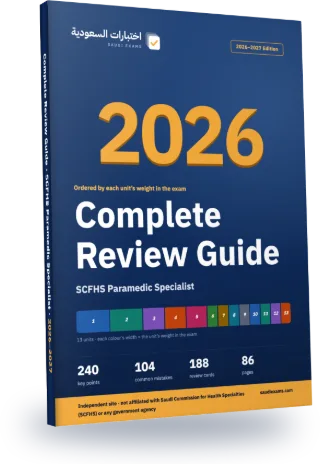
SCFHS Paramedic Specialist Complete Review Guide 2026–2027
Every exam topic in a 86-page Arabic PDF, ordered from the heaviest unit to the lightest. The first three chapters alone cover about 40% of the exam questions.
- 86Pages
- 240Key points
- 104Common mistakes
- 188Flashcards
Guide map
Each chapter is one exam unit, ordered by its weight in the real exam.
| Chapter | Unit | Weight | Exam questions | Key points |
|---|---|---|---|---|
| 1 | Trauma | 15% | 23 | 19 |
| 2 | Shock and Resuscitation | 15% | 23 | 18 |
| 3 | Airway | 10% | 15 | 19 |
| 4 | Medical Emergency | 10% | 15 | 20 |
| 5 | Cardiac Emergency | 10% | 15 | 18 |
| 6 | Fundamentals and Operations | 5% | 8 | 20 |
| 7 | Disaster | 5% | 8 | 17 |
| 8 | Environmental and Toxicology | 5% | 8 | 16 |
| 9 | Pediatrics and Neonates | 5% | 7 | 17 |
| 10 | OB/GYN | 5% | 7 | 19 |
| 11 | Special Populations | 5% | 7 | 20 |
| 12 | Patient Safety | 5% | 7 | 18 |
| 13 | Professionalism and Ethics | 5% | 7 | 19 |
Chapter 1 in full: Trauma
15% of the exam, about 23 questions. These are its key points, as in the guide.
- The PHTLS primary survey (XABCDE): X exsanguinating hemorrhage, A airway with spinal protection, B breathing, C circulation, D disability (GCS), E exposure and warmth.
- Mechanism of injury: rear impact with a low head restraint causes cervical hyperextension; a star-shaped windshield crack means head and neck injury; the down-and-under path injures knee, femur and posterior hip; side impact injures ribs, spleen and pelvis on the struck side.
- A child pedestrian struck by a car: femur or pelvis (bumper), then chest or abdomen (hood), then head. Blast: primary injury affects air-filled organs such as the ears and lungs (blast lung).
The rest of chapter 1, on this page
- GCS = eyes (4) + verbal (5) + motor (6), maximum 15; for example eyes to voice 3 + confused 4 + localizes pain 5 = 12.
- Highest-level trauma center criteria: systolic BP under 90 mmHg, a low GCS, and high-risk mechanisms such as ejection; an older patient on anticoagulants after head injury is transported despite looking well because of delayed bleeding risk.
- Field principle: scene time for a critical patient is about 10 minutes or less; treat only hemorrhage, airway and chest decompression on scene, and do IV access and the secondary survey en route; reassess an unstable patient every 5 minutes, and any deterioration means repeating the primary survey.
- Cushing's triad (hypertension, bradycardia, irregular breathing) signals raised intracranial pressure; herniation signs are falling GCS with a dilated sluggish pupil and extensor posturing, and only then is brief mild hyperventilation to ETCO2 30 to 35 mmHg allowed.
- In severe brain injury a single episode of hypoxia or hypotension raises mortality, so prevent both; raise the stretcher head 30 degrees if BP is normal and no spinal injury is suspected. Bruising behind the ear (Battle's sign) is a late sign of basilar skull fracture.
- Epidural hematoma: a lucid interval after a temporal blow, then rapid decline. Central cord syndrome: arms weaker than legs after hyperextension in an older adult. Abdominal breathing with intercostal paralysis suggests a lower cervical cord injury.
- Neurogenic shock: hypotension with a slow or normal pulse and warm skin after spinal cord injury; first treatment is fluids and warmth, then a vasopressor per protocol.
- Open pneumothorax (sucking wound): vented chest seal; if the patient worsens after an occlusive dressing, briefly open one edge. Flail chest: two or more adjacent ribs broken in two or more places with paradoxical movement; the key treatment in respiratory failure is positive-pressure ventilation.
- Tension pneumothorax is decompressed with a needle in the second intercostal space, midclavicular line (over the top of the rib); if dyspnea returns the catheter may be kinked, so decompress again. An impaled object is stabilized in place unless it blocks the airway or CPR.
- Arterial blood is bright red and spurts with the pulse. Junctional bleeding (groin, axilla, neck) is packed with gauze and pressed firmly. Hemostatic gauze needs firm pressure for at least 3 minutes. Tranexamic acid (TXA) is given within 3 hours of injury.
- Blood loss: Class II has HR 100 to 120 with normal systolic BP, narrowed pulse pressure and anxiety; a 30% to 40% loss (about 1.5 to 2 L in a 70-kg adult) causes marked tachycardia, hypotension and confusion. With uncontrolled internal bleeding aim for systolic 80 to 90 mmHg unless there is a head injury.
- Burn depth: superficial is red and dry; partial-thickness is red, moist, blistered and very painful; full-thickness is white, leathery and painless. Burns to the hands need a burn center. A circumferential chest burn (eschar) restricts breathing. High-voltage electrical injury damages deep tissue and the heart, so monitor.
- Adult rule of nines: head 9, arm 9, anterior trunk 18, posterior 18, leg 18; for an infant, head 18% and arm 9%. Cool small burns under cool running water; large burns are covered with dry clean sheets and the patient kept warm. Parkland formula: 4 mL × kg × %TBSA, half in the first 8 hours from the time of burn.
- Open fractures break the skin, so cover with a sterile dressing and splint without reducing the bone. Check pulse, motor and sensation before and after splinting. A splint includes the joint above and below the break. The most bleeding fractures are pelvis, then femur.
- A traction splint is only for an isolated midshaft femur fracture; with another injury on the same leg or an unstable patient use a long rigid or vacuum splint and move fast. Posterior hip dislocation: flexed, adducted, internally rotated; femoral neck fracture in an older adult: shortened, externally rotated leg.
- Compartment syndrome: pain out of proportion that worsens on passive stretch, with pulses often present. Crush syndrome: when a heavy load is lifted after hours, potassium release can cause arrhythmia, so give fluids and monitor the heart before release. Knee dislocation puts the popliteal artery at risk.
Common mistakes in this chapter
- The long backboard is now mainly an extrication and moving tool; a cooperative patient with neck pain can wear a collar and move to the stretcher with guidance.
- Tamponade, massive hemothorax and tension pneumothorax all cause shock; tamponade has distended neck veins with equal breath sounds, hemothorax has flat neck veins with dullness and absent sounds.
- Neurogenic shock shows hypotension with a slow or normal pulse and warm skin, but trauma patients can also bleed, so exclude hemorrhage first.
- A patient on a beta-blocker may not become tachycardic despite shock; do not rely on pulse alone in older patients.
- After a fall onto the feet, look for lumbar spine compression injury, not only heel and leg injuries.
- A knee dislocation can injure the popliteal artery even when a distal pulse is felt; the pulse alone is not reassuring.
- Dry chemicals are brushed off first, then flushed with plenty of water; alkali burns need continuous irrigation, including en route.
- Severe pain out of proportion that worsens with passive stretch is an early sign of compartment syndrome, and pulses may still be present; do not wait for a lost pulse.
The other chapters are in the full guide
One purchase · lifetime access · review guide included
7-day review plan
The chapters are spread over 6 days by weight so each day carries a similar load. Day 7 is a full exam.
Day 1 · 20% of the exam
Chapter 1: Trauma
Chapter 12: Patient SafetyDay 2 · 20% of the exam
Chapter 2: Shock and Resuscitation
Chapter 13: Professionalism and EthicsDay 3 · 15% of the exam
Chapter 3: Airway
Chapter 8: Environmental and ToxicologyDay 4 · 15% of the exam
Chapter 4: Medical Emergency
Chapter 9: Pediatrics and NeonatesDay 5 · 15% of the exam
Chapter 5: Cardiac Emergency
Chapter 10: OB/GYNDay 6 · 15% of the exam
Chapter 6: Fundamentals and Operations
Chapter 7: Disaster
Chapter 11: Special PopulationsDay 7
Full mock exam: 150 questions in 180 minutes, then review the common mistakes in the units where you lost marks.
How many correct answers do you need?
- Pass mark 60%90 correct out of 150
Before you read: see your score today
10 free questions from the main units, no sign-up. Then you know which chapter to start with.
Try 10 free questions and see your levelA look at each chapter
The first three key points of each chapter, as they appear in the guide (in Arabic in the PDF).
Chapter 1: Trauma
- The PHTLS primary survey (XABCDE)
- Mechanism of injury
- A child pedestrian struck by a car
Chapter 2: Shock and Resuscitation
- Shock is inadequate oxygen delivery to the tissues. Types
- Compensated shock shows tachycardia, cool extremities and slow capillary refill with normal BP, and…
- Septic shock
Chapter 3: Airway
- The normal adult respiratory rate is 12 to 20 breaths per minute. A slow…
- In adults the narrowest part of the upper airway is the glottic opening between…
- Breathing patterns
Chapter 4: Medical Emergency
- Severe asthma
- Nebulized salbutamol for adults
- Severe asthma not responding
Chapter 5: Cardiac Emergency
- Lead placement
- ST elevation in aVR with diffuse ST depression suggests left main or multivessel disease;…
- Wellens pattern
Chapter 6: Fundamentals and Operations
- Negligence needs all four elements
- Abandonment is ending care without handing over to a provider of equal or higher…
- Medical oversight types
Chapter 7: Disaster
- A mass-casualty incident (MCI) is an event where patient numbers or needs exceed the…
- Triage colors
- The first START step
Chapter 8: Environmental and Toxicology
- Heat stroke
- Heat exhaustion
- Drowning
Chapter 9: Pediatrics and Neonates
- The pediatric assessment triangle (PAT)
- The normal infant respiratory rate is about 30 to 60 per minute. Minimum systolic…
- Croup
Chapter 10: OB/GYN
- Stage 1 of labor ends at full cervical dilation; stage 2 runs from full…
- Control the crowning head with light palm pressure, avoiding the fontanelles, to prevent explosive…
- After the head delivers, feel around the neck for the cord before delivering the…
Chapter 11: Special Populations
- Atypical ACS in older adults
- Delirium
- Polypharmacy increases interactions, falls and confusion; bring the medication list or containers to hospital.
Chapter 12: Patient Safety
- The core rights of drug administration
- Tall Man lettering such as hydrOXYzine and hydrALAZINE highlights the differing parts of look-alike…
- Dose calculation
Chapter 13: Professionalism and Ethics
- Implied consent assumes a reasonable person would accept emergency care when unconscious or unable…
- Capacity
- Mild dementia does not mean lost capacity for every decision; a patient who understands…
The full guide comes with lifetime access
The full guide (86 pages) is included with lifetime access to this exam, together with every question and full mock exam. Chapter 1 is free for everyone.
Questions about the guide
Is the guide free?
Chapter 1 is free to read on the guide page. The full guide comes with lifetime access to this exam; 7-day access does not include it.
Is it up to date for 2026–2027?
Yes. Unit weights and exam facts follow what the exam body last published, and the last check date is printed in the guide. If the standards change we update the file and buyers download the new version.
Does the guide have questions?
No. The guide covers key points and common mistakes; scoring, weak-area practice and full mock exams are on the site.
Can I read it on my phone?
Yes. A5 pages in a single column, with chapters linked from the contents.
- Pages
- 86
- Edition
- 1448 AH · 2026–2027
- Language
- Arabic
- Last updated
Buy this exam
Pick the access that lasts until your test date.
Included
- Full mock exams: 150 questions in 180 minutes, with a score for every unit
- 750 questions, every option explained with its source
- Practice that starts with your weakest units, plus a review of your mistakes
- Complete Review Guide 2026–2027 (PDF), with lifetime access only
Continue with your Google account and you go straight to the payment page.
You pay on the Waffo Pancake checkout page (in English). The amount is in US dollars and your bank converts it to riyals. One payment with no automatic renewal, by Visa, Mastercard (a mada card with either logo works too), Apple Pay or Google Pay. Your statement shows "WAFFO". Purchases are not refundable.