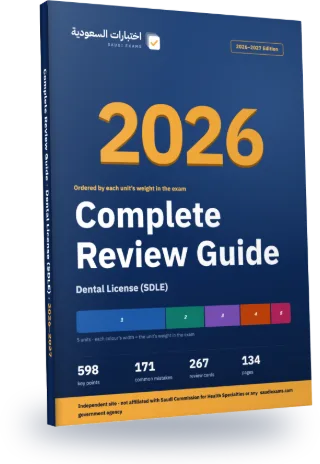
Dental License (SDLE) Complete Review Guide 2026–2027
Every exam topic in a 134-page Arabic PDF, ordered from the heaviest unit to the lightest. The first three chapters alone cover about 75% of the exam questions.
- 134Pages
- 598Key points
- 171Common mistakes
- 267Flashcards
Guide map
Each chapter is one exam unit, ordered by its weight in the real exam.
| Chapter | Unit | Weight | Exam questions | Key points |
|---|---|---|---|---|
| 1 | Restorative Dentistry | 40% | 80 | 222 |
| 2 | Periodontics | 18% | 36 | 100 |
| 3 | Endodontics | 17% | 34 | 113 |
| 4 | Oral Medicine and Oral Surgery | 15% | 30 | 97 |
| 5 | Orthodontics and Pediatric Dentistry | 10% | 20 | 66 |
Chapter 1 in full: Restorative Dentistry
40% of the exam, about 80 questions. These are its key points, as in the guide.
- For a noncavitated occlusal lesion, a sealant with or without varnish is prioritized. [R3–R4 p. 1]
- A noncavitated proximal lesion may be managed with resin infiltration or other listed nonrestorative options. [R3 p. 1]
- For permanent root lesions selected for nonrestorative care, daily high-fluoride toothpaste or gel is prioritized. [R3 p. 1]
The rest of chapter 1, on this page
- Selective excavation is prioritized for moderate and advanced lesions in vital permanent teeth when restoration is needed without pulp therapy. [R1 p. 1]
- In selected advanced lesions in vital primary teeth, selective removal or sealing with a preformed crown are prioritized approaches. [R2 pp. 1–2]
- When choosing a material, account for isolation and whether light-curing is feasible. [R1 p. 2, notes 11–15]
- Clean dentures outside the mouth and rinse before reinsertion. [Care 2026 p. 16]
- Avoid high heat and prevent acrylic dehydration during storage. [Care 2026 p. 17]
- Support sleep-time removal when clinically appropriate, particularly for vulnerable adults. [Care 2026 p. 15]
- A partial denture care plan must protect remaining teeth with fluoride toothpaste and interdental cleaning. [Care 2026 p. 17]
- Train carers and label dentures in dependent-care settings. [Care 2026 p. 17]
- Preserve sound structure while providing retention, resistance, durability and margin integrity. [p. 81]
- Discuss alternatives, risks, maintenance and future revision before irreversible care. [p. 81]
- Document findings, diagnosis and management. [p. 82]
- Address etiologic factors and arrange follow-up rather than stopping at restoration delivery. [p. 83]
- Record the arch and occlusal relationship appropriate to the clinical plan. [pp. 22–24]
- The complex RPD pathway includes framework assessment, trial placement and insertion as distinct stages. [p. 23]
- Transition to complete edentulism needs a prognosis-based discussion of consequences. [p. 20]
- Healing-phase immediate dentures have different initial goals from definitive prostheses. [p. 20]
- Assess bone, tissues, interarch space, loading and healing factors. [ACP2020 pp. 68–70]
- Full-arch prosthetic contours must permit hygiene. [Maintenance 2023]
- Record a baseline and use compatible cleaning instruments. [Maintenance 2023]
- Investigate repeated screw loosening. [Maintenance 2023]
- Rests should provide positive tooth support and direct load axially; central extension is relevant in tooth-supported molar designs. [R: main text]
- Paired embrasure rests distribute load; preserve proximal contact and avoid a locking vertical slot. [R: Embrasure occlusal rest]
- Indirect retention targets lifting rotation; tissueward settling needs adequate ridge/base support. [I: Figures 4-1–2]
- Effective indirect retention needs direct retention, a definite rest seat, a rigid connection and a useful lever arm. [I: Factors]
- Measure indirect-retainer distance perpendicular to the fulcrum axis; anatomy can limit the geometrically ideal site. [P: opening and Class I]
- For the stated Class IV anterior-base lifting problem, posterior molar rests can provide indirect retention. [P: Figure 8-39]
- Connector choice balances rigidity, anatomical clearance and support; a full palatal plate provides broad mucosal support. [C: Full palatal plate; Lingual Bar]
- Optimise saddle support on suitable attached mucosa and provide reciprocal bracing against lateral clasp forces. [B: p.8, elements 2 and 6]
- Check tray borders in function and correct overextension before the definitive impression. [C: Definitive impressions]
- A mobile ridge may need low-displacement recording, such as a window technique. [F: slides 51–55]
- Preserve functional sulcus form when pouring. Stable record bases precede dependable jaw records. [B: pp.3,7]
- Assess vertical dimension through several indicators: rest clearance, speech, facial support and comfort. [J: slides 28–36]
- Verify jaw relations at try-in. Changes require new recording and re-trial. [T: slides 4–10; B:p.5]
- Use functional anatomy and tissue displacement to guide posterior sealing, not a universal groove depth. [P: slides 21–26]
- Remounting corrects processing-related occlusal changes; finishing should preserve functional borders. [L:slides 2–3; D:slides 8,10–13]
- Localize pressure or border interference before targeted post-insertion correction. [U: sections 1,6; B:p.5]
- FDI uses quadrant and tooth-from-midline digits. Permanent quadrants are 1–4 and primary quadrants 5–8. [H:printed p.16/PDF p.17]
- An anatomical crown is enamel-covered; a clinical crown is the visible portion and changes with the gingival margin. [A2:p.5]
- The usual maxillary first-premolar mesial ridge can be crossed by a developmental groove. [A8:p.2]
- A mandibular first premolar commonly has a dominant buccal cusp; the three-cusp second-premolar type typically has Y-shaped grooves. [A9:pp.1–2; A10:p.3]
- The maxillary first-molar oblique ridge links mesiolingual and distobuccal regions; Carabelli, when present, is lingual to the mesiolingual cusp. [A11:pp.1–2]
- In the usual non-crossbite relationship, upper palatal and lower buccal cusps provide centric support. [O:PDF p.18]
- Working side means the side toward which the jaw moves. Canine guidance differs from group function in the number of contacting working-side teeth. [O:PDF pp.14–15]
- Cusp–fossa form combines limited contacts with food spillways; reproducing a broad flat contact everywhere loses this anatomy. [O:PDF pp.20–21]
- Cervical overcontour, marginal fit and surface roughness affect gingival response; assess these separately. [F:slides 8,18,21–23,30]
- Excessive convergence and reduced preparation height weaken conventional geometric retention/resistance; suitable auxiliary grooves can help selected preparations. [T:Factors affecting retention and resistance]
- The insertion path must be unobstructed; an undercut is not an intentional retentive feature for a rigid crown. [T:Path of insertion; Taperness]
- Anatomical occlusal reduction and appropriate functional-cusp beveling provide space while conserving tissue. Assess clearance in static and excursion positions. [T:Structural durability]
- Insufficient axial reduction may force deficient material bulk or overcontour; use a reduction index to assess the planned space. [T:Axial reduction; B:Tooth preparations,PDF7]
- A chamfer is a common conservative choice for a cast-metal margin. Ceramic-system-specific shoulder designs may require rounded internal angles. [T:Finish line configurations]
- Use accessible supragingival sound tissue for margins when clinically suitable. [B:Tooth preparations,PDF7]
- Provisional fit, seal, tissue protection and removable cementation matter; wax-up-derived provisionals can test substantial planned changes. [B:printed pp.16–17/PDF9]
- A definitive impression needs continuous finish-line detail, no critical voids and secure tray attachment; digital previews also need completeness checks. [I:pp.8–9]
- A crown that seats dry can be prevented from seating by excessive cement volume and hydraulic effects during luting. [B:printed pp.20–21/PDF11]
- scfhs-dentistry-u1-0181: Align the tip close to the surface. Distance and angulation affect the energy reaching the restoration; optimize access and alignment while following the material instructions. [ADA, Dental Curing Lights; Last updated 27 March 2023; accessed 3 November 2026; Key Points; Curing Light Use, irradiance versus radiant exitance.]
- scfhs-dentistry-u1-0182: Match emission to initiator absorption. The initiator must absorb the emitted wavelengths; adequate energy is also required. [ADA, Dental Curing Lights; Last updated 27 March 2023; accessed 3 November 2026; Curing Light Technology.]
- scfhs-dentistry-u1-0183: 12 J/cm². 600 mW/cm² = 0.6 W/cm²; 0.6 × 20 = 12 J/cm². Suitability still depends on the material and clinical delivery. [ADA, Dental Curing Lights; Last updated 27 March 2023; accessed 3 November 2026; Curing Light Use, radiant exposure; Table 1.]
- scfhs-dentistry-u1-0184: Polymerization can produce contraction. Methacrylate matrix contraction can stress the bonded interface; a gap should not be expected to self-seal by curing. [ADA, Materials for Direct Restorations; Last updated 16 August 2024; accessed 3 November 2026; historical tables explicitly identified as 2003; Resin Matrix.]
- scfhs-dentistry-u1-0185: More constrained shrinkage deformation. A higher C-factor constrains deformation and can increase interfacial shrinkage stress; it is not a stand-alone prediction of clinical failure. [Al-Mustaqbal University, Pre-clinical Operative Dentistry, Lectures 10–11: Light-activation sources / Adhesion to Dentin; University catalogue listing 24 April 2026; PDF itself undated; catalogue attributes Alaa Hashim Abbas; PDF p.2, Factors affecting polymerization shrinkage stress.]
- scfhs-dentistry-u1-0186: Resin infiltration into conditioned dentin. The hybrid layer is the resin-impregnated dentin interface; infiltration and polymerization within the conditioned substrate are central. [Al-Mustaqbal University, Pre-clinical Operative Dentistry, Lectures 10–11: Light-activation sources / Adhesion to Dentin; University catalogue listing 24 April 2026; PDF itself undated; catalogue attributes Alaa Hashim Abbas; PDF pp.6–7, Adhesion to Dentin.]
- scfhs-dentistry-u1-0187: On the enamel bonding margins. Selective enamel etching targets enamel; the adhesive then treats the dentin according to its own instructions. [Scotchbond Universal Plus Adhesive, Instructions for Use, document 3100023493/02; Information as of July 2020; official Solventum-hosted download accessed 3 November 2026; English, PDF p.1; PDF p.1, Selective Enamel Etch versus Total Etch/Etch and Rinse Procedure.]
- scfhs-dentistry-u1-0188: Continue the instructed air-thinning step. For this specific IFU, air is continued to the specified endpoint before light curing. Other adhesive systems require their own protocols. [Scotchbond Universal Plus Adhesive, Instructions for Use, document 3100023493/02; Information as of July 2020; official Solventum-hosted download accessed 3 November 2026; English, PDF p.1; PDF p.1, Application of the Adhesive.]
- scfhs-dentistry-u1-0189: Establish effective fluid control first. Bonding requires control of blood, saliva and sulcular fluid. Establish an adequately isolated field before the adhesive procedure. [Scotchbond Universal Plus Adhesive, Instructions for Use, document 3100023493/02; Information as of July 2020; official Solventum-hosted download accessed 3 November 2026; English, PDF p.1; PDF p.1, Drying the Area.]
- scfhs-dentistry-u1-0190: Respect depth and add the required cap. Bulk-fill formulations differ. Follow the selected product’s depth, exposure and capping requirements rather than a universal thickness rule. [Al-Mustaqbal University, Pre-clinical Operative Dentistry, Lectures 12–13: Placement techniques for composite in Cl I / Cl II; University catalogue listing 24 April 2026; PDF itself undated; catalogue attributes Alaa Hashim Abbas; PDF p.5, Bulk-fill technique; cross-check ADA Materials for Direct Restorations, Filler Particle Classifications:.]
- scfhs-dentistry-u1-0191: Obtain the matching specified liquid. The 03/2025 IFU explicitly prohibits mixing its powder or liquid with other GIC components. [GC Fuji IX GP-EXTRA powder/liquid, Instructions for Use; Last revised 03/2025; English, PDF p.1; PDF p.1, Caution 3 and Powder and Liquid Dispensing.]
- scfhs-dentistry-u1-0192: A gently dried, moist glistening surface. This IFU specifies blotting or gentle air and avoiding desiccation, leaving the preparation moist and glistening. [GC Fuji IX GP-EXTRA powder/liquid, Instructions for Use; Last revised 03/2025; English, PDF p.1; PDF p.1, Restorative Technique 3(b–c).]
- scfhs-dentistry-u1-0193: Apply the specified protective coating. Section 3(g) requires immediate varnish or the specified light-cured coating when set; section 4 also provides a final coating step. [GC Fuji IX GP-EXTRA powder/liquid, Instructions for Use; Last revised 03/2025; English, PDF p.1; PDF p.1, Restorative Technique 3(g); Finishing 4(b).]
- scfhs-dentistry-u1-0194: Reconsider an exposed heavy-load restoration. The proposed sole load-bearing use exceeds the stated permanent-tooth indications. Select a suitable load-bearing design/material rather than extending this IFU. [GC Fuji IX GP-EXTRA powder/liquid, Instructions for Use; Last revised 03/2025; English, PDF p.1; PDF p.1, Indications 2–3.]
- scfhs-dentistry-u1-0195: A resin component changes its setting behavior. RMGI incorporates methacrylate resin chemistry; its particular light/self-curing requirements must be followed. [ADA, Materials for Direct Restorations; Last updated 16 August 2024; accessed 3 November 2026; historical tables explicitly identified as 2003; Modified Glass Ionomers and Bioactive Materials.]
- scfhs-dentistry-u1-0196: Matrix contour and contact positioning. The matrix establishes the proximal contour and contact geometry during placement; correct its shape and position before curing. [Al-Mustaqbal University, Pre-clinical Operative Dentistry, Lectures 12–13: Placement techniques for composite in Cl I / Cl II; University catalogue listing 24 April 2026; PDF itself undated; catalogue attributes Alaa Hashim Abbas; PDF p.7, Retainers & matrix band application.]
- scfhs-dentistry-u1-0197: Adapt a suitable wedge at that margin. A correctly fitted wedge stabilizes and adapts the band gingivally, reducing the risk of an overhang without distorting it into the cavity. [Al-Mustaqbal University, Pre-clinical Operative Dentistry, Lectures 12–13: Placement techniques for composite in Cl I / Cl II; University catalogue listing 24 April 2026; PDF itself undated; catalogue attributes Alaa Hashim Abbas; PDF pp.9–10, Wedge.]
- scfhs-dentistry-u1-0198: Gingival to the contact area. Keep the strip’s finishing action below the contact when smoothing that region to preserve the established contact. [Al-Mustaqbal University, Pre-clinical Operative Dentistry, Lectures 12–13: Placement techniques for composite in Cl I / Cl II; University catalogue listing 24 April 2026; PDF itself undated; catalogue attributes Alaa Hashim Abbas; PDF p.13, Finishing and Polishing of the Composite.]
- scfhs-dentistry-u1-0199: Repolish the adjusted surface. Occlusal adjustment creates a newly finished surface; polishing follows the final necessary contour correction. [Al-Mustaqbal University, Pre-clinical Operative Dentistry, Lectures 12–13: Placement techniques for composite in Cl I / Cl II; University catalogue listing 24 April 2026; PDF itself undated; catalogue attributes Alaa Hashim Abbas; PDF p.5 and p.13, Finishing and Polishing of the Composite.]
- scfhs-dentistry-u1-0200: Dispense when ready and shield from light. Protecting light-sensitive material and delaying dispensing until use reduces premature polymerization. [Al-Mustaqbal University, Pre-clinical Operative Dentistry, Lectures 14–15: Restorative techniques for Cl III / CL IV; University catalogue listing 24 April 2026; PDF itself undated; catalogue attributes Alaa Hashim Abbas; PDF p.3, light-cured material dispensing and ambient-light protection.]
- scfhs-dentistry-u1-0201: Canal clearance alone does not define the cross-sectional bone envelope or exclude a lingual concavity. [ACP, Diagnostic Imaging in the Treatment Planning, Surgical, and Prosthodontic Aspects of Implant Dentistry; Approved 28 February 2016; reaffirmed 24 February 2019; Imaging for Preoperative Implant Treatment Planning, mandibular landmarks and ridge topography.]
- scfhs-dentistry-u1-0202: The sinus and related structures are relevant maxillary landmarks; their relationship must be assessed rather than inferred from crown space. [ACP, Diagnostic Imaging in the Treatment Planning, Surgical, and Prosthodontic Aspects of Implant Dentistry; Approved 28 February 2016; reaffirmed 24 February 2019; Imaging for Preoperative Implant Treatment Planning, maxillary landmarks.]
- scfhs-dentistry-u1-0203: The nasopalatine canal is a relevant anterior maxillary structure. No safe distance is assumed from this description. [ACP, Diagnostic Imaging in the Treatment Planning, Surgical, and Prosthodontic Aspects of Implant Dentistry; Approved 28 February 2016; reaffirmed 24 February 2019; Imaging for Preoperative Implant Treatment Planning, maxillary landmarks.]
- scfhs-dentistry-u1-0204: ACP recommends limiting the field to the necessary region while capturing the required anatomy. [ACP, Diagnostic Imaging in the Treatment Planning, Surgical, and Prosthodontic Aspects of Implant Dentistry; Approved 28 February 2016; reaffirmed 24 February 2019; Conclusions, recommendation 5.]
- scfhs-dentistry-u1-0205: The access position affects esthetics and retention design. Compatible alternatives, including an appropriate correction or cement-retained design, require case-specific evaluation. [University of Toronto Faculty of Dentistry, Single Tooth Implant Restoration; Undated archived teaching chapter; authors Limor Avivi-Arber, Randa Diwan, Rose Marie Jones; reviewers David Chvartszaid and Leslie Laing; accessed 3 November 2026; Restorative options; Appointment #2, Clinical Procedure—Re-evaluation, step 2; cross-check ITI Treatment Guidelines:.]
- scfhs-dentistry-u1-0206: A provisional on a suitable temporary abutment can help evaluate emergence form before the final crown. [University of Toronto Faculty of Dentistry, Single Tooth Implant Restoration; Undated archived teaching chapter; authors Limor Avivi-Arber, Randa Diwan, Rose Marie Jones; reviewers David Chvartszaid and Leslie Laing; accessed 3 November 2026; Appointment #1, Plan the Patient’s Next Appointment, step 2.]
- scfhs-dentistry-u1-0207: Closed-tray transfer can be useful when open-tray access is restricted; it still requires accurate component seating and repositioning. [University of Toronto Faculty of Dentistry, Single Tooth Implant Restoration; Undated archived teaching chapter; authors Limor Avivi-Arber, Randa Diwan, Rose Marie Jones; reviewers David Chvartszaid and Leslie Laing; accessed 3 November 2026; Appointment #1, Open-tray and Closed-tray impression technique selection.]
- scfhs-dentistry-u1-0208: The guide pin must no longer engage the implant so the coping can leave with the set impression. [University of Toronto Faculty of Dentistry, Single Tooth Implant Restoration; Undated archived teaching chapter; authors Limor Avivi-Arber, Randa Diwan, Rose Marie Jones; reviewers David Chvartszaid and Leslie Laing; accessed 3 November 2026; Appointment #2, Open-Tray Impression Technique, steps 6–8.]
- scfhs-dentistry-u1-0209: Correct seating against the recorded flats or indices transfers position and orientation; incomplete indexing introduces error. [University of Toronto Faculty of Dentistry, Single Tooth Implant Restoration; Undated archived teaching chapter; authors Limor Avivi-Arber, Randa Diwan, Rose Marie Jones; reviewers David Chvartszaid and Leslie Laing; accessed 3 November 2026; Appointment #2, Closed-Tray Impression Technique, step 10.]
- scfhs-dentistry-u1-0210: An appropriately directed image and clinical engagement check help distinguish true incomplete seating from projection limitations. [University of Toronto Faculty of Dentistry, Single Tooth Implant Restoration; Undated archived teaching chapter; authors Limor Avivi-Arber, Randa Diwan, Rose Marie Jones; reviewers David Chvartszaid and Leslie Laing; accessed 3 November 2026; Appointment #2, Clinical Procedure, steps 5–7.]
- scfhs-dentistry-u1-0211: The recorded orientation must be preserved; if it has been lost, the impression accuracy needs reassessment rather than guessed replacement. [University of Toronto Faculty of Dentistry, Single Tooth Implant Restoration; Undated archived teaching chapter; authors Limor Avivi-Arber, Randa Diwan, Rose Marie Jones; reviewers David Chvartszaid and Leslie Laing; accessed 3 November 2026; Appointment #2, Open-Tray Impression Technique, step 10.]
- scfhs-dentistry-u1-0212: The impression must capture the required details; a lost transfer index cannot be reliably invented on the cast. [University of Toronto Faculty of Dentistry, Single Tooth Implant Restoration; Undated archived teaching chapter; authors Limor Avivi-Arber, Randa Diwan, Rose Marie Jones; reviewers David Chvartszaid and Leslie Laing; accessed 3 November 2026; Appointment #2, Closed-Tray Impression Technique, steps 9–10.]
- scfhs-dentistry-u1-0213: Opposite-side lift is a sign of misfit in this test; tightening remaining screws would conceal rather than establish passivity. [International Congress of Oral Implantologists, Glossary: One-screw test; Undated live professional glossary; accessed 3 November 2026; One-screw test, definition and opposite-side evaluation.]
- scfhs-dentistry-u1-0214: Verification can detect transfer discrepancies, but tissue contact, screw preload and material behavior can mask misfit; it is an adjunct. [Wong, Nedelcu and Hamilton (University of Western Australia), Clinical Recommendations for Implant Verification Jigs in Analogue and Digital Workflows; Australian Dental Journal 2025;70(Suppl 1):S35–S49, published 25 November 2025; narrative review, not a formal institutional guideline; doi:10.1111/adj.70025; Section 4.1 Analogue Workflows—Materials and Functional Roles; limitations in section 4.2.]
- scfhs-dentistry-u1-0215: Cement retention must permit safe margin management; ITI’s short-span recommendation specifies margins at or above tissue level. Reconsider margin placement or retention. [ITI 5th Consensus Conference, Clinical Performance of Screw- versus Cement-Retained Implant-Supported Fixed Reconstructions; 2013 consensus; Julia-Gabriela Wittneben, Christopher Stewart Millen, Urs Braegger; accessed 3 November 2026; Treatment Guidelines, cement retention for short-span prostheses with margins at or above tissue level.]
- scfhs-dentistry-u1-0216: Cement retention can address an unfavorable access position when other requirements and cement management are satisfied; it is not universally preferable. [ITI 5th Consensus Conference, Clinical Performance of Screw- versus Cement-Retained Implant-Supported Fixed Reconstructions; 2013 consensus; Julia-Gabriela Wittneben, Christopher Stewart Millen, Urs Braegger; accessed 3 November 2026; Treatment Guidelines, esthetics and implant malposition; cross-check Toronto Restorative options:.]
- scfhs-dentistry-u1-0217: Excessively tight proximal contacts can prevent seating; correct the interference and reverify the connection before final fixation. [University of Toronto Faculty of Dentistry, Single Tooth Implant Restoration; Undated archived teaching chapter; authors Limor Avivi-Arber, Randa Diwan, Rose Marie Jones; reviewers David Chvartszaid and Leslie Laing; accessed 3 November 2026; Appointment #3, Clinical Crown Try-in, screw-retained restorations steps 1–2.]
- scfhs-dentistry-u1-0218: The missing contact needs appropriate contour correction, commonly by the laboratory, rather than accepting a food-retentive space. [University of Toronto Faculty of Dentistry, Single Tooth Implant Restoration; Undated archived teaching chapter; authors Limor Avivi-Arber, Randa Diwan, Rose Marie Jones; reviewers David Chvartszaid and Leslie Laing; accessed 3 November 2026; Appointment #3, Clinical Crown Try-in, screw-retained restorations steps 1–2.]
- scfhs-dentistry-u1-0219: The observed defect is a ceramic technical complication; it does not itself establish implant failure. [ITI 5th Consensus Conference, Clinical Performance of Screw- versus Cement-Retained Implant-Supported Fixed Reconstructions; 2013 consensus; Julia-Gabriela Wittneben, Christopher Stewart Millen, Urs Braegger; accessed 3 November 2026; Consensus Statements, technical complications and ceramic chipping.]
- scfhs-dentistry-u1-0220: Prompt healing-abutment replacement supports the soft-tissue opening after transfer-coping removal. [University of Toronto Faculty of Dentistry, Single Tooth Implant Restoration; Undated archived teaching chapter; authors Limor Avivi-Arber, Randa Diwan, Rose Marie Jones; reviewers David Chvartszaid and Leslie Laing; accessed 3 November 2026; Appointment #2, Open-Tray step 8 and Closed-Tray step 8.]
- The retentive arm has a rigid proximal third, a semiflexible middle third, and a flexible terminal third; the terminal third engages below the survey line.
- A seated clasp should be passive. Retention is activated by displacement rather than continuous tooth loading at rest.
- Encirclement can be interrupted: the rest, retentive tip, and reciprocal element collectively surround more than half the crown.
- A horizontal reciprocal arm should contact the opposing surface while the retentive tip flexes, not only after seating.
- With other variables held constant, increasing arm length or reducing diameter increases flexibility; progressive taper provides a flexible tip.
- Round wrought wire can bend in multiple planes. Material form and elastic modulus affect flexibility, so equal geometry does not guarantee equal behavior.
- RPI denotes mesial rest, proximal plate, and I-bar. Its stress-reduction purpose does not remove the need to assess the gingival approach.
- A shallow vestibule or interfering frenum can preclude a bar clasp even when the tooth undercut is favorable. A wrought-wire combination clasp is an option when a bar approach is unsuitable and flexibility is needed.
- In the described conventional T/Y arrangement, one terminal engages the undercut while the other assists encirclement and stabilization above the contour; two undercut terminals are not the routine assumption.
- A long ring clasp requires an auxiliary supporting strut for effective reciprocation and horizontal stabilization.
- Guide planes should be mutually parallel and aligned with the selected insertion path. Their rigid contact also stabilizes the seated prosthesis laterally.
- A distal-extension guide-plane interface must accommodate slight functional base movement without binding and torquing the abutment; no single universal contact length is prescribed here.
- Horizontal undercut depth determines the deflection demanded of the retentive tip; gingival distance alone does not measure this depth.
- A favorable lingual undercut may be used for retention; in that arrangement, the facial arm is rigid and above the survey line for reciprocation.
- The handle should not distort the lip or impinge on the vestibule.
- Posterior finger rests support the tray without placing fingers in the sulci.
- Compound on the inner surface can cause inappropriate tissue displacement and prevent proper seating.
- Controlled cutback provides space while preserving the established functional form.
- The described technique tests the peripheral seal before opening palatal relief holes.
- The chapter uses these movements and warns that pulling the lip down foreshortens the flange.
- BSSPD requires a cast post-dam unless a functional one was already incorporated; this case already has it.
- The hamular notches are required maxillary landmarks; faulty molding can impair retention and cause soreness.
- The anterior lingual segment is molded with this tongue movement in the described technique.
- Posterior lingual molding uses tongue pressure and swallowing; several applications may be needed.
- Observe rest with the patient comfortably upright and the chin unstrained. Saying mm-mm followed by relaxation is one observation method.
- Interocclusal rest space equals VDR minus VDO. Compare several clinical methods rather than treating a numerical range or one landmark as universally decisive.
- Centric relation is independent of tooth contact. Obtain the record at the selected VDO without forceful maximal retrusion.
- Check inter-base interference before registration, support bases with equal vertical pressure, and protect the completed record from distortion.
- Maintain compound or ZOE records in position until hard. A bent wax record should not be used as a mounting reference.
- A centric check record must reproduce the intraoral relationship on the articulator without displacing the condylar elements.
- A protrusive record is used to individualize condylar inclination, not to choose anterior tooth shade or flange thickness.
- At try-in, facial support depends on incisal-edge position, labial flange thickness and contour, and gingival contours. Obtain patient approval for anterior characterization.
- The first premolar has a longer mesial buccal-cusp slope than distal slope. [Lecture 8; Al Maarif University, Dental Anatomy, Lecture 8, PDF p. 2.]
- A mesial developmental depression continues from the crown onto the root in this tooth. [Lecture 8; Al Maarif University, Dental Anatomy, Lecture 8, PDF p. 2–4.]
- The prominent middle buccal lobe produces the buccal ridge from cusp tip cervically. [Lecture 8; Al Maarif University, Dental Anatomy, Lecture 8, PDF p. 2.]
- The crown narrows lingually because its lingual cusp is narrower than its buccal cusp. [Lecture 8; Al Maarif University, Dental Anatomy, Lecture 8, PDF p. 3.]
- A shorter irregular central groove and extra supplemental grooves characterize the second premolar. [Lecture 8; Al Maarif University, Dental Anatomy, Lecture 8, PDF p. 6.]
- The buccal and lingual cusp tips of a typical second premolar are nearly level. [Lecture 8; Al Maarif University, Dental Anatomy, Lecture 8, PDF p. 6.]
- Marked lingual inclination brings the buccal cusp tip near the root center in mesial view. [Lecture 9; Al Maarif University, Dental Anatomy, Lecture 9, PDF p. 1–2.]
- This tooth typically has a higher distal marginal ridge with less lingual inclination. [Lecture 9; Al Maarif University, Dental Anatomy, Lecture 9, PDF p. 3.]
- The mesiolingual cusp is larger than the distolingual cusp in the typical three-cusp form. [Lecture 10; Al Maarif University, Dental Anatomy, Lecture 10, PDF p. 1–3.]
- The three triangular ridges do not unite as one transverse ridge in this form. [Lecture 10; Al Maarif University, Dental Anatomy, Lecture 10, PDF p. 1.]
- The lecture places the convergence of the three grooves slightly distal to the center. [Lecture 10; Al Maarif University, Dental Anatomy, Lecture 10, PDF p. 3.]
- The two-cusp type is more rounded than the angular three-cusp type. [Lecture 10; Al Maarif University, Dental Anatomy, Lecture 10, PDF p. 3.]
- The mesial contact lies near the middle–occlusal junction; the distal contact lies in the middle third. [Lecture 11; Al Maarif University, Dental Anatomy, Lecture 11, PDF p. 2.]
- The buccal crest is cervical, whereas the palatal crest is in the middle third. [Lecture 11; Al Maarif University, Dental Anatomy, Lecture 11, PDF p. 2.]
- The more cervical distal marginal ridge reveals part of the occlusal surface from the distal aspect. [Lecture 11; Al Maarif University, Dental Anatomy, Lecture 11, PDF p. 3.]
- The central pit lies at the central-groove/buccal-groove junction within the central fossa. [Lecture 11; Al Maarif University, Dental Anatomy, Lecture 11, PDF p. 4.]
- The lecture describes supplemental grooves and pits as more common than in the first molar. [Lecture 12; Al Maarif University, Dental Anatomy, Lecture 12, PDF p. 2.]
- A smaller first-molar-like crown with less divergent, sometimes coalescent roots fits the maxillary second molar. [Lecture 12; Al Maarif University, Dental Anatomy, Lecture 12, PDF p. 1.]
- The third molar may have a very small or absent distolingual cusp, producing a three-cusp heart-like form. [Lecture 12; Al Maarif University, Dental Anatomy, Lecture 12, PDF p. 4.]
- For conventional unbonded amalgam, slight occlusal wall convergence provides retention against withdrawal; a flat floor and rounded internal angles contribute to resistance.
- Avoid a fragile unsupported enamel lip or thin amalgam feather edge. Finish a conventional amalgam margin as a supported butt joint.
- A sound oblique ridge separating small lesions may be preserved with separate preparations. Do not interpret conventional outlines as a requirement to remove every sound ridge.
- Modified composite preparations can follow the defect with variable depth rather than require a uniform flat floor. Root-surface cavosurface margins use a butt joint rather than an enamel bevel.
- Lingual access can preserve intact facial enamel for Class III composite; facial involvement or a rotated tooth with difficult lingual access can favor a facial approach.
- A proximal matrix substitutes for a missing wall during amalgam condensation. A wedge placed too occlusally can indent the band and produce a proximal concavity.
- Conventional copal varnish is not the adhesive layer for resin composite. The lecture warns against eugenol-containing bases beneath resin because of possible polymerization inhibition; follow the selected material IFU.
- Conventional chemically setting calcium hydroxide has low strength and appreciable solubility. When selected as a liner, use a small amount in the deepest area rather than filling the cavity bulk; the described gentle setting check should not leave an indentation.
- A dry crumbly amalgam mix suggests undertrituration. In Class II placement, begin at the deepest proximal portion and condense successive increments to reduce voids and improve adaptation. Carve only when sufficiently firm.
- In a conventional Class II amalgam preparation, rounding the axiopulpal junction reduces a stress concentration that could favor an isthmus fracture.
- Class I describes width loss with preserved height.
- pink ceramic can simulate the missing gingival part of the ridge.
- for this healed ridge, tissue contact should not create sustained pressure or injury.
- the modified hygienic design uses an archway between retainers to strengthen this metal design.
- a loop connector can join components while preserving a diastema.
- soldering uses a lower-melting filler alloy between the parent castings.
- a cast connector is formed within the one-piece multiunit casting.
- segmentation with a nonrigid connector can permit seating when one common path is unavailable.
- insufficient connector size can allow deformation or fracture under function.
- a smooth polished faciolingual curve facilitates cleaning around the connector.
- temporary restorations maintain prepared tooth position between appointments.
- resistance to fracture and wear must be adequate for the anticipated clinical service time.
- BSRD favors a replica technique when form and function should remain unchanged.
- provisional placement requires occlusal accuracy; the described high contact disrupts closure.
- provisionals may develop adjacent soft-tissue contours as part of treatment.
- Zinc phosphate relies on engagement of surface irregularities; polycarboxylates and glass ionomers can provide molecular adhesion [REST18-R1 pp.33–35].
- Broad-area incremental mixing of conventional zinc phosphate on a cool slab dissipates reaction heat [REST18-R1 p.36, step 3].
- Conventional glass ionomer has high early solubility; its carboxylate groups can interact with surface calcium [REST18-R2 p.39].
- Compared with restorative composites, resin luting formulations generally reduce filler and viscosity; do not assume interchangeability [REST18-R1 p.35].
- Value describes lightness; chroma describes saturation. A lighting-dependent mismatch suggests metamerism; ultraviolet-dependent appearance may involve fluorescence [REST18-R2 p.8].
- Remove vivid lipstick and bright distractions for shade assessment. Translucent incisal porcelain allows the underlying body layer to influence appearance; opaque porcelain masks metal [REST18-R1 pp.33,76].
- For a compatible metal–ceramic system, a controlled small thermal expansion difference can place porcelain under residual compression; an appropriate metal oxide contributes chemical bonding [REST18-R1 p.77; REST18-R3 p.11].
- Porcelain is sensitive to surface microcracks. Alumina reinforcement can obstruct crack propagation. The framework must resist flexure and remain stable during firing [REST18-R1 pp.74–75,78].
- The review protocol uses disclosing wax to guide local correction of frenum overextension, followed by reassessment.
- The transcript explicitly associates this local ulcer pattern with a seal bead that is too deep and sharp; local relief targets it.
- The protocol checks and cleans the mounting interface before joining the parts; seating error would invalidate occlusal adjustment.
- In this specifically described lingualized correction, selective grinding is directed to lower central fossae to restore centric contacts and VDO.
- For working-side discrepancies in this UCLA anatomic method, BULL directs selective reduction to the maxillary buccal and mandibular lingual nonholding cusps.
- For this ramp-based design, inadequate contacts may be supplemented with self-curing acrylic and excursions rechecked.
- The described sequence cools the corrected upper setup before lower-tooth centric refinement, preserving the prior correction.
- The source describes moving this molar lingually toward the ridge line, then repositioning the opposing upper posterior teeth.
- The described embrasure engagement requires adjacent upper marginal ridges at the same level for that tooth form.
- This technique places both premolar cusp tips on the reference plane with the long axis perpendicular, supporting compatible marginal ridge levels.
- The method introduces Spee- and Wilson-type curvature in the molar region to support the prescribed balanced articulation.
- The guidance advises avoiding placement of the last lower tooth over an inclined plane, especially on flat ridges.
- The working description explicitly specifies upper lingual cusps contacting the buccal inclines of lower lingual cusps, with upper buccal clearance.
- Chemical and mechanical contributors may coexist; reduced saliva modifies susceptibility. [W: Context]
- Matching flat glossy antagonist facets favor attrition over erosive cupping. [E: Clinical assessment and classification]
- Record a baseline and comparable follow-up surfaces to assess progression. [C: F5]
- When indicated, a planned VDO increase may create space for additive care; a Dahl approach uses relative tooth movement. [L: pp.115–116, Fig.3]
- A mold for direct rehabilitation can transfer a diagnostic wax-up. [L: p.116, Generalized severe tooth wear]
- Minor hairline cracks may be monitored; extensive multiple bulk fractures may require replacement. [C: F1]
- A suitable intact indirect restoration may be reluted; superficial gaps selected for resealing do not require cavity preparation. [C: F1; Table 2]
- Repair conditioning is substrate-specific: zirconia uses suitable MDP chemistry, while exposed metal may use tribochemical silica coating, silane and adhesive. Follow the chosen system instructions. [R: Policy, Chemical conditioning]
- Condensation silicone produces ethyl alcohol; evaporation can impair dimensional stability when pouring is delayed.
- Set polyether absorbs water; do not treat prolonged immersion as a neutral transport condition.
- The EXAFLEX February 2024 IFU lists latex and several other contaminants as potential inhibitors of setting.
- Sodium phosphate retards alginate gelation; water-cooled trays convert conventional agar sol into gel.
- Impression compound conducts heat poorly, so a soft surface need not indicate a uniformly softened core.
- Excess gypsum mixing water leaves pores after evaporation and reduces strength.
- Complete gypsum vibration during working time; continued manipulation after crystallization starts can weaken the cast.
- Keep gypsum powder sealed against humidity, and protect casts from abrupt thermal changes during cleaning.
- Carving and molding can introduce internal wax stresses; unequal temperatures and gravity flow are additional distortion mechanisms.
- Pattern wax must burn out cleanly. Sticky wax is a temporary positioning aid, firm and brittle at room temperature.
- The investment binder unites refractory particles; sufficient porosity permits gas escape while controlled expansion compensates cooling contraction.
- Select a phosphate-bonded system suitable for higher burnout requirements; it can also form joining fixtures that preserve segment alignment.
- Persistent focal internal disclosing marks can identify a nodule for selective relief; confirmed framework distortion causing rocking calls for remaking. [REST22-BAG pp.2,5; REST22-BSRD p.19]
- A short crown margin ends before the finish line; assess eccentric contacts only after verifying complete seating. [REST22-BAG pp.2,5; REST22-BSRD pp.19–20]
- Remove temporary cement before judging seating and eliminate interproximal/subgingival definitive cement excess using minimally damaging methods. [REST22-PV5 A-1; REST22-BSRD p.20]
- For V5 shade trials, approximate the final cement thickness; wash all trial paste from tooth and restoration. [REST22-PV5 VI.2 Try-in Paste 4–5; A-2]
- V5 Tooth Primer is not for restoration intaglios. For a precious-metal surface, A-4 notes ALLOY PRIMER as an optional alternative for optimal performance, subject to its own IFU. [REST22-PV5 VI.2 Tooth Primer 2; A-4 Note]
- For uncut enamel, veneers and adhesion bridges, V5 specifies enamel-only K-ETCHANT for 10 seconds followed by rinsing and drying before Tooth Primer. Ferric hemostatics are incompatible. [REST22-PV5 A-5; V.2]
- V5 Opaque requires 3-minute chemical final curing after seating; stabilize the restoration during removal of tack-cured excess. Check equal outlet extrusion before installing an automix tip. [REST22-PV5 A-8-b; A-8-a; A-6]
- Apply V5 paste to one veneer at a time. For posts, do not blast glass-fiber posts; remove pooled canal primer with paper points; avoid Lentulo cement delivery and complete one canal’s post placement before another. [REST22-PV5 VI.2 Paste 3,5–6; C-2/C-4]
Common mistakes in this chapter
- Do not treat a conditional recommendation as a universal command. [R1 p. 1]
- SDF arrests lesions but can darken the treated surface; consent and monitoring still matter. [R4 pp. 1–2]
- Do not copy the permanent Class II material ranking to primary teeth without checking the relevant table. [R1–R2 p. 1]
- Adhesive must not conceal poor fit. Increased use calls for assessment. [Adhesive 2026: Professional review]
- A cleanser suitable for acrylic may not suit metal components. [Care 2026 pp. 14, 17]
- Bonding and digital fabrication do not remove the need for preparation fundamentals. [p. 81]
- No universal reduction depth is supplied by this chapter. Consult the appropriate material-specific evidence.
- ACP PDI classes describe complexity; they are not Kennedy topographic classes. [p. 20]
- A pleasing appearance does not prove satisfactory mastication. [p. 22]
- Bone alone does not establish a suitable restorative position. [ACP2020 p. 68]
- A stable assembly does not need routine screw re-tightening. [Maintenance 2023]
- A rest far from the fulcrum is ineffective if its connector flexes or the whole prosthesis lifts. [I: Factors]
- A longer lever arm is not permission to place a rest on an unsuitable inclined anterior surface. [P: Class I; I: Factors]
- Appearance alone does not verify speech clearance or jaw relations. [T:slides 4–6,18–19]
- Digital acquisition does not guarantee reliable mobile-tissue recording. [C:Digital edentulous models]
- A Class I molar relationship alone does not establish a completely normal occlusion or a treatment indication. [O:PDF pp.9,28]
- Accessory cusps and roots vary; textbook patterns do not replace individual examination. [A10; A11]
- A nonworking interference is an undesirable contact; its label alone does not establish TMD causation. [N]
- Retention along the insertion path and resistance to tipping describe different mechanical tests. [T:Mechanical considerations]
- Sharp local scan detail does not prove every finish-line segment was recorded. [I:p.9]
- More cement cannot remedy a seating problem; overfilling can itself impede seating. [B:printed pp.20–21/PDF11]
- Do not convert an undated lecture’s etching times or blanket layer thickness into an instruction for every contemporary material. [A;P;M]
- The Solventum-hosted adhesive IFU is labelled July 2020, not 2026. Its air-film endpoint is tested only for that named document. No universal contamination re-etch time is taught. [B: p.1]
- ADA topic pages are institutional educational summaries, not an ADA standard of care. Historic comparison tables do not override an identified product’s current instructions. [L;M;G]
- Do not infer safety from ridge height alone or use a standard scan volume for every case. No safety distances are supplied here. [A]
- The Toronto archive describes a particular implant system. Its torque, impression setting times, space values and routine out-of-occlusion policy are not general rules. [T]
- ITI2013 supports conditional retention choices, not a universal winner. The university-author verification review is a2025 narrative review, not a university protocol or professional guideline. [I,V]
- Do not equate a deeper undercut with a more flexible clasp: depth changes required deflection, while arm geometry and material determine flexibility.
- Do not replace encirclement with more facial metal or delayed reciprocal contact with mere final seating contact.
- RPI proximal-plate philosophies differ; use the dimensions and contact relationship specified for the selected design.
- Bone location alone does not establish load tolerance: inspect the overlying mucosa. [FFOFR Anatomy, slides 10–11]
- Distobuccal molding uses resisted closure for the masseteric region; anterior/posterior lingual molding uses tongue activity, with swallowing for the posterior segment. [Final Impressions, slides 70, 74–75]
- A clinically verified functional post-dam already in the impression is not automatically supplemented by another cast carving. [BSSPD 2005, p.5]
- A positive bitefork index matters: visual estimation cannot recover a lost transfer relationship.
- A preliminary Centric Tray relationship remains subject to verification with the record bases.
- A check record that fits only with condylar displacement has not proven the original mounting.
- Do not transfer the first-premolar cusp-slope relationship to the maxillary second premolar (Lecture 8, pp. 2, 6).
- Normal grooves are anatomical features; their presence alone does not establish active caries (Lecture 12, p. 2, anatomy only).
- Lecture 12 has inconsistent size statements; do not learn exact first-versus-second molar dimensions from it.
- A proximal matrix substitutes for a missing wall during amalgam condensation. A wedge placed too occlusally can indent the band and produce a proximal concavity.
- Conventional copal varnish is not the adhesive layer for resin composite. The lecture warns against eugenol-containing bases beneath resin because of possible polymerization inhibition; follow the selected material IFU.
- Conventional chemically setting calcium hydroxide has low strength and appreciable solubility. When selected as a liner, use a small amount in the deepest area rather than filling the cavity bulk; the described gentle setting check should not leave an indentation.
- Do not infer from the handling of a selected liner that every deep cavity needs one. The 2026 S3 guideline R2 advises against routine lining; for indicated permanent-tooth exposed-pulp treatment, R4 favors hydraulic calcium silicate rather than calcium hydroxide.
- Do not transfer metal connector dimensions or an archway design to every ceramic system; no universal dimensions are supplied here.
- The lecture is undated. Its absolute full-coverage and cement-failure claims on p.11 are excluded; no claim that all ovate pontics require surgery is adopted.
- Do not infer a universal cement, ceramic thickness, etchant, primer, or curing time from these material principles. Those decisions require the actual system instructions.
- Do not equate opacity with absence of a shade; opaque porcelain has a specific masking role [REST18-R1 p.76].
- Do not interpret “slightly higher alloy expansion” as permission for any large mismatch [REST18-R1 pp.77–78].
- The described insertion can create a wiping artifact; repeat controlled seating before interpreting local pressure.
- The described neutrocentric arrangement has no vertical anterior overlap; it differs from the balancing-ramp variant.
- In the UCLA monoplane design with balancing ramps, exclude anterior teeth from slab reduction to preserve the planned anterior overlap.
- The nonanatomic refinement sequence corrects posterior horizontal overlap by moving upper posterior teeth.
- A cervical wedge does not by itself prove a separate abfraction cause. [W: Definitions]
- One severity score does not measure a progression rate. [L: p.112]
- Repair is not appropriate for every defect; loss of substantial retainable restoration changes the decision. [C: F1; Table 2]
- Hydrofluoric-acid conditioning of glassy ceramics is not an exposed-metal repair protocol. [R: Policy, Physical/Chemical conditioning]
- Good polyether stability does not mean that water immersion is harmless.
- Late gypsum vibration cannot restore the original unset crystalline state.
- A wax pattern can distort without a new temperature change because internal stress can relax.
- Silica heat resistance does not replace the need for a coherent binder and gas permeability.
- Do not transfer a generic ceramic etching time or abrasion setting to every material: A-3 prioritizes the restoration manufacturer’s specific IFU. [REST22-PV5 A-3]
- Tack curing is a cleanup stage, not proof that all cement is finally cured. Trial paste never becomes definitive cement by light curing. [REST22-PV5 A-8; VI.2 Try-in Paste 2]
The other chapters are in the full guide
One purchase · lifetime access · review guide included
7-day review plan
The chapters are spread over 6 days by weight so each day carries a similar load. Day 7 is a full exam.
Day 1 · 40% of the exam
Chapter 1: Restorative Dentistry
Day 2 · 18% of the exam
Chapter 2: Periodontics
Day 3 · 17% of the exam
Chapter 3: Endodontics
Day 4 · 15% of the exam
Chapter 4: Oral Medicine and Oral Surgery
Day 5 · 10% of the exam
Chapter 5: Orthodontics and Pediatric Dentistry
Day 6
Full mock exam: 200 questions in 240 minutes, then review the common mistakes in the units where you lost marks.
Before you read: see your score today
10 free questions from the main units, no sign-up. Then you know which chapter to start with.
Try 10 free questions and see your levelA look at each chapter
The first three key points of each chapter, as they appear in the guide (in Arabic in the PDF).
Chapter 1: Restorative Dentistry
- For a noncavitated occlusal lesion, a sealant with or without varnish is prioritized. [R3–R4…
- A noncavitated proximal lesion may be managed with resin infiltration or other listed nonrestorative…
- For permanent root lesions selected for nonrestorative care, daily high-fluoride toothpaste or gel is…
Chapter 2: Periodontics
- Correct plaque-retentive factors, including deficient restoration margins. Offer smoking cessation support and coordinate diabetes…
- Hand instruments, powered instruments or their combination may be used. Quadrant and full-mouth delivery…
- A closed pocket has probing depth ≤4 mm and no bleeding on probing. [R2.1…
Chapter 3: Endodontics
- Handle an avulsed permanent tooth by its crown. When safe and feasible, prompt replantation…
- When immediate replantation is impossible, minimize drying by using an available appropriate medium such…
- Record dry time separately from total time outside the socket. More than 60 minutes…
Chapter 4: Oral Medicine and Oral Surgery
- Determine the exact cardiac condition and whether the dental procedure manipulates gingiva or periapical…
- A prosthetic joint alone generally does not justify antibiotic premedication. Prior joint complications call…
- Clindamycin is no longer an AHA alternative for endocarditis prophylaxis; check allergies and interactions…
Chapter 5: Orthodontics and Pediatric Dentistry
- Combine symptoms, examination, and radiographs; thermal and electric tests alone have limited reliability in…
- For deep caries with a dentin barrier and normal pulp or reversible pulpitis, selective…
- After primary-tooth indirect treatment, maintain a durable seal. Routine re-entry solely to remove residual…
The full guide comes with lifetime access
The full guide (134 pages) is included with lifetime access to this exam, together with every question and full mock exam. Chapter 1 is free for everyone.
Questions about the guide
Is the guide free?
Chapter 1 is free to read on the guide page. The full guide comes with lifetime access to this exam; 7-day access does not include it.
Is it up to date for 2026–2027?
Yes. Unit weights and exam facts follow what the exam body last published, and the last check date is printed in the guide. If the standards change we update the file and buyers download the new version.
Does the guide have questions?
No. The guide covers key points and common mistakes; scoring, weak-area practice and full mock exams are on the site.
Can I read it on my phone?
Yes. A5 pages in a single column, with chapters linked from the contents.
- Pages
- 134
- Edition
- 1448 AH · 2026–2027
- Language
- Arabic
- Last updated
Buy this exam
Pick the access that lasts until your test date.
Included
- Timed supplementary practice sessions: 200 questions in 240 minutes
- 1043 questions, every option explained with its source
- Practice that starts with your weakest units, plus a review of your mistakes
- Complete Review Guide 2026–2027 (PDF), with lifetime access only
Continue with your Google account and you go straight to the payment page.
You pay on the Waffo Pancake checkout page (in English). The amount is in US dollars and your bank converts it to riyals. One payment with no automatic renewal, by Visa, Mastercard (a mada card with either logo works too), Apple Pay or Google Pay. Your statement shows "WAFFO". Purchases are not refundable.