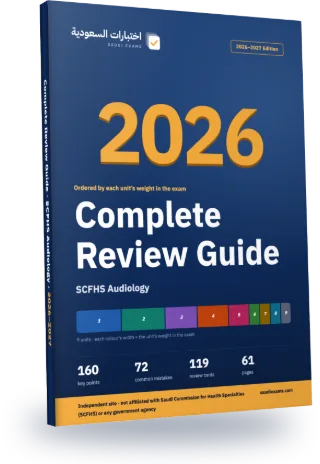
SCFHS Audiology Complete Review Guide 2026–2027
Every exam topic in a 61-page Arabic PDF, ordered from the heaviest unit to the lightest. The first three chapters alone cover about 55% of the exam questions.
- 61Pages
- 160Key points
- 72Common mistakes
- 119Flashcards
Guide map
Each chapter is one exam unit, ordered by its weight in the real exam.
| Chapter | Unit | Weight | Exam questions | Key points |
|---|---|---|---|---|
| 1 | Pediatrics | 20% | 30 | 20 |
| 2 | Adults and Geriatrics | 20% | 30 | 20 |
| 3 | Disorders and Syndromes | 15% | 23 | 20 |
| 4 | Hearing Aids and Implantable Hearing Devices | 15% | 23 | 18 |
| 5 | Counseling | 10% | 15 | 18 |
| 6 | Auditory Evoked Potentials | 5% | 8 | 16 |
| 7 | Documentation and Communication | 5% | 7 | 16 |
| 8 | Infection Control | 5% | 7 | 16 |
| 9 | Professionalism and Ethics | 5% | 7 | 16 |
Chapter 1 in full: Pediatrics
20% of the exam, about 30 questions. These are its key points, as in the guide.
- JCIH 2019 plan: screen by 1 month, diagnose by 3 months, start early intervention by 6 months. Screening should ideally be finished before hospital discharge; home-born infants are screened by 1 month.
- OAEs reflect outer hair cell function (the cochlear amplifier). They are usually absent when loss exceeds 30 to 40 dB HL, and middle-ear effusion reduces or abolishes them.
- TEOAEs are evoked by clicks; DPOAEs use two tones with an f2/f1 ratio of about 1.22, and the product usually measured is 2f1−f2. An OAE is taken as present at an SNR of about 6 dB across several bands.
The rest of chapter 1, on this page
- Automated ABR screening uses clicks at about 35 dB nHL with a pass/refer result; the non-inverting electrode sits on the high forehead, and quiet sleep is the best infant state.
- Common causes of a false refer on OAE are vernix or debris in the canal and high ambient noise, so screening after 24 hours of age in a quiet room is preferred.
- Protocol: inpatient refer, then rescreen of both ears before 1 month, then diagnostic evaluation if either ear still refers. An infant readmitted with hyperbilirubinaemia needing exchange transfusion gets an ABR rescreen before discharge.
- More risk indicators: in-utero infections such as rubella and other TORCH agents, prolonged aminoglycoside therapy, temporal-bone fracture, platinum chemotherapy, and craniofacial anomalies.
- A child with a risk indicator who passed screening needs at least one diagnostic assessment timed by the risk (by 9 months for many). Bacterial meningitis needs prompt evaluation because of the risk of cochlear ossification.
- Consanguineous marriage, common in Saudi Arabia, raises the risk of autosomal recessive hearing loss; a family history of permanent childhood hearing loss is a risk indicator needing follow-up.
- Programme quality: a low inpatient refer rate (below about 4%) is a good sign. Loss to follow-up is the main challenge; data tracking and explaining the result and next step to parents reduce it.
- BOA responses are unconditioned and variable, so they are called minimal response levels, not thresholds. A startle (Moro) response usually needs 65 to 80 dB or louder.
- VRA relies on a head turn that matures at about 5 to 6 months. The speaker sits at 90°, the toy or video lights up only after a correct response, no-signal control trials catch false positives, and one low and one high frequency (500 and 2000 Hz) are tested first.
- Conditioned play audiometry (2.5 to 5 years): the child does a play task such as dropping a block on hearing the sound. For children with developmental delay choose by developmental age, and for preterm infants by corrected age.
- Normal hearing in children is often defined as thresholds of 15 dB HL or better; minimal loss (16 to 25 dB HL) or unilateral loss can affect school performance.
- Cross-check principle (Jerger and Hayes): behavioural results are confirmed by independent tests such as tympanometry, OAE and ABR. Example: absent OAEs, normal tympanograms and 50 dB thresholds point to sensorineural loss.
- The speech awareness threshold is the lowest level at which speech is detected, not recognised, and is about 5 to 10 dB better than the SRT. Picture tests such as WIPI and ESP are closed-set; the Ling Six Sounds (/m, oo, ah, ee, sh, s/) check speech-frequency access with devices.
- Otitis media with effusion is the most common cause of conductive loss in young children; watchful waiting is about 3 months in a child without risk factors, with ventilation tubes for persistent cases. It is more common in Down syndrome and cleft palate because of Eustachian-tube dysfunction.
- cCMV-related hearing loss can be late-onset or progressive and needs monitoring until about age 6; valganciclovir may be offered to newborns with symptomatic cCMV within the first month.
- Syndromes to link: Pendred (goitre with enlarged vestibular aqueduct, SLC26A4), Usher (retinitis pigmentosa), Jervell and Lange-Nielsen (long QT, so an ECG is needed). Enlarged vestibular aqueduct causes fluctuating, progressive loss, so head trauma should be avoided.
- Amplification: fitting before 6 months gives the best outcomes, using DSL v5 or NAL-NL2 with a measured RECD because small canals produce higher SPL. Unoccupied classroom noise should be 35 dBA with reverberation of 0.6 s or less (ANSI S12.60), and cochlear implants are labelled from 9 months.
Common mistakes in this chapter
- Passing an OAE screen does not rule out auditory neuropathy, because outer hair cells can work while the neural pathway is abnormal. That is why NICU infants are screened with AABR.
- A unilateral refer on rescreen still needs a full diagnostic evaluation, and the rescreen covers both ears. Repeating the screen until a pass appears is discouraged because it increases false negatives.
- Sound-field VRA reflects only the better ear. For ear-specific results, use insert earphones.
- A 226 Hz probe in an infant under 6 months can show a normal-looking peak despite effusion; the correct choice is a 1000 Hz probe.
- A flat Type B tympanogram has three readings by ear-canal volume: normal volume means effusion, large volume means perforation or a patent tube, small volume means wax or the probe against the canal wall.
- A newborn pass does not guarantee normal hearing later: late-onset or progressive loss (for example from cCMV) needs surveillance, and parental concern about hearing or speech calls for prompt assessment.
- Congenital CMV must be tested within 21 days of birth. After that, congenital and postnatally acquired infection cannot be told apart.
- In auditory neuropathy, ABR thresholds do not predict hearing, so hearing aids are fitted to behavioural thresholds; a cochlear implant may help if aided speech perception stays poor.
The other chapters are in the full guide
One purchase · lifetime access · review guide included
7-day review plan
The chapters are spread over 6 days by weight so each day carries a similar load. Day 7 is a full exam.
Day 1 · 20% of the exam
Chapter 1: Pediatrics
Day 2 · 20% of the exam
Chapter 2: Adults and Geriatrics
Day 3 · 15% of the exam
Chapter 3: Disorders and Syndromes
Day 4 · 15% of the exam
Chapter 4: Hearing Aids and Implantable Hearing Devices
Day 5 · 15% of the exam
Chapter 5: Counseling
Chapter 8: Infection ControlDay 6 · 15% of the exam
Chapter 6: Auditory Evoked Potentials
Chapter 7: Documentation and Communication
Chapter 9: Professionalism and EthicsDay 7
Full mock exam: 150 questions in 180 minutes, then review the common mistakes in the units where you lost marks.
How many correct answers do you need?
- Pass mark 60%90 correct out of 150
Before you read: see your score today
10 free questions from the main units, no sign-up. Then you know which chapter to start with.
Try 10 free questions and see your levelA look at each chapter
The first three key points of each chapter, as they appear in the guide (in Arabic in the PDF).
Chapter 1: Pediatrics
- JCIH 2019 plan
- OAEs reflect outer hair cell function (the cochlear amplifier). They are usually absent when…
- TEOAEs are evoked by clicks; DPOAEs use two tones with an f2/f1 ratio of…
Chapter 2: Adults and Geriatrics
- Clark scale
- Air conduction starts at 1000 Hz, goes up, retests 1000 Hz (agreement ±5 dB)…
- Bone conduction is measured from 250 to 4000 Hz with the oscillator on the…
Chapter 3: Disorders and Syndromes
- Otosclerosis most often fixes the stapes footplate at the oval window (fenestral), causing progressive…
- Features of otosclerosis include better hearing in noise (paracusis Willisii) and the Schwartze sign…
- Cholesteatoma is keratinising squamous epithelium in the middle ear that erodes bone; signs are…
Chapter 4: Hearing Aids and Implantable Hearing Devices
- Real-ear measurement (REM) is the recommended way to verify hearing-aid output; the probe-tube tip…
- NAL-NL2 is a prescriptive formula that aims to maximise speech intelligibility at normal loudness;…
- REM terms
Chapter 5: Counseling
- Informational counselling is content-focused (explaining results and options); adjustment counselling addresses emotions such as…
- Parents told their baby is deaf often experience grief and retain little; give information…
- When delivering a diagnosis, pause and let the family respond, use the SPIKES protocol…
Chapter 6: Auditory Evoked Potentials
- Wave I arises from the distal auditory nerve near the cochlea, wave III from…
- Adult wave V latency is about 5.5 to 6.0 ms at 80 dB nHL…
- Retrocochlear signs
Chapter 7: Documentation and Communication
- An audiology report must include results, interpretation and recommendations and be written so the…
- Busy referrers prefer a brief summary and recommendations up front; good reports go beyond…
- The case history records onset, symptoms and risk factors because it guides testing; the…
Chapter 8: Infection Control
- Spaulding classification
- Cleaning must precede disinfection because debris inactivates disinfectants; sterilisation kills all microbes including bacterial…
- Hand hygiene is the single most important measure; alcohol rub is not adequate when…
Chapter 9: Professionalism and Ethics
- Audiology practice in Saudi Arabia requires registration and professional classification with SCFHS, and CPD…
- Scope of practice
- Evidence-based practice integrates research evidence with clinical expertise and patient values; telepractice must meet…
The full guide comes with lifetime access
The full guide (61 pages) is included with lifetime access to this exam, together with every question and full mock exam. Chapter 1 is free for everyone.
Questions about the guide
Is the guide free?
Chapter 1 is free to read on the guide page. The full guide comes with lifetime access to this exam; 7-day access does not include it.
Is it up to date for 2026–2027?
Yes. Unit weights and exam facts follow what the exam body last published, and the last check date is printed in the guide. If the standards change we update the file and buyers download the new version.
Does the guide have questions?
No. The guide covers key points and common mistakes; scoring, weak-area practice and full mock exams are on the site.
Can I read it on my phone?
Yes. A5 pages in a single column, with chapters linked from the contents.
- Pages
- 61
- Edition
- 1448 AH · 2026–2027
- Language
- Arabic
- Last updated
Buy this exam
Pick the access that lasts until your test date.
Included
- Full mock exams: 150 questions in 180 minutes, with a score for every unit
- 756 questions, every option explained with its source
- Practice that starts with your weakest units, plus a review of your mistakes
- Complete Review Guide 2026–2027 (PDF), with lifetime access only
Continue with your Google account and you go straight to the payment page.
You pay on the Waffo Pancake checkout page (in English). The amount is in US dollars and your bank converts it to riyals. One payment with no automatic renewal, by Visa, Mastercard (a mada card with either logo works too), Apple Pay or Google Pay. Your statement shows "WAFFO". Purchases are not refundable.