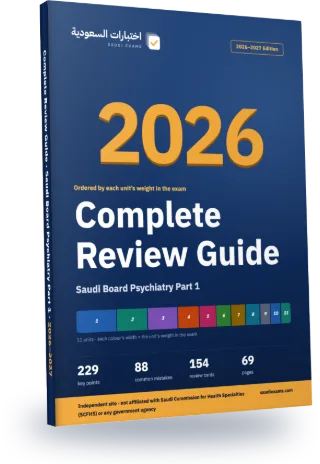
Saudi Board Psychiatry Part 1 Complete Review Guide 2026–2027
Every exam topic in a 69-page Arabic PDF, ordered from the heaviest unit to the lightest. The first three chapters alone cover about 46% of the exam questions.
- 69Pages
- 229Key points
- 88Common mistakes
- 154Flashcards
Guide map
Each chapter is one exam unit, ordered by its weight in the real exam.
| Chapter | Unit | Weight | Exam questions | Key points |
|---|---|---|---|---|
| 1 | Basic Sciences / Essential Topics in Psychiatry | 18% | 27 | 24 |
| 2 | Therapeutic Interventions | 14% | 21 | 24 |
| 3 | Patient Evaluation / Descriptive Psychopathology | 14% | 21 | 22 |
| 4 | Substance-related and Addictive Disorders | 10% | 15 | 22 |
| 5 | Psychosomatic Medicine (C-L Psychiatry) / Geriatric Psychiatry | 8% | 12 | 21 |
| 6 | Schizophrenia Spectrum & other Psychotic Disorders | 7% | 11 | 20 |
| 7 | Depressive Disorders / Bipolar & related Disorders | 7% | 11 | 24 |
| 8 | Anxiety / OCD-related / Impulse-Control and Conduct Disorders | 7% | 11 | 21 |
| 9 | Personality / Trauma and Stress-related / Dissociative Disorders | 5% | 7 | 17 |
| 10 | Emergency Psychiatry | 5% | 7 | 17 |
| 11 | Feeding & Eating Disorders | 5% | 7 | 17 |
Chapter 1 in full: Basic Sciences / Essential Topics in Psychiatry
18% of the exam, about 27 questions. These are its key points, as in the guide.
- The amygdala drives fear conditioning. Bilateral anterior temporal (amygdala) damage causes Kluver-Bucy syndrome: hyperorality, hypersexuality and placidity.
- Bilateral medial temporal (hippocampal) damage causes anterograde amnesia, as in patient H.M.
- Orbitofrontal damage causes disinhibition, poor judgement and personality change (Phineas Gage). The dorsolateral prefrontal cortex serves working memory and executive function.
The rest of chapter 1, on this page
- GABA is the main inhibitory brain transmitter (glycine in the spinal cord). Benzodiazepines bind an allosteric GABA-A site and increase chloride channel opening frequency.
- Serotonin is made from tryptophan via 5-HTP. Dopamine is made from tyrosine, and tyrosine hydroxylase is the rate-limiting enzyme.
- NMDA receptor hypofunction underlies the glutamate hypothesis of schizophrenia, since ketamine and PCP produce positive and negative symptoms.
- Depression shows HPA axis hyperactivity, dexamethasone non-suppression and reduced REM latency. PTSD shows low or normal basal cortisol with enhanced negative feedback.
- Orexin (hypocretin) from the lateral hypothalamus promotes wakefulness. Its loss causes narcolepsy type 1.
- Alpha rhythm (8-13 Hz) dominates relaxed wakefulness with eyes closed. Sleep spindles and K-complexes mark stage N2, about 50% of sleep.
- A variable ratio schedule produces behaviour most resistant to extinction, as in gambling.
- Piaget: sensorimotor, preoperational, concrete operational (7-11 years, when conservation appears), then formal operational.
- Erikson's adolescent stage is identity vs role confusion. Mahler's rapprochement is at about 16-24 months. Stranger anxiety appears at about 7-9 months.
- Disorganised attachment is linked to frightening or abusive caregiving. An avoidant infant ignores the caregiver on reunion.
- Mature defences (Vaillant): humour, altruism, sublimation and suppression. Projection is immature. Undoing, isolation of affect and reaction formation are typical of OCD.
- Authors: Kohut (self psychology), Winnicott (good-enough mother, transitional object), Seligman (learned helplessness), Festinger (cognitive dissonance), Engel (biopsychosocial model), Parsons (sick role).
- High expressed emotion in the family (critical comments, hostility, emotional over-involvement) increases relapse in schizophrenia.
- Lifetime schizophrenia risk is about 0.3-0.7% in the population and about 40-50% in a monozygotic co-twin. Bipolar I heritability is about 60-85%.
- 22q11.2 deletion carries about 25% psychosis risk. APOE ε4 is the strongest genetic risk for late-onset Alzheimer disease. Huntington disease is autosomal dominant CAG expansion with anticipation.
- Down syndrome is the most common chromosomal cause of intellectual disability. Fragile X (CGG expansion in FMR1) is the most common inherited cause.
- Case-control studies suit rare outcomes and report odds ratios. Cross-sectional studies measure prevalence and cannot show temporality.
- A type I error rejects a true null hypothesis (false positive, α). NNT = 1 / absolute risk reduction, so an ARR of 0.2 gives NNT 5.
- Cohen's kappa measures inter-rater agreement corrected for chance. Validity means measuring what is intended. Reliability means consistency.
- DSM-5-TR added prolonged grief disorder (at least 12 months after the loss in adults). ICD-11 added complex PTSD and grades personality disorder by severity.
- M'Naghten: not knowing the nature or wrongfulness of the act. Fitness to stand trial: understanding proceedings and assisting counsel (Dusky). Testamentary capacity: knowing the will, the property and the heirs (Banks v Goodfellow).
Common mistakes in this chapter
- Negative reinforcement is often confused with punishment. Negative reinforcement increases a behaviour by removing an aversive stimulus. Punishment decreases a behaviour.
- Serotonin is wrongly placed in the locus coeruleus. The locus coeruleus makes noradrenaline. Serotonin comes from the raphe nuclei.
- High sensitivity is thought to confirm disease. A highly sensitive test rules disease out when negative (SnNout). A highly specific test rules it in when positive (SpPin).
- PPV is assumed to be fixed. It rises as prevalence rises, even when sensitivity and specificity stay the same.
- Agreeing with the doctor is treated as part of capacity. A patient with capacity may refuse treatment, even if the choice seems unwise.
- Malingering is confused with factitious disorder. Malingering is driven by an external incentive. Factitious disorder is driven by the wish for the sick role.
- Schizophrenia is assumed to be the main driver of community violence. Substance use disorders carry the strongest association, and past violence is the best single predictor.
- The expert witness is taken to be the patient's advocate. The primary duty is to the court, with objectivity.
The other chapters are in the full guide
One purchase · lifetime access · review guide included
7-day review plan
The chapters are spread over 6 days by weight so each day carries a similar load. Day 7 is a full exam.
Day 1 · 18% of the exam
Chapter 1: Basic Sciences / Essential Topics in Psychiatry
Day 2 · 19% of the exam
Chapter 2: Therapeutic Interventions
Chapter 10: Emergency PsychiatryDay 3 · 19% of the exam
Chapter 3: Patient Evaluation / Descriptive Psychopathology
Chapter 11: Feeding & Eating DisordersDay 4 · 15% of the exam
Chapter 4: Substance-related and Addictive Disorders
Chapter 9: Personality / Trauma and Stress-related / Dissociative DisordersDay 5 · 15% of the exam
Chapter 5: Psychosomatic Medicine (C-L Psychiatry) / Geriatric Psychiatry
Chapter 8: Anxiety / OCD-related / Impulse-Control and Conduct DisordersDay 6 · 14% of the exam
Chapter 6: Schizophrenia Spectrum & other Psychotic Disorders
Chapter 7: Depressive Disorders / Bipolar & related Disorders
How many correct answers do you need?
- Pass mark 65%98 correct out of 150
Before you read: see your score today
10 free questions from the main units, no sign-up. Then you know which chapter to start with.
Try 10 free questions and see your levelA look at each chapter
The first three key points of each chapter, as they appear in the guide (in Arabic in the PDF).
Chapter 1: Basic Sciences / Essential Topics in Psychiatry
- The amygdala drives fear conditioning. Bilateral anterior temporal (amygdala) damage causes Kluver-Bucy syndrome: hyperorality…
- Bilateral medial temporal (hippocampal) damage causes anterograde amnesia, as in patient H.M.
- Orbitofrontal damage causes disinhibition, poor judgement and personality change (Phineas Gage). The dorsolateral prefrontal…
Chapter 2: Therapeutic Interventions
- Fluoxetine has the longest half-life among SSRIs because of norfluoxetine (about 1-2 weeks), so…
- Citalopram prolongs QTc in a dose-dependent way. The maximum dose over age 65 is…
- Serotonin syndrome
Chapter 3: Patient Evaluation / Descriptive Psychopathology
- A hallucination is perception without an external stimulus. Hypnagogic hallucinations at sleep onset are…
- Reflex hallucination
- Pseudohallucinations
Chapter 4: Substance-related and Addictive Disorders
- Alcohol withdrawal
- First-line alcohol withdrawal drug
- Wernicke triad
Chapter 5: Psychosomatic Medicine (C-L Psychiatry) / Geriatric Psychiatry
- Delirium
- Alzheimer disease is the most common dementia (about 60-70%). APOE ε4 is the strongest…
- Lewy body dementia
Chapter 6: Schizophrenia Spectrum & other Psychotic Disorders
- Schneider's first-rank symptoms include thought broadcasting, insertion and withdrawal, running commentary or discussing voices…
- Negative symptoms
- Good prognosis
Chapter 7: Depressive Disorders / Bipolar & related Disorders
- Major depressive episode
- Persistent depressive disorder
- Melancholic features
Chapter 8: Anxiety / OCD-related / Impulse-Control and Conduct Disorders
- GAD
- First-line drug in GAD (NICE)
- Panic disorder
Chapter 9: Personality / Trauma and Stress-related / Dissociative Disorders
- Cluster A
- Borderline
- DBT (Linehan) has the best evidence for borderline personality disorder: individual therapy, skills group…
Chapter 10: Emergency Psychiatry
- Suicide risk factors
- Suicide risk is highest in the first week to month after psychiatric discharge, so…
- Protective factors
Chapter 11: Feeding & Eating Disorders
- Anorexia nervosa
- First-line for adolescent anorexia
- Anorexia has the highest mortality of psychiatric disorders (SMR about 5-6). Complications: bradycardia, QTc…
The full guide comes with lifetime access
The full guide (69 pages) is included with lifetime access to this exam, together with every question and full mock exam. Chapter 1 is free for everyone.
Questions about the guide
Is the guide free?
Chapter 1 is free to read on the guide page. The full guide comes with lifetime access to this exam; 7-day access does not include it.
Is it up to date for 2026–2027?
Yes. Unit weights and exam facts follow what the exam body last published, and the last check date is printed in the guide. If the standards change we update the file and buyers download the new version.
Does the guide have questions?
No. The guide covers key points and common mistakes; scoring, weak-area practice and full mock exams are on the site.
Can I read it on my phone?
Yes. A5 pages in a single column, with chapters linked from the contents.
- Pages
- 69
- Edition
- 1448 AH · 2026–2027
- Language
- Arabic
- Last updated
Buy this exam
Pick the access that lasts until your test date.
Included
- Timed supplementary practice sessions: 150 questions in 90 minutes
- 756 questions, every option explained with its source
- Practice that starts with your weakest units, plus a review of your mistakes
- Complete Review Guide 2026–2027 (PDF), with lifetime access only
Continue with your Google account and you go straight to the payment page.
You pay on the Waffo Pancake checkout page (in English). The amount is in US dollars and your bank converts it to riyals. One payment with no automatic renewal, by Visa, Mastercard (a mada card with either logo works too), Apple Pay or Google Pay. Your statement shows "WAFFO". Purchases are not refundable.