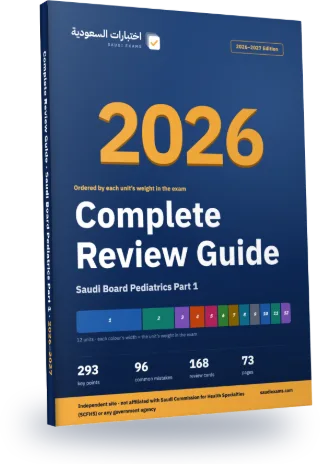
Saudi Board Pediatrics Part 1 Complete Review Guide 2026–2027
Every exam topic in a 73-page Arabic PDF, ordered from the heaviest unit to the lightest. The first three chapters alone cover about 52% of the exam questions.
- 73Pages
- 293Key points
- 96Common mistakes
- 168Flashcards
Guide map
Each chapter is one exam unit, ordered by its weight in the real exam.
| Chapter | Unit | Weight | Exam questions | Key points |
|---|---|---|---|---|
| 1 | General Paediatrics / Growth & Development | 30% | 45 | 24 |
| 2 | Acute Care (PICU/ED/NICU) | 15% | 23 | 24 |
| 3 | Adolescent and Behavioural / Ambulatory | 7% | 11 | 24 |
| 4 | Endocrinology / Genetics & Metabolic | 7% | 10 | 27 |
| 5 | Gastroenterology / Nutrition | 6% | 9 | 25 |
| 6 | Cardiology | 5% | 8 | 20 |
| 7 | Neurology | 5% | 8 | 22 |
| 8 | Pulmonary / Allergy & Immunology | 5% | 8 | 24 |
| 9 | Nephrology / Rheumatology / Dermatology | 5% | 7 | 23 |
| 10 | Infectious Diseases / Preventive Medicine / Immunization | 5% | 7 | 25 |
| 11 | Hematology & Oncology | 5% | 7 | 27 |
| 12 | Pediatric Surgery / Ophthalmology / ENT | 5% | 7 | 28 |
Chapter 1 in full: General Paediatrics / Growth & Development
30% of the exam, about 45 questions. These are its key points, as in the guide.
- Mid-parental height: boys = (father + mother + 13 cm) ÷ 2; girls = (father + mother − 13 cm) ÷ 2.
- Normal growth velocity from about 4 years to puberty is roughly 5–6 cm per year. Slower growth with falling centiles needs investigation.
- Bone age is assessed on a left hand–wrist radiograph compared with the Greulich and Pyle atlas.
The rest of chapter 1, on this page
- Unexplained short stature in a girl needs a karyotype for Turner syndrome; at diagnosis, image the heart for coarctation and bicuspid aortic valve.
- Screen for GH deficiency with IGF-1 and IGFBP-3; confirm with GH stimulation testing.
- GH therapy complications include slipped capital femoral epiphysis and idiopathic intracranial hypertension.
- Precocious puberty: basal ultrasensitive LH separates central from peripheral. Central precocious puberty in boys always needs brain MRI. Treat with a long-acting GnRH agonist.
- In undernutrition, weight falls first, then length, while head circumference is spared.
- Social smile by 6–8 weeks; stranger anxiety around 9 months; independent walking is normal up to about 18 months.
- At 12 months: first steps, neat pincer grasp, one word plus specific mama/dada. At 24 months: two-word phrases and two-step commands.
- Strangers understand about 75% of speech at 3 years and nearly all at 4. At 4 years a child hops on one foot and copies a cross.
- Hand preference before 12 months is a red flag, often meaning hemiplegic cerebral palsy.
- DQ = developmental age ÷ chronological age × 100; below 70 is significant delay. Loss of acquired skills argues against cerebral palsy.
- Refer a delayed child to early intervention now; do not wait for genetic results.
- AAP recommends a standardised developmental screen at 9, 18 and 30 months, and autism screening at 18 and 24 months.
- Hearing 1-3-6 goal: screen by 1 month, diagnose by 3 months, intervene by 6 months.
- Breastfed infants need vitamin D 400 IU daily from the first days, and iron 1 mg/kg/day from 4 months until iron-rich foods are established.
- Cow's milk protein allergy: extensively hydrolysed formula first; amino acid formula for severe cases. If breastfed, the mother avoids dairy.
- WHO severe acute malnutrition: MUAC <115 mm, weight-for-height <−3 SD or bilateral oedema. Stabilise with F-75 and advance slowly to avoid refeeding syndrome.
- Holliday–Segar daily: 100 mL/kg for the first 10 kg, 50 mL/kg for the next 10 kg, 20 mL/kg for each kg above 20.
- Mild to moderate dehydration: ORS 50–100 mL/kg over 4 hours; one dose of ondansetron if vomiting. Zinc 20 mg daily for 10–14 days (10 mg under 6 months).
- Hyponatraemic seizure: 3% saline 2 mL/kg (max 100 mL) over 10 minutes, repeated if needed.
- Hyperkalaemia with ECG changes: IV calcium gluconate first, then insulin–dextrose and salbutamol to shift potassium; dialysis removes it.
- Suspected abuse under 2 years needs a full skeletal survey; under 6 months also needs neuroimaging even if neurologically normal, plus a dilated retinal exam.
Common mistakes in this chapter
- Low IGF-1 is often read as GH deficiency, but it also falls in malnutrition and hypothyroidism, so it is not diagnostic alone.
- Obesity with short stature is often called simple obesity. Dietary obesity usually comes with tall stature; falling height points to an endocrine cause.
- Starting thyroxine before hydrocortisone in hypopituitarism is wrong; it can trigger adrenal crisis. Replace cortisol first.
- Judging a preterm infant by chronological age shows false delay. Use corrected age until about 2 years.
- Isolated speech delay with good social communication is sometimes sent for autism work-up first. Formal hearing assessment comes first.
- Fast correction of hypernatraemia with hypotonic fluid causes cerebral oedema. Lower sodium by no more than 10–12 mmol/L per 24 hours.
- A normal anogenital exam is often taken to exclude sexual abuse. Over 90% of abused children have normal findings; the disclosure is the key evidence.
- Pyloric stenosis is treated as an immediate surgical emergency. Correct dehydration, alkalosis, chloride and potassium before surgery.
The other chapters are in the full guide
One purchase · lifetime access · review guide included
7-day review plan
The chapters are spread over 6 days by weight so each day carries a similar load. Day 7 is a full exam.
Day 1 · 30% of the exam
Chapter 1: General Paediatrics / Growth & Development
Day 2 · 15% of the exam
Chapter 2: Acute Care (PICU/ED/NICU)
Day 3 · 12% of the exam
Chapter 3: Adolescent and Behavioural / Ambulatory
Chapter 9: Nephrology / Rheumatology / DermatologyDay 4 · 12% of the exam
Chapter 4: Endocrinology / Genetics & Metabolic
Chapter 10: Infectious Diseases / Preventive Medicine / ImmunizationDay 5 · 16% of the exam
Chapter 5: Gastroenterology / Nutrition
Chapter 8: Pulmonary / Allergy & Immunology
Chapter 12: Pediatric Surgery / Ophthalmology / ENTDay 6 · 15% of the exam
Chapter 6: Cardiology
Chapter 7: Neurology
Chapter 11: Hematology & Oncology
How many correct answers do you need?
- Pass mark 65%98 correct out of 150
Before you read: see your score today
10 free questions from the main units, no sign-up. Then you know which chapter to start with.
Try 10 free questions and see your levelA look at each chapter
The first three key points of each chapter, as they appear in the guide (in Arabic in the PDF).
Chapter 1: General Paediatrics / Growth & Development
- Mid-parental height
- Normal growth velocity from about 4 years to puberty is roughly 5–6 cm per…
- Bone age is assessed on a left hand–wrist radiograph compared with the Greulich and…
Chapter 2: Acute Care (PICU/ED/NICU)
- Pediatric Assessment Triangle
- Systolic hypotension at 1–10 years is below 70 + (2 × age in years)…
- Compressions at 100–120/min, one-third chest depth (about 4 cm infant, 5 cm child); 15:2…
Chapter 3: Adolescent and Behavioural / Ambulatory
- First sign of puberty
- Delayed puberty
- Hypogonadotropic hypogonadism with anosmia is Kallmann syndrome.
Chapter 4: Endocrinology / Genetics & Metabolic
- Diabetes diagnosis
- Severe DKA
- DKA fluids
Chapter 5: Gastroenterology / Nutrition
- Rotavirus is the leading cause of severe dehydrating diarrhoea in unvaccinated infants: vomiting, then…
- WHO persistent diarrhoea
- Shigella
Chapter 6: Cardiology
- VSD is the most common lesion
- Secundum ASD
- PDA
Chapter 7: Neurology
- Simple febrile seizure
- Febrile seizure recurrence rises with age under 18 months, family history, lower temperature at…
- Status epilepticus
Chapter 8: Pulmonary / Allergy & Immunology
- Bronchiolitis
- Give oxygen in bronchiolitis only if SpO2 falls below 90%.
- RSV prevention
Chapter 9: Nephrology / Rheumatology / Dermatology
- Typical nephrotic syndrome (1–10 years, normal BP, no haematuria): minimal change disease; prednisolone 60…
- Steroid resistance
- Nephrotic complications
Chapter 10: Infectious Diseases / Preventive Medicine / Immunization
- True contraindication to any vaccine
- Steroids ≥2 mg/kg/day or ≥20 mg/day for ≥14 days
- Live injectable vaccines (MMR, varicella) not given the same day are separated by at…
Chapter 11: Hematology & Oncology
- Physiological anaemia in term infants
- Mentzer index = MCV ÷ RBC; below 13 favours thalassaemia, above 13 favours iron…
- Beta-thalassaemia trait
Chapter 12: Pediatric Surgery / Ophthalmology / ENT
- Hypertrophic pyloric stenosis
- Pyloric stenosis is not a surgical emergency
- Malrotation with volvulus
The full guide comes with lifetime access
The full guide (73 pages) is included with lifetime access to this exam, together with every question and full mock exam. Chapter 1 is free for everyone.
Questions about the guide
Is the guide free?
Chapter 1 is free to read on the guide page. The full guide comes with lifetime access to this exam; 7-day access does not include it.
Is it up to date for 2026–2027?
Yes. Unit weights and exam facts follow what the exam body last published, and the last check date is printed in the guide. If the standards change we update the file and buyers download the new version.
Does the guide have questions?
No. The guide covers key points and common mistakes; scoring, weak-area practice and full mock exams are on the site.
Can I read it on my phone?
Yes. A5 pages in a single column, with chapters linked from the contents.
- Pages
- 73
- Edition
- 1448 AH · 2026–2027
- Language
- Arabic
- Last updated
Buy this exam
Pick the access that lasts until your test date.
Included
- Timed supplementary practice sessions: 150 questions in 90 minutes
- 751 questions, every option explained with its source
- Practice that starts with your weakest units, plus a review of your mistakes
- Complete Review Guide 2026–2027 (PDF), with lifetime access only
Continue with your Google account and you go straight to the payment page.
You pay on the Waffo Pancake checkout page (in English). The amount is in US dollars and your bank converts it to riyals. One payment with no automatic renewal, by Visa, Mastercard (a mada card with either logo works too), Apple Pay or Google Pay. Your statement shows "WAFFO". Purchases are not refundable.