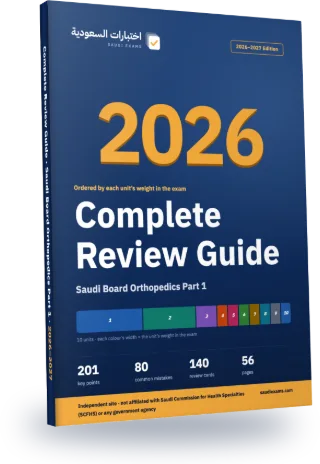
Saudi Board Orthopedics Part 1 Complete Review Guide 2026–2027
Every exam topic in a 56-page Arabic PDF, ordered from the heaviest unit to the lightest. The first three chapters alone cover about 65% of the exam questions.
- 56Pages
- 201Key points
- 80Common mistakes
- 140Flashcards
Guide map
Each chapter is one exam unit, ordered by its weight in the real exam.
| Chapter | Unit | Weight | Exam questions | Key points |
|---|---|---|---|---|
| 1 | Principle of Surgery | 30% | 45 | 24 |
| 2 | Trauma | 25% | 38 | 24 |
| 3 | Pediatric | 10% | 15 | 20 |
| 4 | Arthroplasty | 5% | 8 | 20 |
| 5 | Sport Medicine | 5% | 8 | 18 |
| 6 | Upper Limb | 5% | 8 | 18 |
| 7 | Oncology | 5% | 7 | 18 |
| 8 | Foot and Ankle | 5% | 7 | 18 |
| 9 | Spine | 5% | 7 | 21 |
| 10 | Other MSK Disorders | 5% | 7 | 20 |
Chapter 1 in full: Principle of Surgery
30% of the exam, about 45 questions. These are its key points, as in the guide.
- Adult daily water need is 25 to 30 mL/kg and potassium about 1 mmol/kg (NICE).
- Maximum peripheral IV potassium rate on a general ward is 10 mmol/h.
- Large volumes of 0.9% saline cause hyperchloraemic metabolic acidosis; prefer balanced crystalloids.
The rest of chapter 1, on this page
- Pyloric obstruction with vomiting causes hypochloraemic hypokalaemic metabolic alkalosis.
- Refeeding syndrome: hypophosphataemia is the hallmark; start at 10 kcal/kg/day or less with thiamine.
- Anion gap is Na minus (Cl plus HCO3), normally 8 to 12; lactic acidosis is a common cause of a high gap.
- Cardiogenic shock: low output, high wedge pressure and high SVR (cold and wet).
- Septic shock: noradrenaline is the first-line vasopressor; vasopressors needed for MAP 65 or more with lactate over 2 despite fluids.
- Lung-protective ventilation: tidal volume 6 mL/kg predicted body weight with plateau pressure under 30.
- Berlin criteria: moderate ARDS at PaO2/FiO2 100 to 200 with PEEP of 5 or more.
- Necrotising fasciitis: urgent radical debridement with broad antibiotics; LRINEC 6 or more is suspicious.
- Steam sterilisation: 134 °C for about 3 minutes, or 121 °C for 15 minutes.
- Healing phases: haemostasis, inflammation, proliferation, remodelling; maximum tensile strength is about 80% of normal skin.
- A keloid extends beyond the original wound margin, unlike a hypertrophic scar.
- Restrictive transfusion threshold: Hb 70 g/L (target 70 to 90), and 80 in acute coronary syndrome.
- TACO is the commonest cause of transfusion mortality; TRALI is non-cardiogenic pulmonary oedema within 6 hours.
- Acute haemolytic reaction: stop the transfusion at once, keep IV access, check patient and unit identity.
- Warfarin reversal in life-threatening bleeding: PCC plus IV vitamin K; dabigatran: idarucizumab; heparin: protamine.
- Stop apixaban 48 hours before high-bleed-risk surgery with normal renal function.
- HIT occurs 5 to 10 days after starting heparin: stop all heparin and start a non-heparin agent such as argatroban.
- ATLS: tension pneumothorax is treated by needle decompression at the 4th or 5th intercostal space anterior to the midaxillary line, then a chest drain.
- Beck triad of tamponade: hypotension, raised JVP and muffled heart sounds.
- Parkland formula for burns: 4 mL × kg × %TBSA, half in the first 8 hours from time of burn.
- Urine output target in adult trauma resuscitation is 0.5 mL/kg/h, and 1 in children.
Common mistakes in this chapter
- Hyperkalaemia with ECG changes gets insulin and glucose first. IV calcium gluconate comes first to stabilise the membrane.
- Chronic hyponatraemia is corrected quickly. Keep it to 8 to 10 mmol/L per 24 h to avoid osmotic demyelination.
- Day 1 to 2 postoperative fever is blamed on pneumonia or infection. It is usually the benign inflammatory response to surgery.
- Prophylactic antibiotics are extended after surgery. In clean surgery do not extend beyond the end of the operation (WHO).
- Hair is shaved with a razor before surgery. Avoid removal or clip only; razors raise SSI.
- Bridging anticoagulation is given for AF without a mechanical valve. It is generally unnecessary and increases bleeding.
- DAPT is stopped early after a recent drug-eluting stent for elective surgery. Defer surgery; do not stop DAPT prematurely.
- Metronidazole is first-line for non-severe C. difficile. Oral vancomycin or fidaxomicin is now first-line.
The other chapters are in the full guide
One purchase · lifetime access · review guide included
7-day review plan
The chapters are spread over 6 days by weight so each day carries a similar load. Day 7 is a full exam.
Day 1 · 30% of the exam
Chapter 1: Principle of Surgery
Day 2 · 25% of the exam
Chapter 2: Trauma
Day 3 · 15% of the exam
Chapter 3: Pediatric
Chapter 10: Other MSK DisordersDay 4 · 10% of the exam
Chapter 4: Arthroplasty
Chapter 7: OncologyDay 5 · 10% of the exam
Chapter 5: Sport Medicine
Chapter 8: Foot and AnkleDay 6 · 10% of the exam
Chapter 6: Upper Limb
Chapter 9: Spine
How many correct answers do you need?
- Pass mark 65%98 correct out of 150
Before you read: see your score today
10 free questions from the main units, no sign-up. Then you know which chapter to start with.
Try 10 free questions and see your levelA look at each chapter
The first three key points of each chapter, as they appear in the guide (in Arabic in the PDF).
Chapter 1: Principle of Surgery
- Adult daily water need is 25 to 30 mL/kg and potassium about 1 mmol/kg…
- Maximum peripheral IV potassium rate on a general ward is 10 mmol/h.
- Large volumes of 0.9% saline cause hyperchloraemic metabolic acidosis; prefer balanced crystalloids.
Chapter 2: Trauma
- About 95% of shoulder dislocations are anterior. The axillary nerve is most often injured…
- Posterior shoulder dislocation follows seizures or electrocution. It shows the light-bulb sign on AP…
- Humeral shaft fractures are usually treated in a functional (Sarmiento) brace. Absolute surgical indications…
Chapter 3: Pediatric
- DDH risk factors
- Galeazzi sign in DDH
- DDH found at 2 years usually needs open reduction with femoral or pelvic osteotomy.
Chapter 4: Arthroplasty
- Active local or systemic infection is an absolute contraindication to elective joint replacement.
- Lewinnek safe zone for the acetabular cup
- Repairing the posterior capsule and short external rotators reduces dislocation after the posterior approach.
Chapter 5: Sport Medicine
- Segond fracture (lateral tibial rim avulsion) indicates ACL tear.
- ACL tear shows bone bruising of the lateral femoral condyle and posterolateral tibial plateau.
- ACL grafts
Chapter 6: Upper Limb
- Durkan carpal compression test is the most sensitive provocative test for carpal tunnel syndrome.
- A radially placed carpal tunnel incision puts the recurrent motor branch of the median…
- Cubital tunnel syndrome weakens the first dorsal interosseous (ulnar nerve).
Chapter 7: Oncology
- Osteochondroma is the commonest benign bone tumour and points away from the joint.
- A cartilage cap over 2 cm in an adult osteochondroma suggests chondrosarcoma.
- Enchondroma is commonest in the hand phalanges and often presents with fracture.
Chapter 8: Foot and Ankle
- Weber B is a fibular fracture at syndesmosis level; Weber C is above it…
- Weber B with medial clear space widening is unstable and needs ORIF (deltoid injury).
- Unstable bimalleolar fracture needs ORIF; close-contact casting is an option in the elderly.
Chapter 9: Spine
- Cauda equina
- L5 radiculopathy
- C6 radiculopathy
Chapter 10: Other MSK Disorders
- Osteoporosis
- FRAX estimates 10-year probability of major osteoporotic and hip fracture.
- Teriparatide is an anabolic PTH analogue limited to about 2 years.
The full guide comes with lifetime access
The full guide (56 pages) is included with lifetime access to this exam, together with every question and full mock exam. Chapter 1 is free for everyone.
Questions about the guide
Is the guide free?
Chapter 1 is free to read on the guide page. The full guide comes with lifetime access to this exam; 7-day access does not include it.
Is it up to date for 2026–2027?
Yes. Unit weights and exam facts follow what the exam body last published, and the last check date is printed in the guide. If the standards change we update the file and buyers download the new version.
Does the guide have questions?
No. The guide covers key points and common mistakes; scoring, weak-area practice and full mock exams are on the site.
Can I read it on my phone?
Yes. A5 pages in a single column, with chapters linked from the contents.
- Pages
- 56
- Edition
- 1448 AH · 2026–2027
- Language
- Arabic
- Last updated
All Health Exams review guides
Back to Saudi Board Part One Examination – Orthopedic Surgery
Buy this exam
Pick the access that lasts until your test date.
Included
- Timed supplementary practice sessions: 150 questions in 90 minutes
- 758 questions, every option explained with its source
- Practice that starts with your weakest units, plus a review of your mistakes
- Complete Review Guide 2026–2027 (PDF), with lifetime access only
Continue with your Google account and you go straight to the payment page.
You pay on the Waffo Pancake checkout page (in English). The amount is in US dollars and your bank converts it to riyals. One payment with no automatic renewal, by Visa, Mastercard (a mada card with either logo works too), Apple Pay or Google Pay. Your statement shows "WAFFO". Purchases are not refundable.