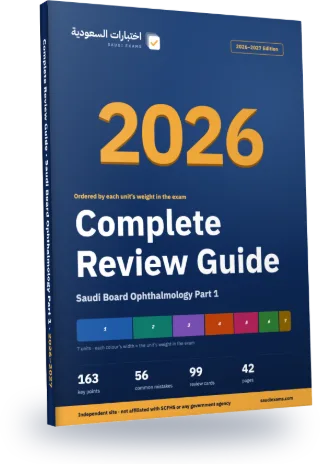
Saudi Board Ophthalmology Part 1 Complete Review Guide 2026–2027
Every exam topic in a 42-page Arabic PDF, ordered from the heaviest unit to the lightest. The first three chapters alone cover about 58% of the exam questions.
- 42Pages
- 163Key points
- 56Common mistakes
- 99Flashcards
Guide map
Each chapter is one exam unit, ordered by its weight in the real exam.
| Chapter | Unit | Weight | Exam questions | Key points |
|---|---|---|---|---|
| 1 | Anterior segment | 25% | 38 | 24 |
| 2 | Pediatric Ophthalmology | 18% | 27 | 24 |
| 3 | Oculoplastic | 15% | 22 | 24 |
| 4 | Retina | 14% | 21 | 24 |
| 5 | Glaucoma | 12% | 18 | 22 |
| 6 | Neuro-ophthalmology | 10% | 15 | 23 |
| 7 | Uveitis | 6% | 9 | 22 |
Chapter 1 in full: Anterior segment
25% of the exam, about 38 questions. These are its key points, as in the guide.
- Cataract is the leading cause of reversible blindness worldwide and in Saudi Arabia.
- Corticosteroids cause posterior subcapsular cataract; amiodarone causes anterior subcapsular deposits and vortex keratopathy.
- Polychromatic 'Christmas tree' crystals suggest myotonic dystrophy; an oil-droplet cataract in an infant suggests galactosemia.
The rest of chapter 1, on this page
- Superotemporal lens subluxation suggests Marfan; inferonasal suggests homocystinuria, with thromboembolism risk under anesthesia.
- Posterior capsule rupture with vitreous loss: perform anterior vitrectomy and clear vitreous from the wounds.
- Acute post-cataract endophthalmitis: coagulase-negative staphylococci are most common; treat with vitreous tap and intravitreal antibiotics.
- In the EVS, immediate vitrectomy benefited only eyes with light perception vision.
- Chronic delayed inflammation with a white capsular plaque months after surgery suggests Cutibacterium acnes.
- Pseudophakic CME (Irvine-Gass) peaks at 4-6 weeks and is treated first with topical NSAID plus steroid.
- Tamsulosin causes intraoperative floppy iris syndrome (IFIS).
- A 1 mm axial length error gives about 2.5-3 D of refractive error; a 1 D keratometry error gives about 1 D.
- Each degree of toric IOL rotation loses about 3.3% of cylinder correction; 30 degrees loses almost all of it.
- Intracameral cefuroxime at the end of surgery reduced endophthalmitis about fivefold (ESCRS study).
- Phacolytic glaucoma has an open angle with lens protein in the chamber; phacomorphic has a closed angle from a swollen lens. Both need cataract extraction.
- Contact lens keratitis: Pseudomonas is the classic organism; severe pain out of proportion with a ring infiltrate suggests Acanthamoeba.
- First-line Acanthamoeba treatment: topical biguanide (PHMB or chlorhexidine), with or without a diamidine.
- In HEDS, oral acyclovir 400 mg twice daily halved recurrences of ocular HSV.
- Hutchinson sign (vesicles on the nose tip) means nasociliary involvement and higher ocular risk in herpes zoster ophthalmicus.
- Lattice dystrophy has amyloid, granular has hyaline, and macular has glycosaminoglycans, is autosomal recessive and relatively common in Saudi Arabia.
- A Khodadoust line of keratic precipitates on the graft endothelium means endothelial rejection; treat with intensive topical steroids.
- Phenylephrine 10% blanches episcleral vessels but not the deep vessels of scleritis.
- Prentice's rule: prism (Δ) = decentration in cm × lens power in dioptres.
- Normal central corneal thickness is about 540 µm; corneal power is about 43 D and the lens about 20 D.
- Post-LASIK ectasia risk rises when residual stromal bed is below 250 µm or percent tissue altered exceeds 40%.
Common mistakes in this chapter
- Topical steroids are often chosen for active HSV dendritic epithelial keratitis. They worsen it; treat with antivirals.
- Voriconazole is often picked for filamentous fungal ulcers, but MUTT I showed natamycin is better, especially for Fusarium.
- In alkali burns, testing acuity or pH before irrigating is wrong. Irrigate immediately first.
- Nuclear and posterior subcapsular cataract are confused: 'second sight' for reading means nuclear; glare and poor near vision point to PSC.
- Patching bacterial keratitis is wrong, especially in contact lens wearers. Take cultures, then start intensive drops.
- Placing a single-piece acrylic IOL in the sulcus after capsule rupture causes UGH syndrome. Use a three-piece IOL.
- Working distance is often applied the wrong way in retinoscopy. At 67 cm, subtract 1.50 D from the neutralizing lens.
- Standard keratometry formulas after myopic LASIK overestimate corneal power and cause a hyperopic surprise. Use post-refractive formulas.
The other chapters are in the full guide
One purchase · lifetime access · review guide included
7-day review plan
The chapters are spread over 6 days by weight so each day carries a similar load. Day 7 is a full exam.
Day 1 · 25% of the exam
Chapter 1: Anterior segment
Day 2 · 18% of the exam
Chapter 2: Pediatric Ophthalmology
Day 3 · 15% of the exam
Chapter 3: Oculoplastic
Day 4 · 14% of the exam
Chapter 4: Retina
Day 5 · 12% of the exam
Chapter 5: Glaucoma
Day 6 · 16% of the exam
Chapter 6: Neuro-ophthalmology
Chapter 7: Uveitis
Before you read: see your score today
10 free questions from the main units, no sign-up. Then you know which chapter to start with.
Try 10 free questions and see your levelA look at each chapter
The first three key points of each chapter, as they appear in the guide (in Arabic in the PDF).
Chapter 1: Anterior segment
- Cataract is the leading cause of reversible blindness worldwide and in Saudi Arabia.
- Corticosteroids cause posterior subcapsular cataract; amiodarone causes anterior subcapsular deposits and vortex keratopathy.
- Polychromatic 'Christmas tree' crystals suggest myotonic dystrophy; an oil-droplet cataract in an infant suggests…
Chapter 2: Pediatric Ophthalmology
- Young age at treatment start matters most in amblyopia, but children aged 7-12 can…
- PEDIG
- Atropine 1% in the better eye, even on weekends only, works for moderate amblyopia.
Chapter 3: Oculoplastic
- Aponeurotic ptosis in older adults
- Poor levator function (under 4 mm) needs a frontalis sling; its main risk is…
- Normal MRD1 is 4-5 mm; 1 mm indicates moderate ptosis.
Chapter 4: Retina
- Microaneurysms are the earliest clinical sign of diabetic retinopathy.
- 4-2-1 rule for severe NPDR
- Center-involving DME with reduced vision is treated first with intravitreal anti-VEGF.
Chapter 5: Glaucoma
- IOP is the only proven modifiable risk factor for primary open-angle glaucoma.
- The statistical upper limit of normal IOP is 21 mmHg (mean 16 ± 2.5).
- ISNT rule
Chapter 6: Neuro-ophthalmology
- Retrobulbar optic neuritis
- ONTT
- One or more MRI lesions raise 15-year multiple sclerosis risk to about 72%.
Chapter 7: Uveitis
- Acute anterior uveitis
- HLA-B27 is linked to acute, unilateral, alternating, non-granulomatous uveitis with ankylosing spondylitis and reactive…
- Cycloplegics relieve ciliary spasm and prevent posterior synechiae.
The full guide comes with lifetime access
The full guide (42 pages) is included with lifetime access to this exam, together with every question and full mock exam. Chapter 1 is free for everyone.
Questions about the guide
Is the guide free?
Chapter 1 is free to read on the guide page. The full guide comes with lifetime access to this exam; 7-day access does not include it.
Is it up to date for 2026–2027?
Yes. Unit weights and exam facts follow what the exam body last published, and the last check date is printed in the guide. If the standards change we update the file and buyers download the new version.
Does the guide have questions?
No. The guide covers key points and common mistakes; scoring, weak-area practice and full mock exams are on the site.
Can I read it on my phone?
Yes. A5 pages in a single column, with chapters linked from the contents.
- Pages
- 42
- Edition
- 1448 AH · 2026–2027
- Language
- Arabic
- Last updated
Buy this exam
Pick the access that lasts until your test date.
Included
- Timed supplementary practice sessions: 150 questions in 90 minutes
- 752 questions, every option explained with its source
- Practice that starts with your weakest units, plus a review of your mistakes
- Complete Review Guide 2026–2027 (PDF), with lifetime access only
Continue with your Google account and you go straight to the payment page.
You pay on the Waffo Pancake checkout page (in English). The amount is in US dollars and your bank converts it to riyals. One payment with no automatic renewal, by Visa, Mastercard (a mada card with either logo works too), Apple Pay or Google Pay. Your statement shows "WAFFO". Purchases are not refundable.