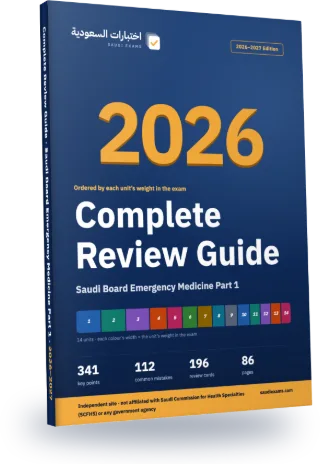
Saudi Board Emergency Medicine Part 1 Complete Review Guide 2026–2027
Every exam topic in a 86-page Arabic PDF, ordered from the heaviest unit to the lightest. The first three chapters alone cover about 33% of the exam questions.
- 86Pages
- 341Key points
- 112Common mistakes
- 196Flashcards
Guide map
Each chapter is one exam unit, ordered by its weight in the real exam.
| Chapter | Unit | Weight | Exam questions | Key points |
|---|---|---|---|---|
| 1 | Cardiovascular | 11% | 17 | 24 |
| 2 | Trauma | 11% | 17 | 24 |
| 3 | Toxicology / Environmental | 11% | 17 | 24 |
| 4 | Dermatology / Cutaneous / Infectious Disease | 8% | 12 | 25 |
| 5 | Orthopedic / Musculoskeletal | 7% | 11 | 24 |
| 6 | Head / Eyes / Ears / Nose / Throat | 7% | 11 | 24 |
| 7 | Abdominal / Gastrointestinal | 7% | 10 | 24 |
| 8 | Obstetrics / Gynaecology | 6% | 9 | 24 |
| 9 | Neurology / Psychiatry | 6% | 9 | 25 |
| 10 | Endocrine / Metabolic | 6% | 9 | 24 |
| 11 | Thoracic / Pulmonary | 5% | 7 | 24 |
| 12 | Hematology / Oncology | 5% | 7 | 26 |
| 13 | Immune / Inflammatory | 5% | 7 | 25 |
| 14 | Nephrology / Urology | 5% | 7 | 24 |
Chapter 1 in full: Cardiovascular
11% of the exam, about 17 questions. These are its key points, as in the guide.
- STEMI: primary PCI is preferred if achievable within 120 minutes of first medical contact; door-to-device target is 90 minutes or less.
- If PCI cannot be done within 120 minutes, give fibrinolysis within 30 minutes of arrival, then transfer to a PCI centre.
- Absolute fibrinolysis contraindications include any prior intracranial haemorrhage, ischaemic stroke within 3 months, intracranial neoplasm, active bleeding and suspected aortic dissection.
The rest of chapter 1, on this page
- Obtain an ECG within 10 minutes of arrival for suspected ACS, especially in older, female and diabetic patients who often present atypically.
- Avoid nitrates within 24 hours of sildenafil (48 hours of tadalafil), in hypotensive RV infarction and in severe aortic stenosis.
- Most specific Sgarbossa criterion in LBBB: concordant ST elevation of 1 mm or more in leads with a positive QRS.
- Posteromedial papillary muscle rupture follows inferior MI at days 2–7, causing acute mitral regurgitation and pulmonary oedema.
- Tachycardia with hypotension, altered mentation, ischaemic chest pain or acute heart failure is unstable and needs synchronised cardioversion.
- Stable SVT: modified Valsalva first, then adenosine 6 mg rapid push with a flush, followed by 12 mg if needed.
- Stable monomorphic VT: amiodarone 150 mg IV over 10 minutes, with cardioversion ready.
- Torsades de pointes: magnesium sulfate 2 g IV even if serum magnesium is normal; stop QT-prolonging drugs.
- Unstable bradycardia: atropine 1 mg every 3–5 minutes up to 3 mg; if no response, transcutaneous pacing or a dopamine or epinephrine infusion.
- AF over 48 hours or unknown onset: rate control and anticoagulation first; cardioversion only after anticoagulation or TEE.
- A magnet on a pacemaker gives asynchronous fixed-rate pacing; on an ICD it suspends shocks without stopping bradycardia pacing.
- Acute pericarditis: diffuse concave ST elevation with PR depression; treat with a high-dose NSAID plus colchicine.
- Tamponade: Beck's triad (hypotension, distended neck veins, muffled heart sounds) and pulsus paradoxus over 10 mm Hg; treat with ultrasound-guided pericardiocentesis.
- Type B dissection: esmolol first to a heart rate below 60/min, then a vasodilator to a systolic pressure of 100–120 mm Hg.
- Hypertensive emergency: lower mean arterial pressure by no more than 25% in the first hour, except in aortic dissection.
- PERC (8 criteria): age under 50, HR under 100, SpO2 95% or more, no haemoptysis, no oestrogen, no prior VTE, no recent surgery or trauma, no unilateral leg swelling.
- High-risk PE with shock is the main indication for systemic thrombolysis; intermediate-risk PE gets anticoagulation and monitoring.
- Adult CPR: depth 5–6 cm, rate 100–120/min, full recoil, and pulse checks no longer than 10 seconds.
- Non-shockable rhythms: epinephrine 1 mg as soon as possible, then every 3–5 minutes. Refractory VF: amiodarone 300 mg then 150 mg, or lidocaine.
- Septic shock: 30 mL/kg balanced crystalloid, then norepinephrine to MAP 65 mm Hg; add vasopressin at about 0.25–0.5 µg/kg/min norepinephrine.
- Maternal arrest: manual left uterine displacement; if the uterus is at or above the umbilicus and there is no ROSC by about 4 minutes, perform perimortem caesarean delivery.
Common mistakes in this chapter
- Waiting for troponin before reperfusion in STEMI is wrong. STEMI is diagnosed on the ECG, and delay increases myocardial loss.
- Giving nitrates in right ventricular MI with hypotension is wrong. The RV is preload dependent; give a fluid bolus first.
- ST depression in V1–V3 with tall R waves is often read as simple ischaemia but may be posterior MI. Record V7–V9.
- AV nodal blockers (adenosine, verapamil, diltiazem, digoxin) in pre-excited AF are dangerous. Use procainamide or electrical cardioversion.
- Wellens pattern is sometimes discharged because the pain has settled and troponin is near normal. It signals critical LAD stenosis and needs admission and early angiography.
- Labelling first-time flank pain in an older patient as renal colic can miss a ruptured AAA. Scan the aorta first.
- A mildly raised D-dimer in an older patient does not always mean imaging. Use the age-adjusted cut-off (age × 10 µg/L above 50).
- Many defibrillators revert to unsynchronised mode after each shock. Reactivate sync before the next cardioversion shock.
The other chapters are in the full guide
One purchase · lifetime access · review guide included
7-day review plan
The chapters are spread over 6 days by weight so each day carries a similar load. Day 7 is a full exam.
Day 1 · 17% of the exam
Chapter 1: Cardiovascular
Chapter 10: Endocrine / MetabolicDay 2 · 16% of the exam
Chapter 2: Trauma
Chapter 11: Thoracic / PulmonaryDay 3 · 16% of the exam
Chapter 3: Toxicology / Environmental
Chapter 12: Hematology / OncologyDay 4 · 19% of the exam
Chapter 4: Dermatology / Cutaneous / Infectious Disease
Chapter 9: Neurology / Psychiatry
Chapter 14: Nephrology / UrologyDay 5 · 14% of the exam
Chapter 5: Orthopedic / Musculoskeletal
Chapter 7: Abdominal / GastrointestinalDay 6 · 18% of the exam
Chapter 6: Head / Eyes / Ears / Nose / Throat
Chapter 8: Obstetrics / Gynaecology
Chapter 13: Immune / Inflammatory
How many correct answers do you need?
- Pass mark 65%98 correct out of 150
Before you read: see your score today
10 free questions from the main units, no sign-up. Then you know which chapter to start with.
Try 10 free questions and see your levelA look at each chapter
The first three key points of each chapter, as they appear in the guide (in Arabic in the PDF).
Chapter 1: Cardiovascular
- STEMI
- If PCI cannot be done within 120 minutes, give fibrinolysis within 30 minutes of…
- Absolute fibrinolysis contraindications include any prior intracranial haemorrhage, ischaemic stroke within 3 months, intracranial…
Chapter 2: Trauma
- Massive haemorrhage
- Tranexamic acid
- ATLS class III haemorrhage
Chapter 3: Toxicology / Environmental
- Anticholinergic toxidrome
- Cholinergic toxidrome (organophosphate)
- Serotonin syndrome starts rapidly after combining serotonergic drugs, with hyperreflexia and clonus greater in…
Chapter 4: Dermatology / Cutaneous / Infectious Disease
- SJS/TEN
- HLA-B*15
- SSSS
Chapter 5: Orthopedic / Musculoskeletal
- Anterior shoulder dislocation
- Extension supracondylar fracture in a child
- Colles fracture
Chapter 6: Head / Eyes / Ears / Nose / Throat
- Central retinal artery occlusion
- Acute angle closure
- Acute glaucoma treatment
Chapter 7: Abdominal / Gastrointestinal
- Peptic ulcer disease is the commonest cause of upper GI bleeding in adults.
- A Glasgow-Blatchford score of 0 allows discharge with outpatient endoscopy.
- Variceal bleeding
Chapter 8: Obstetrics / Gynaecology
- A pregnancy test is required for every woman of reproductive age with abdominal pain…
- Ruptured ectopic with shock (positive hCG, empty uterus, free fluid): blood and surgery without…
- Threatened miscarriage
Chapter 9: Neurology / Psychiatry
- Ischaemic stroke
- IV thrombolysis if BP is below 185/110 mm Hg. Tenecteplase 0.25 mg/kg (maximum 25…
- Large vessel occlusion such as M1
Chapter 10: Endocrine / Metabolic
- Hyperkalaemia with peaked T waves or wide QRS
- Shifting potassium into cells
- Hypokalaemia
Chapter 11: Thoracic / Pulmonary
- Acute asthma
- Asthma resistant to first-line treatment
- Intubated asthma
Chapter 12: Hematology / Oncology
- Sickle pain crisis
- Acute chest syndrome
- Stroke in sickle cell disease
Chapter 13: Immune / Inflammatory
- Adrenaline in anaphylaxis
- A 20 kg child
- Refractory anaphylaxis (after two IM doses and fluids)
Chapter 14: Nephrology / Urology
- AKI (KDIGO)
- FENa below 1% with low urine sodium indicates a prerenal cause with intact tubular…
- Contrast at eGFR about 35
The full guide comes with lifetime access
The full guide (86 pages) is included with lifetime access to this exam, together with every question and full mock exam. Chapter 1 is free for everyone.
Questions about the guide
Is the guide free?
Chapter 1 is free to read on the guide page. The full guide comes with lifetime access to this exam; 7-day access does not include it.
Is it up to date for 2026–2027?
Yes. Unit weights and exam facts follow what the exam body last published, and the last check date is printed in the guide. If the standards change we update the file and buyers download the new version.
Does the guide have questions?
No. The guide covers key points and common mistakes; scoring, weak-area practice and full mock exams are on the site.
Can I read it on my phone?
Yes. A5 pages in a single column, with chapters linked from the contents.
- Pages
- 86
- Edition
- 1448 AH · 2026–2027
- Language
- Arabic
- Last updated
All Health Exams review guides
Back to Saudi Board Part One Examination – Emergency Medicine
Buy this exam
Pick the access that lasts until your test date.
Included
- Timed supplementary practice sessions: 150 questions in 90 minutes
- 750 questions, every option explained with its source
- Practice that starts with your weakest units, plus a review of your mistakes
- Complete Review Guide 2026–2027 (PDF), with lifetime access only
Continue with your Google account and you go straight to the payment page.
You pay on the Waffo Pancake checkout page (in English). The amount is in US dollars and your bank converts it to riyals. One payment with no automatic renewal, by Visa, Mastercard (a mada card with either logo works too), Apple Pay or Google Pay. Your statement shows "WAFFO". Purchases are not refundable.