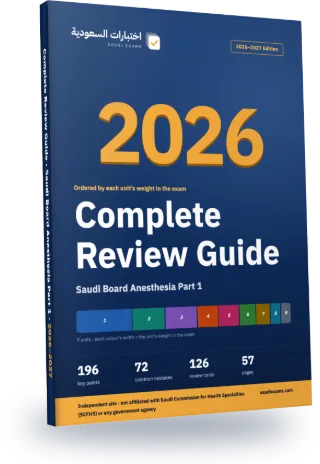
Saudi Board Anesthesia Part 1 Complete Review Guide 2026–2027
Every exam topic in a 57-page Arabic PDF, ordered from the heaviest unit to the lightest. The first three chapters alone cover about 55% of the exam questions.
- 57Pages
- 196Key points
- 72Common mistakes
- 126Flashcards
Guide map
Each chapter is one exam unit, ordered by its weight in the real exam.
| Chapter | Unit | Weight | Exam questions | Key points |
|---|---|---|---|---|
| 1 | Core Anesthesia | 25% | 38 | 24 |
| 2 | Medical Disorder and Anesthesia | 15% | 23 | 24 |
| 3 | Cardiac / Thoracic and Vascular | 15% | 22 | 24 |
| 4 | Pain Management and Regional Anesthesia | 10% | 15 | 23 |
| 5 | Obstetric Anesthesia | 10% | 15 | 21 |
| 6 | Neuro-Anesthesia | 8% | 12 | 21 |
| 7 | Pediatric Anesthesia | 7% | 11 | 19 |
| 8 | Critical Care Medicine | 5% | 7 | 18 |
| 9 | Crisis Management | 5% | 7 | 22 |
Chapter 1 in full: Core Anesthesia
25% of the exam, about 38 questions. These are its key points, as in the guide.
- After 24-48 h of burns, succinylcholine causes life-threatening hyperkalaemia from extrajunctional receptor upregulation. For RSI use rocuronium 1.2 mg/kg.
- Dibucaine number about 80 is normal; about 20 means homozygous atypical plasma cholinesterase with apnoea lasting hours.
- Sugammadex encapsulates rocuronium and vecuronium: 2 mg/kg when T2 reappears, 4 mg/kg for deep block (1-2 post-tetanic counts), 16 mg/kg for immediate reversal.
The rest of chapter 1, on this page
- Give neostigmine with glycopyrrolate to block muscarinic bradycardia and secretions; glycopyrrolate does not cross the blood-brain barrier.
- Cisatracurium undergoes Hofmann elimination independent of liver and kidney, so it suits combined hepatic and renal failure.
- Myasthenia gravis: resistance to succinylcholine and increased sensitivity to non-depolarising blockers.
- Etomidate keeps haemodynamics stable but inhibits 11β-hydroxylase even after one dose; avoid it in adrenal insufficiency.
- Ketamine is an NMDA antagonist; it maintains BP by sympathetic stimulation, bronchodilates and preserves airway reflexes, but causes emergence hallucinations.
- Propofol infusion syndrome follows long infusions above 4 mg/kg/h: metabolic acidosis, rhabdomyolysis and arrhythmia from impaired mitochondrial fatty acid oxidation.
- MAC at age 40: sevoflurane about 2%, isoflurane about 1.2%, desflurane about 6%. Pregnancy lowers MAC by about 30%.
- N2O is 34 times more soluble than nitrogen, so it expands closed air spaces, and causes diffusion hypoxia when stopped; give 100% oxygen.
- Remifentanil is broken down by plasma and tissue esterases; its context-sensitive half-time is about 3-4 minutes regardless of infusion length.
- Pethidine with MAOIs can cause serotonin syndrome or a fatal excitatory reaction; morphine-6-glucuronide accumulates in renal failure.
- Mallampati class III shows soft palate and base of uvula only. Cormack-Lehane grade 3 shows the epiglottis only.
- Predictors of difficult mask ventilation: beard, obesity, snoring, edentulism and age over 55.
- Pre-oxygenation is adequate when end-tidal FeO2 reaches 0.9 or more; it denitrogenates the FRC.
- DAS 2015: Plan A up to 3 laryngoscopy attempts (+1 by a more experienced colleague); Plan B second-generation SAD, max 3 attempts; Plan D in CICO is scalpel-bougie-6.0 mm cuffed tube.
- Cricoid pressure is 10 N while awake, increasing to 30 N after loss of consciousness.
- Tube cuff pressure is 20-30 cmH2O. Depth at the lips is about 21 cm in women and 23 cm in men; usual ID 7.0-7.5 mm for women.
- Capnography: a sudden EtCO2 fall with hypotension suggests embolism; a shark-fin shape suggests bronchospasm; rising inspired CO2 means exhausted absorbent or a faulty valve.
- Pulse oximetry uses two wavelengths: 660 nm (red) and 940 nm (infrared).
- Mapleson A is most efficient for spontaneous breathing (fresh gas flow equal to minute ventilation); Mapleson F (Jackson-Rees) is used under 20 kg.
- ASA fasting: clear fluids 2 h, breast milk 4 h, formula 6 h, light meal 6 h, fatty meal 8 h.
- Stop SGLT2 inhibitors 3 days before surgery (ertugliflozin 4 days) because of euglycaemic ketoacidosis.
Common mistakes in this chapter
- Pretreatment with a non-depolariser is often thought to prevent succinylcholine hyperkalaemia in burns. It does not; avoid succinylcholine entirely.
- SpO2 of 99% in carbon monoxide poisoning is often taken as good oxygenation. Two-wavelength oximeters read COHb as oxyhaemoglobin; request co-oximetry.
- The N2O cylinder gauge is often used to judge contents, but pressure stays constant while liquid remains. Only weighing shows contents.
- Bilateral recurrent laryngeal nerve palsy is confused with unilateral palsy. Bilateral palsy causes stridor with cords near midline; unilateral causes hoarseness.
- Bilateral breath sounds are sometimes taken as proof of intubation. The standard is sustained capnography over several breaths: no trace, wrong place.
- Starting a beta-blocker the day before surgery is thought to protect the heart. POISE showed more stroke and death; only continue it in patients already taking it.
- Repeating ondansetron for PONV after it was given as prophylaxis is ineffective within 6 h. Give an antiemetic from a different class.
- Clinical tests such as a 5-second head lift are used to exclude residual block. Quantitative TOF ratio of 0.9 or more is the accepted standard.
The other chapters are in the full guide
One purchase · lifetime access · review guide included
7-day review plan
The chapters are spread over 6 days by weight so each day carries a similar load. Day 7 is a full exam.
Day 1 · 25% of the exam
Chapter 1: Core Anesthesia
Day 2 · 15% of the exam
Chapter 2: Medical Disorder and Anesthesia
Day 3 · 15% of the exam
Chapter 3: Cardiac / Thoracic and Vascular
Day 4 · 15% of the exam
Chapter 4: Pain Management and Regional Anesthesia
Chapter 8: Critical Care MedicineDay 5 · 15% of the exam
Chapter 5: Obstetric Anesthesia
Chapter 9: Crisis ManagementDay 6 · 15% of the exam
Chapter 6: Neuro-Anesthesia
Chapter 7: Pediatric Anesthesia
How many correct answers do you need?
- Pass mark 65%98 correct out of 150
Before you read: see your score today
10 free questions from the main units, no sign-up. Then you know which chapter to start with.
Try 10 free questions and see your levelA look at each chapter
The first three key points of each chapter, as they appear in the guide (in Arabic in the PDF).
Chapter 1: Core Anesthesia
- After 24-48 h of burns, succinylcholine causes life-threatening hyperkalaemia from extrajunctional receptor upregulation. For…
- Dibucaine number about 80 is normal; about 20 means homozygous atypical plasma cholinesterase with…
- Sugammadex encapsulates rocuronium and vecuronium
Chapter 2: Medical Disorder and Anesthesia
- Severe aortic stenosis
- New atrial fibrillation is poorly tolerated in severe aortic stenosis because the stiff LV…
- Aortic regurgitation
Chapter 3: Cardiac / Thoracic and Vascular
- Initial CPB heparin is 300-400 units/kg; target ACT above 400-480 s before starting bypass.
- Cardioplegia arrests the heart in diastole with high potassium, and with hypothermia reduces myocardial…
- Moderate hypothermia on CPB is 28-32 °C; target mean perfusion pressure 50-70 mmHg, higher…
Chapter 4: Pain Management and Regional Anesthesia
- Maximum plain lidocaine is 3-4.5 mg/kg (about 300 mg), and 7 mg/kg with adrenaline.
- Maximum bupivacaine is 2 mg/kg (about 150 mg).
- A pKa closer to physiological pH gives more un-ionised drug and faster onset. Chloroprocaine…
Chapter 5: Obstetric Anesthesia
- In pregnancy FRC falls and oxygen consumption rises, so desaturation at induction is rapid…
- MAC falls by about 30-40% from progesterone. Pregnancy is hypercoagulable with raised fibrinogen and…
- Cardiac output peaks immediately after delivery (autotransfusion about +75%).
Chapter 6: Neuro-Anesthesia
- Normal CBF is about 50 mL/100 g/min (about 15% of cardiac output). CPP =…
- CBF changes 2-4% per mmHg of PaCO2 within 20-80. Autoregulation spans MAP about 50-150…
- Normal supine ICP is 5-15 mmHg. Monro-Kellie
Chapter 7: Pediatric Anesthesia
- Neonatal cardiac output is rate dependent because the ventricle is non-compliant with limited stroke…
- Neonatal oxygen consumption is about 6 mL/kg/min (twice adult) with low FRC, so desaturation…
- Blood volume of a term neonate is 80-90 mL/kg, and 90-100 in premature infants…
Chapter 8: Critical Care Medicine
- Septic shock
- Initial MAP target in septic shock is 65 mmHg; noradrenaline is the first-line vasopressor.
- Add vasopressin when noradrenaline needs rise, and hydrocortisone 200 mg/day if vasopressors are still…
Chapter 9: Crisis Management
- MH
- Dantrolene 2.5 mg/kg IV, repeat 1 mg/kg as needed up to about 10 mg/kg…
- MH confirmation
The full guide comes with lifetime access
The full guide (57 pages) is included with lifetime access to this exam, together with every question and full mock exam. Chapter 1 is free for everyone.
Questions about the guide
Is the guide free?
Chapter 1 is free to read on the guide page. The full guide comes with lifetime access to this exam; 7-day access does not include it.
Is it up to date for 2026–2027?
Yes. Unit weights and exam facts follow what the exam body last published, and the last check date is printed in the guide. If the standards change we update the file and buyers download the new version.
Does the guide have questions?
No. The guide covers key points and common mistakes; scoring, weak-area practice and full mock exams are on the site.
Can I read it on my phone?
Yes. A5 pages in a single column, with chapters linked from the contents.
- Pages
- 57
- Edition
- 1448 AH · 2026–2027
- Language
- Arabic
- Last updated
Buy this exam
Pick the access that lasts until your test date.
Included
- Timed supplementary practice sessions: 150 questions in 90 minutes
- 756 questions, every option explained with its source
- Practice that starts with your weakest units, plus a review of your mistakes
- Complete Review Guide 2026–2027 (PDF), with lifetime access only
Continue with your Google account and you go straight to the payment page.
You pay on the Waffo Pancake checkout page (in English). The amount is in US dollars and your bank converts it to riyals. One payment with no automatic renewal, by Visa, Mastercard (a mada card with either logo works too), Apple Pay or Google Pay. Your statement shows "WAFFO". Purchases are not refundable.