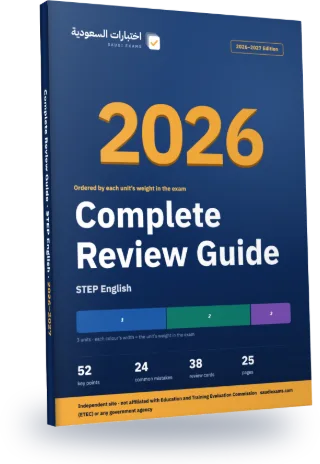
STEP English Complete Review Guide 2026–2027
Every exam topic in a 25-page Arabic PDF, ordered from the heaviest unit to the lightest. The first three chapters alone cover about 100% of the exam questions.
- 25Pages
- 52Key points
- 24Common mistakes
- 38Flashcards
Guide map
Each chapter is one exam unit, ordered by its weight in the real exam.
| Chapter | Unit | Weight | Exam questions | Key points |
|---|---|---|---|---|
| 1 | Reading Comprehension | 40% | 40 | 17 |
| 2 | Structure | 40% | 40 | 18 |
| 3 | Listening Comprehension | 20% | 20 | 17 |
Chapter 1 in full: Reading Comprehension
40% of the exam, about 40 questions. These are its key points, as in the guide.
- Read the question and options before the passage, so you read with a goal and waste less time. Example: What is the passage mainly about?
- A main idea question is answered after reading the whole passage, and its answer recurs in several paragraphs. Example: The best title for the passage is…
- The first paragraph usually introduces the topic, and the last sentence may summarize or open a new idea, so watch both. Example: Paragraph 1 introduces the topic.
The rest of chapter 1, on this page
- In a vocabulary question, put each option in place of the word, and the one that keeps the sentence sound is the answer. Example: The word "frontiers" is closest in meaning to borders.
- Context clues: nearby text may explain a word with a synonym, definition, example or opposite, often after signals such as or, that is, such as and but. Example: He was reluctant, or unwilling, to go.
- A stated detail question has its answer in the text: spot the key word in the question, then search for it in the named paragraph. Example: According to paragraph (2), when did the war begin?
- In a NOT or EXCEPT question, cross out the three options stated in the text and the one left is the answer. Example: All of the following are mentioned EXCEPT…
- Numbers, dates and names are compared exactly with the text, and an option that changes one number is wrong. Example: built in 1890, not 1980.
- An inference question uses words such as suggests, implies and can be inferred, and its answer rests on one or more sentences without copying them. Example: The passage suggests that the author…
- The author's purpose is shown by the verb: to inform explains, to persuade convinces, to describe depicts, to warn cautions. Example: The author wrote the passage to explain how volcanoes form.
- Fact versus opinion: a fact can be checked, while an opinion carries judgment words such as best, should and beautiful. Example: It is the best city to live in (opinion).
- In a pronoun reference question, replace the pronoun with the proposed noun and reread the sentence, and if it makes sense it is the answer. Example: The word "they" refers to the scientists.
- A pronoun matches its referent in number: it is for a singular thing, they and them are plural, and this or that may point to the idea of a whole sentence. Example: Prices rose. This worried many families.
- The topic sentence is usually the first sentence of a paragraph, and the other sentences are examples and details supporting it. Example: Paragraph 4 is mainly about the animals' diet.
- Linking words reveal how the text is organized: first and then for order, however and but for contrast, because and therefore for cause and result, for example for an example. Example: It was cold. Therefore, we stayed inside.
- When time is short, skip a question that needs long re-reading, answer vocabulary and detail questions first, then return to it. Example: do the word-meaning question before the best-title one.
- If you do not know the answer, eliminate the wrong options first, since each one removed raises your chance, then choose and never leave the question blank. Example: remove two options, then pick between the other two.
Common mistakes in this chapter
- An option that is true in real life but not stated in the passage: reject it, because the question is about the text, not your own knowledge.
- An option that reuses the passage's words but changes the meaning, such as swapping cause and result or altering a number or name.
- A title that is too narrow and describes one detail, or too broad and goes beyond the topic of the passage.
- The word has a well-known meaning but the context needs another: do not pick the first meaning that comes to mind before testing the options in the sentence.
- In a NOT question a rushed reader picks the first option that is true in the text, but the answer is the one that is false or not mentioned.
- Absolute words in an option such as always, never, only and all often make it wrong, because passages rarely generalize that strongly.
- Linking a pronoun to the closest noun without checking the meaning: the closest noun is not always the referent.
- Reading the wrong paragraph: the question says according to paragraph (3) and the student answers from a similar-looking paragraph.
The other chapters are in the full guide
One purchase · lifetime access · review guide included
7-day review plan
The chapters are spread over 6 days by weight so each day carries a similar load. Day 7 is a full exam.
Day 1 · 40% of the exam
Chapter 1: Reading Comprehension
Day 2 · 40% of the exam
Chapter 2: Structure
Day 3 · 20% of the exam
Chapter 3: Listening Comprehension
Day 4
Full mock exam: 100 questions in 125 minutes, then review the common mistakes in the units where you lost marks.
Before you read: see your score today
10 free questions from the main units, no sign-up. Then you know which chapter to start with.
Try 10 free questions and see your levelA look at each chapter
The first three key points of each chapter, as they appear in the guide (in Arabic in the PDF).
Chapter 1: Reading Comprehension
- Read the question and options before the passage, so you read with a goal…
- A main idea question is answered after reading the whole passage, and its answer…
- The first paragraph usually introduces the topic, and the last sentence may summarize or…
Chapter 2: Structure
- Use the present simple for habits and facts (Sara takes the bus every day)…
- State verbs (know, like, believe, want, think meaning believe) are not normally used in…
- The present perfect (have/has + past participle) covers something that began in the past…
Chapter 3: Listening Comprehension
- Before the recording
- Options reveal the topic
- Gist questions are usually answered in the first two sentences. Example: "Hi, I'm calling…
The full guide comes with lifetime access
The full guide (25 pages) is included with lifetime access to this exam, together with every question and full mock exam. Chapter 1 is free for everyone.
Questions about the guide
Is the guide free?
Chapter 1 is free to read on the guide page. The full guide comes with lifetime access to this exam; 7-day access does not include it.
Is it up to date for 2026–2027?
Yes. Unit weights and exam facts follow what the exam body last published, and the last check date is printed in the guide. If the standards change we update the file and buyers download the new version.
Does the guide have questions?
No. The guide covers key points and common mistakes; scoring, weak-area practice and full mock exams are on the site.
Can I read it on my phone?
Yes. A5 pages in a single column, with chapters linked from the contents.
- Pages
- 25
- Edition
- 1448 AH · 2026–2027
- Language
- Arabic
- Last updated
Buy this exam
Pick the access that lasts until your test date.
Included
- Full mock exams: 100 questions in 125 minutes, with a score for every unit
- 565 questions, every option explained with its source
- Practice that starts with your weakest units, plus a review of your mistakes
- Complete Review Guide 2026–2027 (PDF), with lifetime access only
Continue with your Google account and you go straight to the payment page.
You pay on the Waffo Pancake checkout page (in English). The amount is in US dollars and your bank converts it to riyals. One payment with no automatic renewal, by Visa, Mastercard (a mada card with either logo works too), Apple Pay or Google Pay. Your statement shows "WAFFO". Purchases are not refundable.