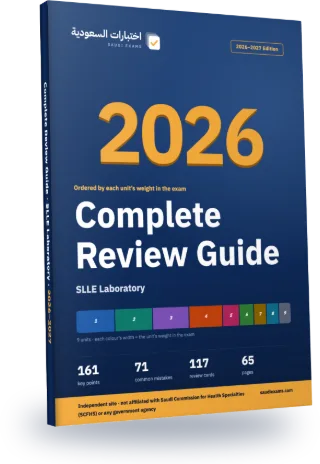
SLLE Laboratory Complete Review Guide 2026–2027
Every exam topic in a 65-page Arabic PDF, ordered from the heaviest unit to the lightest. The first three chapters alone cover about 51% of the exam questions.
- 65Pages
- 161Key points
- 71Common mistakes
- 117Flashcards
Guide map
Each chapter is one exam unit, ordered by its weight in the real exam.
| Chapter | Unit | Weight | Exam questions | Key points |
|---|---|---|---|---|
| 1 | Clinical Chemistry | 17% | 34 | 18 |
| 2 | Hematology | 17% | 34 | 18 |
| 3 | Microbiology | 17% | 34 | 18 |
| 4 | Blood Bank | 16% | 32 | 18 |
| 5 | Laboratory Operations | 8% | 16 | 18 |
| 6 | Patient Safety and Professionalism | 7% | 14 | 17 |
| 7 | Urinalysis and Other Body Fluids | 6% | 12 | 18 |
| 8 | Immunology and Serology | 6% | 12 | 18 |
| 9 | Histotechnology and Cytotechnology | 6% | 12 | 18 |
Chapter 1 in full: Clinical Chemistry
17% of the exam, about 34 questions. These are its key points, as in the guide.
- Diabetes is diagnosed by fasting plasma glucose of 126 mg/dL (7.0 mmol/L) or more on two occasions, or an HbA1c of 6.5% or more.
- Glucose in unseparated whole blood falls about 5 to 7% per hour because cells consume it by glycolysis; sodium fluoride inhibits glycolysis.
- HbA1c reflects average glucose over about 2 to 3 months because the red cell lifespan is about 120 days; it falls when red cells survive less time and is affected by hemoglobin variants.
The rest of chapter 1, on this page
- Henderson-Hasselbalch: pH = 6.1 + log [HCO3 ÷ (0.03 × pCO2)]. Normal arterial values: pH 7.35 to 7.45, pCO2 35 to 45 mmHg, HCO3 22 to 26 mmol/L.
- Metabolic acidosis: low HCO3, compensated by hyperventilation that lowers pCO2. Respiratory acidosis: high pCO2, compensated by the kidneys raising HCO3.
- Anion gap = Na − (Cl + HCO3), normally about 8 to 12 mmol/L when K is not included. It rises in lactic acidosis, ketoacidosis, renal failure and poisoning with methanol, ethylene glycol or salicylate.
- About half of serum calcium is ionized (the active form) and the rest is bound to albumin or small complexes. Acidosis raises ionized calcium. Phosphorus varies inversely with calcium through parathyroid hormone (PTH).
- Creatinine comes from muscle creatine metabolism and is used to estimate the glomerular filtration rate (GFR). It is measured by the Jaffe (alkaline picrate) or enzymatic method. The BUN to creatinine ratio rises above the usual (about 10 to 20) in prerenal causes.
- Iron patterns: in iron deficiency, iron and ferritin fall and TIBC rises; in chronic inflammation, iron and TIBC fall and ferritin is normal or high; in iron overload (hemochromatosis), iron and transferrin saturation (iron ÷ TIBC × 100) rise.
- Cardiac troponin (cTnI and cTnT) is the most specific marker of myocardial infarction: it rises within hours and stays high for several days. CK-MB falls faster (within 2 to 3 days), and BNP and NT-proBNP are used to assess heart failure.
- Bilirubin: unconjugated (indirect) rises in hemolysis; conjugated (direct) rises in biliary obstruction and appears in urine with reduced urobilinogen. The specimen is protected from light because bilirubin breaks down in it.
- Enzymes: ALT and AST for hepatocellular injury (ALT is more liver-specific); ALP and GGT for cholestasis (GGT confirms a liver origin of ALP); lipase is more specific than amylase for pancreatitis; CK for muscle; LD rises in myocardial infarction and hemolysis.
- Calculated LDL (Friedewald) = total cholesterol − HDL − TG ÷ 5 (mg/dL units), and it is not valid when TG exceeds about 400 mg/dL. Measuring TG needs fasting of about 9 to 12 hours, and chylomicrons form a creamy layer when serum stands in the refrigerator.
- Thyroid: high TSH with low T4 indicates primary hypothyroidism, and low TSH with high T4 and T3 indicates primary hyperthyroidism. Total T4 rises when TBG rises, as in pregnancy and estrogen use.
- Tumor markers: AFP for hepatocellular carcinoma and germ cell tumors, CEA for colorectal cancer, PSA for prostate, hCG for germ cell and trophoblastic tumors. They are used mainly for follow-up and response to treatment.
- Therapeutic drug monitoring (TDM): the peak is drawn a set time after the dose and the trough just before the next dose. A drug reaches steady state after about 5 half-lives.
- Urine drug testing starts with an immunoassay screen, and a positive result is confirmed by gas chromatography with mass spectrometry (GC-MS). Carbon monoxide is measured as carboxyhemoglobin by CO-oximetry, and a pulse oximeter may falsely read normal.
- PCR steps: heat separation of the DNA strands (denaturation), primer binding (annealing), then extension by Taq polymerase. PCR detects known mutations, SSCP detects unknown mutations, and Southern blot detects copy number changes.
Common mistakes in this chapter
- Mixing up metabolic acidosis (low HCO3) and respiratory acidosis (high pCO2): first find the variable that moved in the same direction as the pH.
- Assuming compensation brings the pH fully back to normal: in a partly compensated disorder the pH stays outside the reference range.
- Accepting a high K as real: hemolysis, delayed serum separation and EDTA contamination all raise K falsely.
- Confusing total and ionized calcium: total calcium depends on albumin, while ionized calcium is the physiologically active form and depends on pH.
- Treating HbA1c as current glucose: it reflects about 2 to 3 months and can mislead in hemolytic anemia or with hemoglobin variants.
- Treating ALT and AST as equally liver-specific: ALT is more liver-specific, and AST also rises with muscle, heart and hemolysis.
- Applying the Friedewald equation when triglycerides exceed about 400 mg/dL, which makes the calculated LDL unreliable.
- Confusing the screening test (immunoassay) with the confirmatory test (GC-MS): the first is presumptive, the second confirms.
The other chapters are in the full guide
One purchase · lifetime access · review guide included
7-day review plan
The chapters are spread over 6 days by weight so each day carries a similar load. Day 7 is a full exam.
Day 1 · 17% of the exam
Chapter 1: Clinical Chemistry
Day 2 · 17% of the exam
Chapter 2: Hematology
Day 3 · 17% of the exam
Chapter 3: Microbiology
Day 4 · 16% of the exam
Chapter 4: Blood Bank
Day 5 · 14% of the exam
Chapter 5: Laboratory Operations
Chapter 8: Immunology and SerologyDay 6 · 19% of the exam
Chapter 6: Patient Safety and Professionalism
Chapter 7: Urinalysis and Other Body Fluids
Chapter 9: Histotechnology and CytotechnologyDay 7
Full mock exam: 200 questions in 240 minutes, then review the common mistakes in the units where you lost marks.
Before you read: see your score today
10 free questions from the main units, no sign-up. Then you know which chapter to start with.
Try 10 free questions and see your levelA look at each chapter
The first three key points of each chapter, as they appear in the guide (in Arabic in the PDF).
Chapter 1: Clinical Chemistry
- Diabetes is diagnosed by fasting plasma glucose of 126 mg/dL (7.0 mmol/L) or more…
- Glucose in unseparated whole blood falls about 5 to 7% per hour because cells…
- HbA1c reflects average glucose over about 2 to 3 months because the red cell…
Chapter 2: Hematology
- Tube types
- The citrate to blood ratio is 1
- Unacceptable samples
Chapter 3: Microbiology
- Gram stain
- Normal flora
- Steam sterilization (autoclave) kills spores; it is monitored with a biological indicator of Geobacillus…
Chapter 4: Blood Bank
- The H antigen is the precursor made by the FUT1 gene; the A enzyme…
- The Bombay phenotype (Oh) lacks the H antigen, so it carries no A or…
- Anti-Rh, anti-Kell, anti-Duffy and anti-Kidd are IgG, react at 37 °C or in the…
Chapter 5: Laboratory Operations
- Testing phases
- Most laboratory errors occur in the pre-analytical phase, such as wrong patient identification, hemolysis…
- Sensitivity = TP/(TP+FN); specificity = TN/(TN+FP); positive predictive value (PPV) = TP/(TP+FP); negative predictive…
Chapter 6: Patient Safety and Professionalism
- The term healthcare practitioner includes laboratory technicians among the licensed categories (Article 1).
- Practicing any health profession without a Ministry license is prohibited. Requirements are a recognized…
- Practitioners in the private sector hold a two-year license renewed for equal periods, and…
Chapter 7: Urinalysis and Other Body Fluids
- A first morning specimen is the most concentrated and suits routine testing and detection…
- Urine left unpreserved
- The normal yellow color comes from urochrome. Normal adult urine volume is about 600–2000…
Chapter 8: Immunology and Serology
- Innate immunity is fast and nonspecific (neutrophils, macrophages, NK cells, complement); adaptive immunity is…
- Helper T cells carry CD4 and recognize HLA class II; cytotoxic T cells carry…
- IgM is the first immunoglobulin in the primary response; it is a pentamer, the…
Chapter 9: Histotechnology and Cytotechnology
- Tissue fixation stops autolysis and putrefaction and preserves cell structure.
- The routine fixative is 10% NBF, and its volume should greatly exceed the tissue…
- Accepting a specimen requires the patient identity on the container to match the requisition;…
The full guide comes with lifetime access
The full guide (65 pages) is included with lifetime access to this exam, together with every question and full mock exam. Chapter 1 is free for everyone.
Questions about the guide
Is the guide free?
Chapter 1 is free to read on the guide page. The full guide comes with lifetime access to this exam; 7-day access does not include it.
Is it up to date for 2026–2027?
Yes. Unit weights and exam facts follow what the exam body last published, and the last check date is printed in the guide. If the standards change we update the file and buyers download the new version.
Does the guide have questions?
No. The guide covers key points and common mistakes; scoring, weak-area practice and full mock exams are on the site.
Can I read it on my phone?
Yes. A5 pages in a single column, with chapters linked from the contents.
- Pages
- 65
- Edition
- 1448 AH · 2026–2027
- Language
- Arabic
- Last updated
All University & Graduate Exams review guides
Back to Saudi Laboratory Specialist Licensure Examination (SLLE)
Buy this exam
Pick the access that lasts until your test date.
Included
- Full mock exams: 200 questions in 240 minutes, with a score for every unit
- 1064 questions, every option explained with its source
- Practice that starts with your weakest units, plus a review of your mistakes
- Complete Review Guide 2026–2027 (PDF), with lifetime access only
Continue with your Google account and you go straight to the payment page.
You pay on the Waffo Pancake checkout page (in English). The amount is in US dollars and your bank converts it to riyals. One payment with no automatic renewal, by Visa, Mastercard (a mada card with either logo works too), Apple Pay or Google Pay. Your statement shows "WAFFO". Purchases are not refundable.