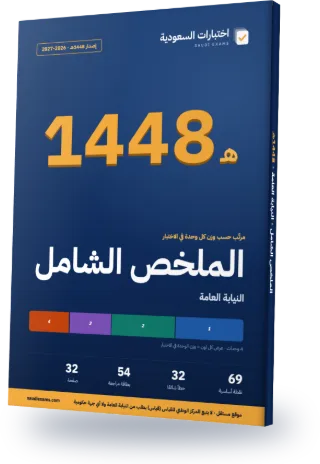
Public Prosecution Complete Review Guide 2026–2027
Every exam topic in a 32-page Arabic PDF, ordered from the heaviest unit to the lightest. The first three chapters alone cover about 80% of the exam questions.
- 32Pages
- 69Key points
- 32Common mistakes
- 54Flashcards
Guide map
Each chapter is one exam unit, ordered by its weight in the real exam.
| Chapter | Unit | Weight | Exam questions | Key points |
|---|---|---|---|---|
| 1 | Sharia Sciences | 30% | 45 | 18 |
| 2 | Law | 30% | 44 | 18 |
| 3 | Verbal Ability | 20% | 30 | 15 |
| 4 | Quantitative Ability | 20% | 30 | 18 |
Chapter 1 in full: Sharia Sciences
30% of the exam, about 45 questions. These are its key points, as in the guide.
- The five taklifi rulings: wajib (the same as fard) is rewarded if done and blamed if left; mandub is rewarded if done and not blamed if left; mubah carries neither reward nor blame; makruh is rewarded if left and not sinful if done; haram is the opposite of wajib. In the Hanbali school wajib and fard mean the same.
- The wad'i rulings: a cause is what, if present, makes the ruling present and, if absent, makes it absent; a condition is what, if absent, makes the ruling absent but its presence does not by itself require the ruling; an impediment blocks the ruling even though its cause exists, as killing does for inheritance. Capacity is not required for wad'i rulings, so a child pays for what he destroys.
- The agreed sources are the Qur'an, the Sunnah, consensus and analogy, and analogy has four pillars: the original case, the new case, the ruling of the original case and the effective cause. The disputed ones include istihsan, maslaha mursala, istishab, laws of earlier prophets and blocking the means. A bare command means obligation and a bare prohibition means haram. General wording such as man (whoever) covers all cases and can be narrowed by an attached exception and other means; the unrestricted text is read in light of the restricted one when ruling and cause are the same. Mafhum muwafaqa is the stronger-than-stated meaning, as in the ban on striking parents drawn from 'do not say uff to them', and mafhum sifa is the meaning drawn from a qualifier, as in the hadith 'on grazing sheep there is zakat' implying none on fed sheep. Abrogation cannot be established when it is unknown which text came later.
The rest of chapter 1, on this page
- The five major maxims: matters are judged by their aims; certainty is not removed by doubt; hardship brings ease; harm is to be removed; custom is a basis for judgment. Under certainty fall: the default is freedom from liability, and the default is that what was stays as it was. Under 'harm is to be removed': necessity permits the forbidden; necessity is measured by its extent; preventing harm comes before gaining benefit; private harm is borne to prevent public harm; harm is not removed by equal harm. And one ijtihad does not overturn another. Other maxims: the accessory follows the principal; giving words effect is better than disregarding them; entitlement to profit follows liability; no statement is attributed to a silent person; a valid custom is one that is constant or prevailing and does not count if it contradicts a text. Hudud are averted by doubt.
- Hanbali ruling on zina: a free unmarried offender gets 100 lashes and exile for a year, a muhsan is stoned to death. Ihsan is intercourse in the vagina in a valid marriage. It is proved by four upright men or by four confessions, and if the confessor retracts, even during execution, he is left. A coerced person is not subject to the hadd, and neither is a new Muslim ignorant of the prohibition. If three witness zina and the number is not completed, the accused is not punished and the witnesses receive the qadhf hadd. The qadhf hadd for a free person is eighty lashes, and the one slandered must be muhsan (free, Muslim, sane, chaste). A husband avoids the hadd by li'an. The hadd for drinking an intoxicant is eighty lashes for a free person, proved by one confession or two upright witnesses. A hadd is not carried out in a mosque and only the imam or his deputy carries it out. If an executioner adds even one lash and the offender dies, he owes the diya.
- Hadd for theft: amputation applies at the nisab of a quarter dinar of gold or three dirhams of silver, with secret taking from a hirz and a claim by the owner. The first theft costs the right hand at the wrist, the second the left foot at the ankle, after which he is imprisoned and nothing more is cut. Amputation and compensation are both due. It is proved by two witnesses or by two confessions.
- Hirabah: whoever kills and takes property is killed and crucified; whoever kills without taking property is killed as a fixed penalty; whoever takes the theft nisab without killing loses his right hand and left foot; whoever only frightens people is exiled. One who repents before being caught loses only God's right and the human right remains. Apostasy: the apostate is asked to repent for three days and, if he persists, is killed, and the imam or his deputy carries this out. Rebels are a group with strength who rise against the imam on an acceptable interpretation; the imam writes to them and removes their grievance, and if they persist he fights them, but does not pursue the fleeing or finish off the wounded.
- Kinds of killing: intentional, quasi-intentional and by error. Intention is aiming to kill a protected person by means likely to kill, and it gives qisas or diya at the heir's choice. Quasi-intentional is a blow with something not usually lethal that still causes death; it gives a heavier diya borne by the aqila and expiation, with no qisas. Error is killing without intent and gives a lighter diya on the aqila and expiation.
- Conditions for qisas to be due: capacity, protected status and equality (Islam and freedom). So no qisas against a boy or an insane person, a Muslim is not killed for a non-Muslim, a father is not killed for his son, and a son is killed for his father. Being male is not a condition. A group is killed for one. Conditions for carrying out qisas: agreement of all heirs with capacity, safety from harming anyone but the offender, and the ruler or his deputy present with a sharp instrument. It is delayed for a young heir to reach majority and for a pregnant woman until she gives birth and nurses the child with colostrum. If one heir pardons, qisas falls altogether, and a free pardon drops the diya too. Whoever chose the diya has nothing else. Qisas below the level of life requires safety from excess, matching name and place, and equal health and completeness of the limbs, so right for right, and a healthy hand is not cut for a paralysed one. Qisas applies to a mudiha because it ends at bone. The spread of an injury is on the offender, while the spread of a lawful qisas is not on the one who carried it out.
- The diya: 100 camels, or 1,000 mithqals of gold, or 12,000 dirhams of silver, or 200 cows, or 2,000 sheep. A woman's diya is half a man's. It is made heavier in intentional and quasi-intentional killing, in quarters: 25 each of bint makhad, bint labun, hiqqa and jadha'a. In error it is lighter, in fifths: 20 each of bint makhad, bint labun, hiqqa, jadha'a and ibn makhad.
- The aqila are the male agnates of the killer by lineage and wala', and the diya is paid in three years. The aqila does not bear intentional killing, what is proved by confession, a settlement, a slave's value or anything below a third of the diya. Expiation for killing falls on the killer himself even if a child: freeing a believing slave, and if he cannot, fasting two months in a row.
- Diya of organs: what a person has only one of carries the full diya, like the tongue, and what he has two of carries the full diya for both and half for one, like the eyes. Each finger is ten camels and each tooth five. For head wounds: mudiha five, hashima ten, munaqqila fifteen, ma'muma and ja'ifa a third of the diya, and the wounds before the mudiha carry a hukuma. Qasama is repeated oaths in a claim of killing a protected person, and it needs lawth, which is clear enmity such as feuding tribes. The male heirs of the victim swear first, fifty oaths, and judgment is given for them. If they refuse or are all women, the defendant swears fifty oaths and is cleared. There is no qasama for a claim of a cut limb or a wound.
- Ta'zir is a mandatory disciplinary penalty for any sin that has no hadd and no expiation, such as theft below the nisab or from an unguarded place, and insult not involving zina. On the school's view it does not exceed ten lashes, and ta'zir by shaving the beard or cutting a limb is forbidden. A hadd is not dropped by intercession once it reaches the ruler, nor swapped for another penalty; a hadd is averted by doubt while ta'zir may be imposed despite a doubt that does not negate the crime.
- The elements of a crime: the legal element (the text that criminalises), the material element (the act) and the moral element (capacity and intent). Preparation is not punished, while an attempt is the start of execution. Impediments to liability are youth and insanity: no hadd applies to them, but they pay for property they destroyed. On the school's view coercion does not remove qisas from the coercer or the coerced. An aggressor is repelled by the easiest means first. Multiple offences and repetition: if hudud of the same kind are repeated before any is carried out, they merge and one suffices. One act producing two crimes is a conceptual multiplicity. Repetition is an aggravating factor in ta'zir. If a man orders a child who cannot discern to kill and he does, qisas falls on the one who ordered, because the child was his tool. Whoever digs a well on a public road owes for anyone who dies in it.
- Judging is a communal duty. The ten conditions for a judge: adult, sane, male, free, Muslim, upright, hearing, seeing, speaking and a mujtahid. He may not judge in any state that distracts him from careful checking, such as severe anger or a pressing need to relieve himself, and he may not accept a gift from someone not used to giving them or from someone with a case before him. He must treat the two parties equally in glance, word and seating. He does not rule for anyone whose testimony for him would be refused.
- The claim: the claimant is the one who would be left alone if he stayed silent, and the defendant is the one who would not. Proof is on the claimant and the oath on the one who denies, and the judge does not make the denier swear unless the claimant asks. A claim of something unspecified is not valid. If the defendant refuses the oath, the judge tells him three times, swear or I will rule against you. Judgment may be given against an absent party once the right is proved, and he keeps his defence on returning. A judge's letter to another judge is not accepted in God's hudud.
- Conditions for a witness: Islam, sanity, adulthood and uprightness, and freedom is not required. Testimony is rejected from a child for his father and the reverse, from an enemy against his enemy, and from one who gains a benefit by it. Giving testimony when called is a personal duty if it causes no harm. If the two witnesses retract before judgment, no judgment is given and nothing is owed, and if they retract after judgment and collection they owe the money. Witness numbers: zina needs four upright men, hudud and qisas need two men, and property or what is aimed at property takes two men, or a man and two women, or one witness and the claimant's oath; what men usually cannot see, such as childbirth, accepts one upright woman. A confession requires free choice, so a coerced one is invalid, and a confession of something unspecified is valid and he must explain it. Possession is evidence of ownership, so the one in possession wins with his oath.
- Custody and maintenance under the Personal Status Law: a custodian needs full capacity, the ability to raise and protect the child, and freedom from serious infectious disease, and someone who stays silent on claiming custody for a period without excuse loses the right unless the child's interest requires otherwise. A daughter's maintenance is on her father until she marries. Usurpation: the usurper is liable for what he took even if it is lost by a natural cause, pays the like for fungibles and the value for non-fungibles, and owes a fair rent for the time it was with him. A direct doer is liable even without wrongdoing, while one who only causes it is liable only if he acted wrongfully. A depositary is a trustee and is liable only for wrongdoing or neglect, and if he uses the deposit without permission he is liable. A significant lost item is announced for a full year.
Common mistakes in this chapter
- Mixing up hadd and ta'zir: a hadd is fixed in kind and amount, while ta'zir is not fixed, is left to the judge and may not exceed ten lashes.
- Thinking a marriage contract alone makes a man muhsan: it takes intercourse in a valid marriage, so a man who contracted but never consummated is treated as unmarried.
- Assuming every theft means amputation: if the nisab, the hirz or the owner's claim is missing, or the property is the thief's father's, there is no amputation and ta'zir applies.
- Treating every blow as intentional: a blow with something that does not usually kill, such as a small whip, is quasi-intentional, so there is no qisas.
- One heir's pardon drops qisas altogether and the others keep only their share of the diya, and a free pardon drops both qisas and diya.
- Confusing claimant and defendant: the claimant brings proof and the one who denies swears, and the judge does not make the defendant swear unless the claimant asks.
- Assuming a witness must be free: the school does not require it of a witness, but it does require it of a judge, along with being male.
- Mixing the conditions for qisas to be due with those for carrying it out: being male is no condition, equality, protected status and capacity are conditions for it to be due, and safety from harming others and the ruler's presence are for carrying it out.
The other chapters are in the full guide
One purchase · lifetime access · review guide included
7-day review plan
The chapters are spread over 6 days by weight so each day carries a similar load. Day 7 is a full exam.
Day 1 · 30% of the exam
Chapter 1: Sharia Sciences
Day 2 · 30% of the exam
Chapter 2: Law
Day 3 · 20% of the exam
Chapter 3: Verbal Ability
Day 4 · 20% of the exam
Chapter 4: Quantitative Ability
Day 5
Full mock exam: 149 questions in 150 minutes, then review the common mistakes in the units where you lost marks.
Before you read: see your score today
10 free questions from the main units, no sign-up. Then you know which chapter to start with.
Try 10 free questions and see your levelA look at each chapter
The first three key points of each chapter, as they appear in the guide (in Arabic in the PDF).
Chapter 1: Sharia Sciences
- The five taklifi rulings
- The wad'i rulings
- The agreed sources are the Qur'an, the Sunnah, consensus and analogy, and analogy has…
Chapter 2: Law
- Basic guarantees
- The Public Prosecution is competent to bring and pursue the criminal action before the…
- Flagrante delicto and arrest
Chapter 3: Verbal Ability
- Verbal analogy gives a pair of words with a relation and asks for the…
- Synonymy
- Part to whole
Chapter 4: Quantitative Ability
- Percentage
- Ready-made equivalents to memorise
- To recover the original after a percentage change
The full guide comes with lifetime access
The full guide (32 pages) is included with lifetime access to this exam, together with every question and full mock exam. Chapter 1 is free for everyone.
Questions about the guide
Is the guide free?
Chapter 1 is free to read on the guide page. The full guide comes with lifetime access to this exam; 7-day access does not include it.
Is it up to date for 2026–2027?
Yes. Unit weights and exam facts follow what the exam body last published, and the last check date is printed in the guide. If the standards change we update the file and buyers download the new version.
Does the guide have questions?
No. The guide covers key points and common mistakes; scoring, weak-area practice and full mock exams are on the site.
Can I read it on my phone?
Yes. A5 pages in a single column, with chapters linked from the contents.
- Pages
- 32
- Edition
- 1448 AH · 2026–2027
- Language
- Arabic
- Last updated
Buy this exam
Pick the access that lasts until your test date.
Included
- Full mock exams: 149 questions in 150 minutes, with a score for every unit
- 787 questions, every option explained with its source
- Practice that starts with your weakest units, plus a review of your mistakes
- Complete Review Guide 2026–2027 (PDF), with lifetime access only
Continue with your Google account and you go straight to the payment page.
You pay on the Waffo Pancake checkout page (in English). The amount is in US dollars and your bank converts it to riyals. One payment with no automatic renewal, by Visa, Mastercard (a mada card with either logo works too), Apple Pay or Google Pay. Your statement shows "WAFFO". Purchases are not refundable.