CME-4A · ICWIM
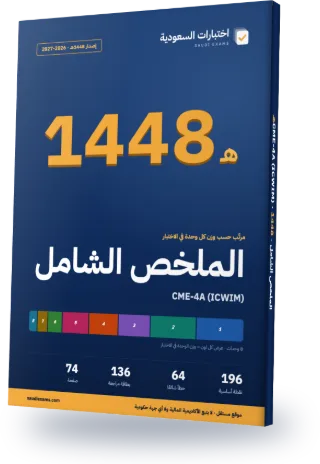
CME-4A (ICWIM) Complete Review Guide 2026–2027
Every exam topic in a 74-page Arabic PDF, ordered from the heaviest unit to the lightest. The first three chapters alone cover about 57% of the exam questions.
- 74Pages
- 196Key points
- 64Common mistakes
- 136Flashcards
Guide map
Each chapter is one exam unit, ordered by its weight in the real exam.
| Chapter | Unit | Weight | Exam questions | Key points |
|---|---|---|---|---|
| 1 | Economics and Investment Analysis | 21% | 21 | 36 |
| 2 | Investment Advice | 21% | 21 | 32 |
| 3 | Investment Management | 15% | 15 | 28 |
| 4 | Asset Classes and Financial Markets | 14% | 14 | 30 |
| 5 | Lifetime Financial Provision | 13% | 13 | 26 |
| 6 | Collective Investments | 7% | 7 | 18 |
| 7 | Industry Regulation | 5% | 5 | 14 |
| 8 | The Financial Services Sector | 4% | 4 | 12 |
Chapter 1 in full: Economics and Investment Analysis
21% of the exam, about 21 questions. These are its key points, as in the guide.
- GDP = C + I + G + (X − M): consumption, investment and government spending, plus exports minus imports. It measures final output produced within the country, before depreciation (hence 'gross').
- GNP = GDP + net property income (wages, profits, interest, dividends) from nationals, firms and individuals, based abroad. It may exceed or fall short of GDP; US GNP exceeds it.
- Real GDP is nominal GDP adjusted for inflation using the GDP deflator. Economic growth is always quoted in real terms; GDP is a lagging indicator and is often revised.
The rest of chapter 1, on this page
- Recession: negative growth for at least two consecutive quarters. Typical cycle: recovery, acceleration, boom, overheating, deceleration, recession; a cycle's length is measured peak to peak or trough to trough.
- Balance of payments = current account (goods or 'visibles', services or 'invisibles', plus income such as overseas dividends and remittances) and capital/financial account (FDI, portfolio and other investment).
- A falling currency (depreciation if floating, devaluation if fixed) makes exports cheaper and imports dearer, raising demand and growth, risking higher inflation and improving the current account.
- CPI tracks the prices households pay for a weighted basket (buyer's view). PPI tracks producers' selling prices (seller's view, 'factory gate') and can give early warning of inflation.
- Deflation: a general fall in prices. Disinflation: inflation still positive but slowing. Stagflation: inflation combined with slow or negative growth and rising unemployment, as in the 1970s oil shock.
- Real return = nominal return − inflation. A nominal return (e.g. a bond's flat yield) ignores inflation; if inflation exceeds the nominal rate, the real return is negative.
- Fiscal policy works through spending, taxation and borrowing. Expansionary: higher spending funded by borrowing, so a bigger budget deficit. Contractionary: higher taxes or lower spending. Neutral: a balanced budget.
- Monetary policy controls the supply, availability and cost of money through interest rates, open market operations and reserve requirements; expansionary means more money or lower rates, contractionary the reverse.
- QE: with rates near zero, the central bank injects money by buying securities from banks (government debt, MBSs, even equities), lifting asset prices and cutting yields. QT does the reverse.
- MMT: a government borrowing in its own currency need never default, because its central bank can create money, so fiscal policy should drive the economy. Main risk: runaway inflation.
- Narrow money (the monetary base) = notes and coins in circulation + overnight deposits. Broad money = narrow money + bank deposits + money market instruments. Exact measures differ by country.
- Central bank roles: banker to banks and government, lender of last resort, setting short-term interest rates, controlling money supply, issuing currency, managing national debt and gold and FX reserves.
- A change in a good's own price moves along its demand or supply curve; other factors (income, tastes, related goods' prices, production costs) shift the whole curve.
- PED = % change in quantity demanded ÷ % change in price. Demand is elastic if the absolute value exceeds 1 and inelastic if below 1; total revenue peaks at unit elasticity.
- Cross elasticity (XED) is positive for substitutes and negative for complements. Income elasticity (YED) is positive for normal goods, above 1 for luxuries and negative for inferior goods.
- Firms maximise profit where marginal revenue equals marginal cost (MR = MC). Average revenue (AR) equals price and traces the demand curve; MR is always below AR.
- Short run: capital fixed, labour and materials variable; only variable costs need covering. Long run: all inputs vary; costs fall to minimum efficient scale (MES), then diseconomies begin.
- Perfect competition: infinite price-taking firms, a homogeneous product, no entry or exit barriers, perfect information. Monopoly: one price-setting supplier behind barriers. Oligopoly: a few interdependent, often colluding firms.
- Mean = sum of values ÷ number of values. Median = middle ordered value, at position (n + 1) ÷ 2; for an even count, average the middle two. Mode = most frequent value.
- Geometric mean return = nth root of [(1 + r1) × … × (1 + rn)] − 1. It measures average compound growth and is lower than the arithmetic mean (equal only if all returns are the same).
- Range = highest − lowest value. Population variance = average of the squared deviations from the mean; standard deviation = its square root. For a sample, divide by n − 1 instead of n.
- Normal distribution: about 68% of outcomes lie within 1 standard deviation of the mean, 95% within 2, 99.7% within 3. Mean 8%, SD 5%: two-thirds fall between 3% and 13%.
- The correlation coefficient runs from +1 (perfectly positive) to −1 (perfectly negative); the lower it is, the greater the diversification benefit. Covariance depends on both standard deviations and their correlation.
- Simple interest = principal × rate × time, with time in years (part-years as days ÷ 365 under the UK convention). Compound: final amount = P × (1 + r)^n, as interest earns interest.
- FV = PV × (1 + r)^n; PV = FV ÷ (1 + r)^n. With interest paid i times a year, FV = PV × (1 + r/i)^(n × i).
- PV of an annuity = payment × (1/r) × [1 − 1/(1 + r)^n], the same as discounting each payment separately: $100 a year for 3 years at 5% = $272.32.
- PV of a perpetuity = annual payment ÷ r, e.g. €1,000 a year at 5% = €20,000. A perpetuity has no future value formula because it never ends.
- Technical analysis trend classes: primary movements last years (bull or bear markets), secondary movements up to a couple of months, tertiary movements day to day.
- ROCE = profit before interest and tax ÷ capital employed (shareholders' funds + loans + overdrafts). It equals profit margin (PBIT ÷ sales) × asset turnover (sales ÷ capital employed).
- Financial gearing = (interest-bearing debt + preference shares) ÷ ordinary shareholders' equity. Interest cover = PBIT ÷ interest payable; 1.5x or less signals a doubtful ability to meet interest.
- Current ratio = current assets ÷ current liabilities (good: 1.2x–2x). Quick ratio = (current assets − stock) ÷ current liabilities. Cash ratio = (cash + cash equivalents + invested funds) ÷ current liabilities.
- EPS = (net income − preference dividends) ÷ ordinary shares in issue. P/E = share price ÷ EPS. Dividend yield = net dividend per share ÷ share price. Dividend cover = EPS ÷ net dividend per share.
- Dividend valuation: price = D ÷ k; Gordon growth: price = D ÷ (k − g). EVA = NOPAT − (invested capital × WACC). MVA = market value of the company − capital invested.
Common mistakes in this chapter
- GDP adds exports and subtracts imports, not the reverse. Where GNP is higher than GDP, as in the US, the reason is net income from nationals' production outside the country, not stronger exports or higher government spending; GNP can also be lower than GDP.
- PPI measures inflation from the seller's (producer's) side; CPI measures it from the buyer's (household's) side. Don't pick 'a basket of goods bought by households' for PPI; that describes CPI.
- Raising banks' reserve requirements reduces the money in circulation; it does not increase it. Likewise, a central bank buying bonds injects money and selling bonds withdraws it.
- A change in a good's own price causes a movement along the demand curve, not a shift. Changes in income, tastes or the prices of related goods shift the curve; greater consumer preference shifts demand to the right.
- 'Interest left in the account' means compound interest: 1,000 at 4% for 3 years grows to 1,124.86, not 1,120 (simple interest). Count the periods carefully when interest is paid half-yearly.
- Technical analysts assume a company's fundamentals are already reflected in the price and focus on short-term trading; studying accounts, management and long horizons is fundamental analysis. A primary movement is a long-term trend, not a short-term one.
- In the Gordon growth model, price = D ÷ (k − g): the denominator is k minus g, not k plus g, and D is the dividend expected in one year's time, not the one just paid.
- A negative EVA means the company destroyed value in that period, not that its value is nil or its growth is slowing. EVA alone cannot show whether shares are over- or undervalued; MVA is used for that.
The other chapters are in the full guide
One purchase · lifetime access · review guide included
7-day review plan
The chapters are spread over 6 days by weight so each day carries a similar load. Day 7 is a full exam.
Day 1 · 21% of the exam
Chapter 1: Economics and Investment Analysis
Day 2 · 21% of the exam
Chapter 2: Investment Advice
Day 3 · 15% of the exam
Chapter 3: Investment Management
Day 4 · 14% of the exam
Chapter 4: Asset Classes and Financial Markets
Day 5 · 13% of the exam
Chapter 5: Lifetime Financial Provision
Day 6 · 16% of the exam
Chapter 6: Collective Investments
Chapter 7: Industry Regulation
Chapter 8: The Financial Services SectorDay 7
Full mock exam: 100 questions in 120 minutes, then review the common mistakes in the units where you lost marks.
How many correct answers do you need?
- Pass mark 70%70 correct out of 100
Before you read: see your score today
10 free questions from the main units, no sign-up. Then you know which chapter to start with.
Try 10 free questions and see your levelA look at each chapter
The first three key points of each chapter, as they appear in the guide (in Arabic in the PDF).
Chapter 1: Economics and Investment Analysis
- GDP = C + I + G + (X − M)
- GNP = GDP + net property income (wages, profits, interest, dividends) from nationals, firms…
- Real GDP is nominal GDP adjusted for inflation using the GDP deflator. Economic growth…
Chapter 2: Investment Advice
- Client categorisation protects most those who know least and have least experience, separating retail…
- Set the client's category at the start and keep it under review; in some…
- Acting in the client's best interest means acting honestly, fairly and professionally, with the…
Chapter 3: Investment Management
- Time value of money
- The risk-free rate is usually the return on Treasury bills or short-dated government bonds;…
- Risk premium = the extra return over the risk-free rate that investors demand for…
Chapter 4: Asset Classes and Financial Markets
- AER = (1 + r/n)^n − 1, where r is the nominal annual rate…
- Notice accounts typically require 30, 60 or 90 days' notice and pay variable rates…
- Deposit protection examples
Chapter 5: Lifetime Financial Provision
- Retirement may need funding for 20–30 and up to 45 years; worldwide, state pensions…
- FV of savings paid at the start of each year = Payment × [((1…
- Chapter illustration (saving from age 25)
Chapter 6: Collective Investments
- Benefits of collective investment
- Authorised funds
- Open-ended fund
Chapter 7: Industry Regulation
- Regulation aims to build confidence and trust in financial markets, systems and products, support…
- Rules-based
- IOSCO (founded 1983) has 38 principles in ten categories, built on three objectives: protecting…
Chapter 8: The Financial Services Sector
- Three core functions of the sector
- Long term, technology plus globalisation has generally brought low inflation, strong growth, fast-spreading bond…
- Wholesale (B2B) activities
The full guide comes with lifetime access
The full guide (74 pages) is included with lifetime access to this exam, together with every question and full mock exam. Chapter 1 is free for everyone.
Questions about the guide
Is the guide free?
Chapter 1 is free to read on the guide page. The full guide comes with lifetime access to this exam; 7-day access does not include it.
Is it up to date for 2026–2027?
Yes. Unit weights and exam facts follow what the exam body last published, and the last check date is printed in the guide. If the standards change we update the file and buyers download the new version.
Does the guide have questions?
No. The guide covers key points and common mistakes; scoring, weak-area practice and full mock exams are on the site.
Can I read it on my phone?
Yes. A5 pages in a single column, with chapters linked from the contents.
- Pages
- 74
- Edition
- 1448 AH · 2026–2027
- Language
- Arabic
- Last updated
All Finance & Insurance Exams review guides
Back to CME-4A (ICWIM) – International Certificate in Wealth & Investment Management
Buy this exam
Pick the access that lasts until your test date.
Included
- Full mock exams: 100 questions in 120 minutes, with a score for every unit
- 538 questions, every option explained with its source
- Practice that starts with your weakest units, plus a review of your mistakes
- Complete Review Guide 2026–2027 (PDF), with lifetime access only
Continue with your Google account and you go straight to the payment page.
You pay on the Waffo Pancake checkout page (in English). The amount is in US dollars and your bank converts it to riyals. One payment with no automatic renewal, by Visa, Mastercard (a mada card with either logo works too), Apple Pay or Google Pay. Your statement shows "WAFFO". Purchases are not refundable.