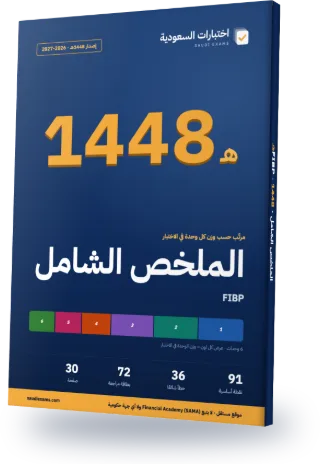
FIBP Complete Review Guide 2026–2027
Every exam topic in a 30-page Arabic PDF, ordered from the heaviest unit to the lightest. The first three chapters alone cover about 60% of the exam questions.
- 30Pages
- 91Key points
- 36Common mistakes
- 72Flashcards
Guide map
Each chapter is one exam unit, ordered by its weight in the real exam.
| Chapter | Unit | Weight | Exam questions | Key points |
|---|---|---|---|---|
| 1 | Structure of the Banking System in Saudi Arabia | 20% | 20 | 17 |
| 2 | Shariah Governance in Islamic Banks | 20% | 20 | 14 |
| 3 | Internal Shariah Control | 20% | 20 | 16 |
| 4 | Islamic Banking Products and Services | 14% | 14 | 13 |
| 5 | Nature of the Islamic Banking Sector | 13% | 13 | 15 |
| 6 | Islamic Financing Modes | 13% | 13 | 16 |
Chapter 1 in full: Structure of the Banking System in Saudi Arabia
20% of the exam, about 20 questions. These are its key points, as in the guide.
- The Banking Control Law (1386 AH) is the main statute for licensing and supervising banks.
- The Anti-Money Laundering Law (2017) criminalises money laundering and sets obligations on financial institutions.
- SAMA's Cyber Security Framework (2017) sets mandatory controls for regulated financial institutions.
The rest of chapter 1, on this page
- SIMAH is the licensed credit bureau providing credit reports and scores to banks.
- The Social Development Bank provides social and small-business loans, such as productive-family loans.
- The Wage Protection System links payroll files to monitoring of private-sector wages.
- A Saudi IBAN has 24 characters and starts with SA.
- A standing order is an instruction for recurring payments on set dates.
- A safe deposit box is a service for storing valuables securely at a branch.
- The mada card is a debit card drawing directly on the current account.
- Working capital financing covers short-term needs such as inventory and receivables.
- A documentary letter of credit pays the exporter against compliant shipping documents.
- Liquidity (maturity mismatch) risk arises when long-term financing is funded by short-term deposits.
- Banks are systemically important because failure of one can spread losses and disrupt payments and credit.
- Risk-weighted assets are the denominator of the capital ratio and reflect credit, market and operational risk.
- The leverage ratio is a simple non-risk-based backstop that limits excessive balance-sheet growth.
- The disclosure and transparency principle in customer protection requires banks to explain fees and terms before signing.
Common mistakes in this chapter
- Customer deposits are not assets but liabilities (owed to customers).
- Capital absorbs losses and protects depositors; it is not just funding for operating assets.
- Do not mix up regulators: SAMA supervises banks; the Capital Market Authority regulates securities, brokerage and investment funds.
- The Net Stable Funding Ratio covers a one-year horizon, while the Liquidity Coverage Ratio is short-term.
- A current account is payable on demand; it is not a return-bearing savings product.
- "Lender of last resort" is the central bank giving liquidity to sound banks facing a temporary shortage.
The other chapters are in the full guide
One purchase · lifetime access · review guide included
7-day review plan
The chapters are spread over 6 days by weight so each day carries a similar load. Day 7 is a full exam.
Day 1 · 20% of the exam
Chapter 1: Structure of the Banking System in Saudi Arabia
Day 2 · 20% of the exam
Chapter 2: Shariah Governance in Islamic Banks
Day 3 · 20% of the exam
Chapter 3: Internal Shariah Control
Day 4 · 14% of the exam
Chapter 4: Islamic Banking Products and Services
Day 5 · 13% of the exam
Chapter 5: Nature of the Islamic Banking Sector
Day 6 · 13% of the exam
Chapter 6: Islamic Financing Modes
Day 7
Full mock exam: 100 questions in 120 minutes, then review the common mistakes in the units where you lost marks.
Before you read: see your score today
10 free questions from the main units, no sign-up. Then you know which chapter to start with.
Try 10 free questions and see your levelA look at each chapter
The first three key points of each chapter, as they appear in the guide (in Arabic in the PDF).
Chapter 1: Structure of the Banking System in Saudi Arabia
- The Banking Control Law (1386 AH) is the main statute for licensing and supervising…
- The Anti-Money Laundering Law (2017) criminalises money laundering and sets obligations on financial institutions.
- SAMA's Cyber Security Framework (2017) sets mandatory controls for regulated financial institutions.
Chapter 2: Shariah Governance in Islamic Banks
- SAMA's "Key Principles of Governance in Financial Institutions" sit alongside the Banking Control Law.
- The Basel document
- AAOIFI GS 2 covers Shariah review, GS 3 internal Shariah review, GS 4 the…
Chapter 3: Internal Shariah Control
- Shariah risk steps
- Outsourcing does not transfer accountability; Shariah clauses go into service agreements and providers are…
- The best time to review a new product's documents is before launch (ex-ante).
Chapter 4: Islamic Banking Products and Services
- Fees on payroll cards or current accounts are permissible when for real services (ujrah).
- Islamic syndicated corporate facilities typically use commodity murabahah, ijarah or wakalah.
- Home finance in the Kingdom uses ijarah ending in ownership, murabahah or diminishing musharakah.
Chapter 5: Nature of the Islamic Banking Sector
- The first private commercial Islamic bank is generally regarded as Dubai Islamic Bank (1975).
- Al Rajhi began as a money-exchange business and became a joint-stock company in 1987/88.
- AAOIFI is headquartered in Manama, Bahrain, and issues Shariah, accounting and governance standards.
Chapter 6: Islamic Financing Modes
- Salam is buying described goods for later delivery paying the full price now.
- Parallel istisna' is a second independent istisna' in which the bank orders the item…
- If part of mudarabah capital was lost, profit first makes good the loss before…
The full guide comes with lifetime access
The full guide (30 pages) is included with lifetime access to this exam, together with every question and full mock exam. Chapter 1 is free for everyone.
Questions about the guide
Is the guide free?
Chapter 1 is free to read on the guide page. The full guide comes with lifetime access to this exam; 7-day access does not include it.
Is it up to date for 2026–2027?
Yes. Unit weights and exam facts follow what the exam body last published, and the last check date is printed in the guide. If the standards change we update the file and buyers download the new version.
Does the guide have questions?
No. The guide covers key points and common mistakes; scoring, weak-area practice and full mock exams are on the site.
Can I read it on my phone?
Yes. A5 pages in a single column, with chapters linked from the contents.
- Pages
- 30
- Edition
- 1448 AH · 2026–2027
- Language
- Arabic
- Last updated
All Finance & Insurance Exams review guides
Back to FIBP – Fundamentals of Islamic Banking (Financial Academy)
Buy this exam
Pick the access that lasts until your test date.
Included
- Full mock exams: 100 questions in 120 minutes, with a score for every unit
- 500 questions, every option explained with its source
- Practice that starts with your weakest units, plus a review of your mistakes
- Complete Review Guide 2026–2027 (PDF), with lifetime access only
Continue with your Google account and you go straight to the payment page.
You pay on the Waffo Pancake checkout page (in English). The amount is in US dollars and your bank converts it to riyals. One payment with no automatic renewal, by Visa, Mastercard (a mada card with either logo works too), Apple Pay or Google Pay. Your statement shows "WAFFO". Purchases are not refundable.