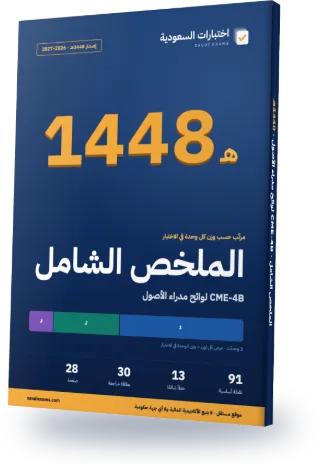
CME-4B Asset Manager Regulations Complete Review Guide 2026–2027
Every exam topic in a 28-page Arabic PDF, ordered from the heaviest unit to the lightest. The first three chapters alone cover about 100% of the exam questions.
- 28Pages
- 91Key points
- 13Common mistakes
- 30Flashcards
Guide map
Each chapter is one exam unit, ordered by its weight in the real exam.
| Chapter | Unit | Weight | Exam questions | Key points |
|---|---|---|---|---|
| 1 | Investment Funds Regulations | 56% | 14 | 40 |
| 2 | Real Estate Investment Funds Regulations | 32% | 8 | 34 |
| 3 | Market Conduct Regulations | 12% | 3 | 17 |
Chapter 1 in full: Investment Funds Regulations
56% of the exam, about 14 questions. These are its key points, as in the guide.
- 1.1 Management: the manager owes fiduciary duties to unitholders and has primary responsibility for management, offering and complete, clear and accurate terms. Delegation does not discharge that responsibility; liability covers losses caused by its fraud, negligence, misconduct or wilful default. [Workbook: printed pp.3–4; current Regulations: Art.9.]
- Financial statements are prepared in Arabic, which prevails over a conflicting translation. Public funds and private real estate funds require statements at least half-yearly; interim statements are reviewed and annual statements audited. Review and audit are different requirements. [Workbook: printed pp.4; current Regulations: Art.11.]
- Investment policy follows objectives and terms. Liquidity for anticipated redemptions concerns open-ended funds. Assess concentration against strategy and concentration disclosed in the terms, rather than treating every concentration as prohibited. [Workbook: printed pp.4; current Regulations: Art.14.]
The rest of chapter 1, on this page
- Special commissions may provide execution services or research benefiting the fund, with disclosure in the terms; direct cash payments to the manager are prohibited. Management and service charges must be on arm’s-length terms and stay within the stated cap. [Workbook: printed pp.4–5; current Regulations: Arts.16,19.]
- Liquidation: where the fund term expires before all assets have been sold, the workbook gives six months for liquidation and distribution, while current Article 23(i) gives twelve months. These are different deadlines for the same trigger; twelve months is not thereby a verified exam answer. [Workbook: printed pp.5; current Regulations: Art.23(i) — version conflict.]
- 2.1 Custody: the manager appoints a Kingdom-based, custody-licensed custodian by written contract, independent of the manager, sub-manager and their affiliates. Fund assets belong collectively to unitholders, rather than to the custodian. [Workbook: printed pp.6; current Regulations: Arts.25(a)–(c),26.]
- The custodian segregates each fund’s assets from its own and other clients’ assets, using a separate cash account in its name for the fund’s benefit. Appointing a sub-custodian does not transfer ultimate responsibility; the custodian pays the sub-custodian from its own resources. [Workbook: printed pp.6–7; current Regulations: Arts.27–29.]
- Additional current-law exception: Article 25(d) permits a non-independent feeder-fund custodian only where the feeder invests in another fund inside or outside the Kingdom, the custodian imposes no additional fees and the underlying fund is closed-ended. Workbook p.6 gives the independence rule without these details; do not generalise the exception to every feeder fund. [Workbook: printed pp.6; current Regulations: Art.25(d) — current-law supplement.]
- 3.1 Public funds: a public fund is established in the Kingdom and offered other than by private placement. Open-ended unit dealing is NAV-based; a closed-ended traded fund may trade at a premium or discount because its market price reflects supply and demand. [Workbook: printed pp.8–9; current Regulations: Arts.2,49,67,74.]
- The manager appoints the public-fund board with Authority approval. It has at least three directors; independent directors number at least two or one third, whichever is greater. Independence is assessed annually; a director discloses a direct or indirect interest and abstains on the affected resolution. [Workbook: printed pp.9–10; current Regulations: Art.39.]
- The board approves material contracts, decisions and reports, such as management and custody contracts; that does not mean approving each underlying investment trade. It oversees conflicts, meets the compliance committee or officer at least twice yearly and reviews risks and complaints. [Workbook: printed pp.10–11; current Regulations: Art.40.]
- Ordinary public-fund limits are not universal: Article 43 excludes approved specialised funds or a specific waiver. Denominators matter: holding 10% of an issuer’s issued securities differs from investing a percentage of fund NAV in one issuer’s class of securities; the latter also has specified exceptions. [Workbook: printed pp.11–12; current Regulations: Art.43(a),(c)–(d).]
- An index fund tracks a specified index: assess transparent constituents, weights and replicability rather than assuming every index is suitable. For an ETF, the custodian checks that in-kind creations or cancellations match the underlying assets, and the manager appoints a licensed market maker. [Workbook: printed pp.13–14; current Regulations: Arts.47–48.]
- Money market funds have specific liquidity and risk rules: derivatives are for hedging only, capped at 5% of NAV; liquidity or investments with remaining maturity no longer than seven days must be at least 10% of NAV; stress tests occur at least twice yearly. [Workbook: printed pp.15; current Regulations: Art.56(b),(i)–(j).]
- A public feeder invests in one fund and cannot invest in another feeder. A fund of funds invests in at least three funds, with at least 5% of its NAV in each of the three; the single-fund cap is 50%, cash is capped at 5% of total assets, and private funds at 10% of NAV. [Workbook: printed pp.15–16; current Regulations: Arts.57–58.]
- Capital protection is an investment objective, not merely a label: relevant documents must identify the fund as capital protected, and the counterparty or group cap is 25% of NAV. Endowment funds also follow General Authority of Awqaf requirements, with private-fund investment capped at 25% of NAV. [Workbook: printed pp.16; current Regulations: Arts.59–60.]
- 4.1 Private funds: private placement does not mean absence of regulation. Kingdom offerings follow private-placement procedures and client categories. The workbook identifies institutional and qualified clients and permits a retail offeree amount capped at SAR200,000 or equivalent per offeree: a maximum, not a minimum. [Workbook: printed pp.17–19; current Regulations: Arts.82–83.]
- Before a private-fund offer, the manager notifies the Authority at least 15 days before the proposed start, supplying the declaration, terms, documents, investment-decision information and compliance programme. The Authority can request information or prohibit the offer; notification is not an investment-quality guarantee. [Workbook: printed pp.19; current Regulations: Art.83.]
- The private-fund operator values assets, prices units and deals under a clear policy disclosed by the manager in the terms and annual report, consistently covering issue, transfer and redemption. The manager notifies unitholders of policy changes within five days. [Workbook: printed pp.20,26; current Regulations: Art.92(a)–(c).]
- Before a private real estate fund buys or sells property, it needs valuations from at least two accredited valuers independent of related parties and holding the Saudi Authority for Accredited Valuers fellowship. The reports must be no older than three months when the transaction occurs. [Workbook: printed pp.20; current Regulations: Art.92(d)–(f).]
- A private real estate fund has a manager-appointed board of at least three directors, with independent directors numbering at least two or one third, whichever is greater. Do not apply this private real estate board requirement to every private fund. [Workbook: printed pp.20; current Regulations: Art.86.]
- Current-text detail for private real estate board responsibilities within the topic on workbook p.20: the board approves development, custody, marketing, valuation and engineering-office contracts, decides on disclosed conflicts, approves auditor appointment and terms or amendments, and reviews compliance at least twice yearly. The workbook summarises oversight; this entire detail is not attributed to its wording. [Workbook: printed p.20; current Regulations: Art.87 — current-law supplement.]
- 5.1 A foreign fund is established outside the Kingdom. Its Kingdom offer goes through a licensed capital-market-institution distributor by private placement; its manager is authorised in a jurisdiction with at least equivalent regulatory standards. Foreign establishment does not remove local distribution requirements. [Workbook: printed pp.21; current Regulations: Arts.99–100.]
- The distributor connects Kingdom holders of a foreign fund with its manager: it sends manager-issued reports and documents and ensures holders directly receive the rights in the fund documentation. Do not assume the foreign manager’s website replaces this distribution duty. [Workbook: printed pp.23; current Regulations: Art.105(1).]
- 6.1 Public-fund reporting: the annual report includes audited statements and is available within three months after period-end; interim statements are available within 30 days. Reports are supplied to unitholders free on request. Do not substitute private-fund deadlines. [Workbook: printed pp.21–22; current Regulations: Art.78(a)–(c).]
- Use reports to assess performance and costs: comparative information includes NAV, NAV per unit, outstanding units, distributions and expense ratios; performance records include returns, actual fees and key service providers. Unit-price movement alone does not capture distributions or expenses. [Workbook: printed pp.22; current Regulations: Annex 3.]
- Private annual reporting: the workbook gives 90 working days, while current Article 95(a) says 90 days without “working”. Keep this as an unresolved exam-version difference. Private real estate interim reports are six-monthly and available within 35 days, a shared rule here. [Workbook: printed pp.23; current Regulations: Art.95(a)–(b) — annual deadline conflict.]
- Public-fund meetings: a written request from the custodian or holders of at least 25% requires the manager to call a meeting within ten days. First-meeting notice is ten to 21 days and quorum is 25% unless the terms require more; a second meeting on five days’ notice is valid regardless of represented holdings. [Workbook: printed pp.23; current Regulations: Art.77.]
- 7.1 The public-fund initial offer lasts no more than 60 days, at the stated initial price. The manager specifies a minimum amount; if it is not raised, full subscriptions and investment returns are refunded without deduction. Qualifying deposits are a temporary use shared by the workbook and current text. [Workbook: printed pp.24; current Regulations: Art.66.]
- Open-ended public funds have at least two dealing days weekly; closed-ended funds use the days specified in the terms. The operator uses NAV per unit for subscriptions and redemptions, paying redemption proceeds no later than the close of the fifth day after the valuation point that determined the price. [Workbook: printed pp.24–25; current Regulations: Arts.67(a),(e),74(a).]
- Pricing-point conflict: the workbook says the next valuation point after the subscription or redemption request; current Article 67(c) says after the submission deadline. A valuation point between request and deadline can produce different prices. Do not collapse the two into one settled exam rule. [Workbook: printed pp.25; current Regulations: Art.67(c) — version conflict.]
- The operator fully and fairly values public-fund assets on each dealing day under the terms, with the valuation point no more than one day from the request deadline. The manager documents a fair, consistent methodology; unit prices have at least four decimal places. [Workbook: printed pp.25; current Regulations: Arts.73–74.]
- NAV per unit equals fund net assets divided by outstanding units. Deduct liabilities and accrued expenses once: do not deduct expenses again if already included in liabilities. Deposits use nominal value plus accrued return; fund units use the latest published NAV per unit. [Workbook: printed pp.26; current Regulations: Art.73,Annex 5.]
- The operator records valuation or pricing errors and compensates all harmed holders, including former holders, as soon as reasonably practicable. At 0.5% or more, the manager immediately reports to the Authority and discloses. The disclosure threshold does not exempt smaller errors from recording and compensation. [Workbook: printed pp.25; current Regulations: Art.75.]
- Current-text supplement to the dealing framework introduced on workbook pp.24–25: open-ended public-fund redemptions may be deferred to the next dealing day if requests reach at least 10% of NAV, using fair selection procedures disclosed in the terms. Deferral differs from suspension; Article 69 governs suspension grounds, review and immediate notices to the Authority and holders at its start and end. These added details do not independently confirm exam scope. [Workbook: printed pp.24–25 (framework only); current Regulations: Arts.68–69 — current-law supplement.]
- Secondary transfers of private and foreign fund units are restricted: permitted categories include existing holders, qualified and institutional clients, or a transaction with consideration no greater than SAR200,000 or equivalent. Distinguish subsequent-transfer eligibility from the original offering procedure. [Workbook: printed pp.27; current Regulations: Arts.98,107.]
- 8.1 Closed-ended traded funds accept cash or in-kind consideration, but in-kind assets require two independent licensed valuations and transfer of title to the fund. Holders of at least 5% in units paid for in kind face a one-year disposal restriction from trading commencement; this is not a lock-up on every cash investor. [Workbook: printed pp.27–28; current Regulations: Art.49.]
- Closed-ended traded offering conditions include initial assets of at least SAR300 million for the Main Market or SAR100 million for the Parallel Market, and SAR10 nominal value per unit. Public holders subscribe in cash; the minimum subscription must not exceed 1,000 units per holder. The fund-size floor differs from the cap on the individual subscription minimum. [Workbook: printed pp.28; current Regulations: Art.50.]
- Closed-ended traded disclosure does not wait for annual reporting: non-public material developments are disclosed without delay. Specified events include an asset transaction or loss at 10% of NAV, a dispute at 5%, or a related-party transaction at 1% of gross revenue. The last denominator is revenue, not NAV. [Workbook: printed pp.28–29; current Regulations: Art.54(a)–(b).]
- For a holding of at least 5% in a closed-ended traded fund, the workbook names the Authority as notification recipient; current Article 54(c)(1) names the Exchange. Both give the end of the third trading day after the event: the recipient, not that deadline, differs. Aggregate relatives, controlled companies and persons acting in concert to acquire units; the exam recipient remains unresolved. [Workbook: printed pp.29; current Regulations: Art.54(c) — recipient conflict.]
Common mistakes in this chapter
- The operator calculates valuation and price; the manager sets policy and bears management and disclosure duties; the custodian safeguards and segregates assets. Keep the roles distinct.
- Specialised funds have their own rules; do not automatically apply an ordinary public-fund cap to a money market fund or fund of funds.
- SAR200,000 in the offering or transfer rules discussed is a maximum, not a minimum investment ticket.
- Four version differences are marked in place: liquidation six/twelve months; private reporting 90 working days/90 days; valuation after request/after deadline; holding notice to Authority/Exchange. Neither side is used as a definitive exam-answer card.
- Details labelled “current-law supplement” explain the legal comparison; they do not alone establish inclusion in the workbook 1.10 exam.
The other chapters are in the full guide
One purchase · lifetime access · review guide included
7-day review plan
The chapters are spread over 6 days by weight so each day carries a similar load. Day 7 is a full exam.
Day 1 · 56% of the exam
Chapter 1: Investment Funds Regulations
Day 2 · 32% of the exam
Chapter 2: Real Estate Investment Funds Regulations
Day 3 · 12% of the exam
Chapter 3: Market Conduct Regulations
Day 4
Full mock exam: 25 questions in 30 minutes, then review the common mistakes in the units where you lost marks.
How many correct answers do you need?
- Pass mark 68%17 correct out of 25
Before you read: see your score today
10 free questions from the main units, no sign-up. Then you know which chapter to start with.
Try 10 free questions and see your levelA look at each chapter
The first three key points of each chapter, as they appear in the guide (in Arabic in the PDF).
Chapter 1: Investment Funds Regulations
- 1.1 Management
- Financial statements are prepared in Arabic, which prevails over a conflicting translation. Public funds…
- Investment policy follows objectives and terms. Liquidity for anticipated redemptions concerns open-ended funds. Assess…
Chapter 2: Real Estate Investment Funds Regulations
- Structure — These Regulations concern public real estate funds. The five objectives cover land…
- The manager appoints the board after Authority approval. There must be at least three…
- Independence is assessed annually. The manager cannot dismiss an independent director on its own;…
Chapter 3: Market Conduct Regulations
- Inside information combines three conditions
- Secrecy alone is insufficient
- The current text specifies that the related security must be traded and its price…
The full guide comes with lifetime access
The full guide (28 pages) is included with lifetime access to this exam, together with every question and full mock exam. Chapter 1 is free for everyone.
Questions about the guide
Is the guide free?
Chapter 1 is free to read on the guide page. The full guide comes with lifetime access to this exam; 7-day access does not include it.
Is it up to date for 2026–2027?
Yes. Unit weights and exam facts follow what the exam body last published, and the last check date is printed in the guide. If the standards change we update the file and buyers download the new version.
Does the guide have questions?
No. The guide covers key points and common mistakes; scoring, weak-area practice and full mock exams are on the site.
Can I read it on my phone?
Yes. A5 pages in a single column, with chapters linked from the contents.
- Pages
- 28
- Edition
- 1448 AH · 2026–2027
- Language
- Arabic
- Last updated
Buy this exam
Pick the access that lasts until your test date.
Included
- Full mock exams: 25 questions in 30 minutes, with a score for every unit
- 514 questions, every option explained with its source
- Practice that starts with your weakest units, plus a review of your mistakes
- Complete Review Guide 2026–2027 (PDF), with lifetime access only
Continue with your Google account and you go straight to the payment page.
You pay on the Waffo Pancake checkout page (in English). The amount is in US dollars and your bank converts it to riyals. One payment with no automatic renewal, by Visa, Mastercard (a mada card with either logo works too), Apple Pay or Google Pay. Your statement shows "WAFFO". Purchases are not refundable.