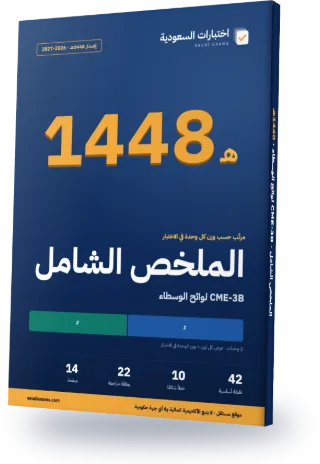
CME-3B Broker Regulations Complete Review Guide 2026–2027
Every exam topic in a 14-page Arabic PDF, ordered from the heaviest unit to the lightest. The first three chapters alone cover about 100% of the exam questions.
- 14Pages
- 42Key points
- 10Common mistakes
- 22Flashcards
Guide map
Each chapter is one exam unit, ordered by its weight in the real exam.
| Chapter | Unit | Weight | Exam questions | Key points |
|---|---|---|---|---|
| 1 | Market Conduct Regulations | 52% | 13 | 20 |
| 2 | Capital Market Institutions Conduct | 48% | 12 | 22 |
Chapter 1 in full: Market Conduct Regulations
52% of the exam, about 13 questions. These are its key points, as in the guide.
- Article 2: the prohibition includes participation with knowledge or reasonable grounds to know, including automated orders.
- Article 3: distinguish fictitious trades, matched orders, promotion to exit a holding and artificial-price orders; exceptions depend on compliance with their rules.
- Article 4: information concerns a security or its orders, is not publicly available and would be expected to have a material effect if made public.
The rest of chapter 1, on this page
- Articles 5 and 6: insiders are not just issuer employees. The rules address family, business and contractual relationships and direct and indirect trading.
- Articles 7–9: a statement may be oral or written; untruth may arise from omitting a material fact or circulating another person’s statement.
- Article 10: separate liability conditions from what a claimant must establish, and distinguish an untrue statement from failure to make a required statement.
- Manipulation is prohibited whether by trades or orders, and covers artificial prices in a related security.
- Orders not intended to execute, creating fictitious buying interest, are specified conduct even if unexecuted.
- Buying and selling between one's own accounts without change in beneficial ownership to fabricate activity is manipulation.
- Matched orders: entering an order knowing of a matching one in size, timing and price to fabricate activity.
- Promoting purchases to sell one's own or a partner's holding is specified conduct, and some accurate analysis does not cure it.
- The market-maker and share buyback exceptions require compliance with the governing rules and procedures.
- Inside information concerns a security or its orders, is non-public and would be expected to have a material effect on price or value if made public.
- Information may concern orders yet to be entered, not just orders visible in the order book.
- Insider trading covers selling and buying and indirect trading via an agent or attorney-in-fact.
- An insider can be an employee, contractor or related person, and a non-insider who receives the information by any means is not exempt.
- Article 6(b): it is enough that the trader knew or should have known the nature of the information.
- An untrue statement includes omitting a required material fact and may be oral or written.
- In an Article 10 claim the claimant must establish specific conditions such as materiality and lack of awareness of the untruth.
- Not authoring a rumour does not exempt circulating it for a prohibited purpose.
Common mistakes in this chapter
- An unexecuted order can still be manipulative.
- Not authoring a rumour does not exempt its circulation for a prohibited purpose.
- Not being an issuer employee is no exemption from inside-information rules.
- Treating use of an algorithm as removing the prohibition; automated orders are covered.
- Classifying an instrument as a security without checking traded-security status and the information's effect.
- Thinking insider-trading rules cover buying only; selling and negative news are covered too.
- Confusing materiality with non-public status; each element has its own test.
The other chapters are in the full guide
One purchase · lifetime access · review guide included
7-day review plan
The chapters are spread over 6 days by weight so each day carries a similar load. Day 7 is a full exam.
Day 1 · 52% of the exam
Chapter 1: Market Conduct Regulations
Day 2 · 48% of the exam
Chapter 2: Capital Market Institutions Conduct
Day 3
Full mock exam: 25 questions in 30 minutes, then review the common mistakes in the units where you lost marks.
Before you read: see your score today
10 free questions from the main units, no sign-up. Then you know which chapter to start with.
Try 10 free questions and see your levelA look at each chapter
The first three key points of each chapter, as they appear in the guide (in Arabic in the PDF).
Chapter 1: Market Conduct Regulations
- Article 2
- Article 3
- Article 4
Chapter 2: Capital Market Institutions Conduct
- Article 11
- Articles 12–16
- Article 17
The full guide comes with lifetime access
The full guide (14 pages) is included with lifetime access to this exam, together with every question and full mock exam. Chapter 1 is free for everyone.
Questions about the guide
Is the guide free?
Chapter 1 is free to read on the guide page. The full guide comes with lifetime access to this exam; 7-day access does not include it.
Is it up to date for 2026–2027?
Yes. Unit weights and exam facts follow what the exam body last published, and the last check date is printed in the guide. If the standards change we update the file and buyers download the new version.
Does the guide have questions?
No. The guide covers key points and common mistakes; scoring, weak-area practice and full mock exams are on the site.
Can I read it on my phone?
Yes. A5 pages in a single column, with chapters linked from the contents.
- Pages
- 14
- Edition
- 1448 AH · 2026–2027
- Language
- Arabic
- Last updated
All Finance & Insurance Exams review guides
Back to CME-3B – Saudi Capital Market Rules and Regulations (Brokers)
Buy this exam
Pick the access that lasts until your test date.
Included
- Full mock exams: 25 questions in 30 minutes, with a score for every unit
- 500 questions, every option explained with its source
- Practice that starts with your weakest units, plus a review of your mistakes
- Complete Review Guide 2026–2027 (PDF), with lifetime access only
Continue with your Google account and you go straight to the payment page.
You pay on the Waffo Pancake checkout page (in English). The amount is in US dollars and your bank converts it to riyals. One payment with no automatic renewal, by Visa, Mastercard (a mada card with either logo works too), Apple Pay or Google Pay. Your statement shows "WAFFO". Purchases are not refundable.