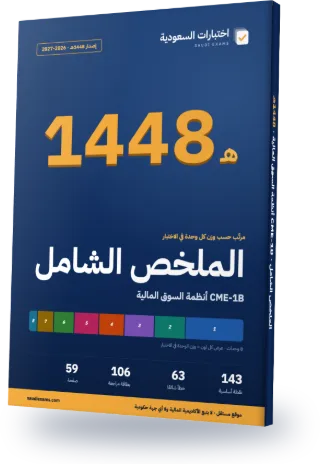
CME-1B Capital Market Rules Complete Review Guide 2026–2027
Every exam topic in a 59-page Arabic PDF, ordered from the heaviest unit to the lightest. The first three chapters alone cover about 54% of the exam questions.
- 59Pages
- 143Key points
- 63Common mistakes
- 106Flashcards
Guide map
Each chapter is one exam unit, ordered by its weight in the real exam.
| Chapter | Unit | Weight | Exam questions | Key points |
|---|---|---|---|---|
| 1 | Regulated Activities | 26% | 13 | 18 |
| 2 | Introduction to the Capital Market Authority | 14% | 7 | 18 |
| 3 | Prohibitions | 14% | 7 | 18 |
| 4 | Securities Business Regulations | 12% | 6 | 18 |
| 5 | Capital Market Institutions Regulations | 12% | 6 | 18 |
| 6 | Anti-Money Laundering and Counter-Terrorist Financing | 10% | 5 | 18 |
| 7 | Systems and Controls | 8% | 4 | 18 |
| 8 | Authorisation | 4% | 2 | 17 |
Chapter 1 in full: Regulated Activities
26% of the exam, about 13 questions. These are its key points, as in the guide.
- The 11 principles (Article 5): integrity; skill, care and diligence; efficiency of management and control; financial prudence; proper market conduct; protection of clients' assets; co-operation with regulators, including telling the Authority of any material event; clear, fair and not misleading communication; due regard to clients' interests; resolving conflicts of interest; suitability of advice and discretionary managing decisions (4.1.1).
- Fiduciary duties (Article 40 and Annex 5.4): loyalty, meaning good faith and acting in the client's interest; conflict of interest; no secret profits; and care, skill and diligence at the level of a person with the knowledge and experience expected of someone in the institution's position and the knowledge and experience it actually has. On a conflict of interest the institution discloses it to the client in writing and obtains written acknowledgment, otherwise it must pay the client any loss caused by the conflict, unless disclosure would reveal inside information (Article 41) (4.1.2).
- Article 42: the institution takes reasonable steps to enable the client to understand the risks, having regard to the client's education and knowledge, field of work, and experience in the capital markets, its duration and nature; the Article does not apply when dealing with an institutional client as counterparty (4.1.3).
The rest of chapter 1, on this page
- An investment fund is a collective investment scheme that lets investors share in its profits collectively and is run by a fund manager for specified fees; the fund manager is responsible for managing its assets and business and offering its units, and must act in the interest of unitholders (Investment Funds Regulations, Article 9) (4.2.1).
- A public fund is established by signing the terms and conditions between the first potential unitholders and the fund manager (Article 34), and is supervised by a fund board of at least three directors, of whom at least two or one third, whichever is greater, are independent (Article 39). The fund board's duties include approving material contracts, decisions and reports and a voting rights policy, overseeing conflicts of interest, meeting at least twice a year with the manager's compliance committee or officer, and confirming that the terms and conditions are complete and accurate (Article 40) (4.2.4).
- The custodian is appointed in the Kingdom under a written contract, must be a capital market institution licensed for custody and may not be the fund manager or its affiliate, and remains liable to the manager and unitholders for losses from its fraud, negligence, misconduct or wilful default (Articles 25 and 29); the fund operator is responsible for operating the fund (Article 9(d)) (4.2.4).
- An independent auditor registered with the Authority is appointed before a public fund is established; if nine months have passed since establishment before the fiscal year end the audit is due at the end of the first fiscal year, otherwise it may be done at the end of the second; fees are set with the fund board's approval (Article 76) (4.2.4).
- Fund classification: by client, public fund and private fund; by capital, open-ended fund whose capital changes with issues and redemptions and closed-ended fund, which is any fund not open-ended; by objective, specialised public fund and non-specialised public fund. There are five specialised public funds: money market fund, feeder fund, fund of funds, capital protected fund and endowment fund (Article 55) (4.2.3).
- Traded funds are the ETF, the closed-ended investment traded fund and the traded real estate investment fund (REIT); a person buying a unit on the Exchange is deemed to have read and accepted the terms and conditions (Articles 48 and 49). Conditions for a traded REIT (Real Estate Investment Funds Regulations, Article 47): a closed-ended fund with assets of at least SAR 500 million for the Main Market and SAR 100 million for the Parallel Market, a nominal unit value of SAR 10, at least 75% invested in developed, income-generating real estate, and distributions of at least 90% of net profits annually (4.2.3).
- The prospectus is submitted to the Authority, published and its fees paid before the offer (Capital Market Law, Article 40), and contains a description of the issuer, its business, management and major shareholders, a description of the securities, their number, price and rights, use of proceeds and commissions, and the financial position with an audited balance sheet, profit and loss account and cash flow statement (Article 42) (4.3.1).
- Every issuer offering securities to the public or traded on the Exchange files quarterly and annual reports with the Authority covering the balance sheet, profit and loss account and cash flow statement, annual reports are audited, and the issuer notifies the Authority of any change to the prospectus that may affect the price or value of the security (Articles 43 and 45) (4.3.2).
- An exempt offer falls outside the Rules, for example securities issued by the government (Article 6); a private placement is limited to institutional and qualified clients or is a limited offer, and is made through a capital market institution licensed for arranging with notice to the Authority 10 days ahead (Articles 8 and 10) (4.4.1).
- A public offer is open to all investors and requires prior arrangements for listing on the Exchange (Articles 15 and 16); a limited offer has no more than 100 offerees (not counting institutional and qualified clients) and SAR 200,000 each; a Parallel Market offer is limited to categories of qualified investors (Article 74) (4.4.1).
- The issuer's two representatives before the Authority are a director and a senior executive, with contact details provided in writing; for a special purposes entity the entity's representatives come from its board and the sponsor's are a board member and a senior executive (Article 18). The financial advisor is authorised for arranging and is the Authority's main point of contact, checks through due diligence that the issuer has met the conditions, provides what the Authority asks for and reports new matters until the offer completes (Article 21); the legal advisor is licensed to practise law in the Kingdom (Article 22) (4.6.1 and 4.6.2).
- A special purposes entity is an entity established and licensed by the Authority to issue debt instruments or investment units, with legal personality and financial autonomy, ending when its purpose ends; its purposes are financing other than bank loans, giving the issue to a separate entity, giving the fund legal personality, and protecting investors from the bankruptcy of related parties (Rules for Special Purposes Entities, Articles 46 and 55) (4.7.1).
- Debt instruments issued by SPEs: asset-backed (return wholly depends on the SPE's asset returns and the sponsor is not obliged to pay), asset-linked recourse (return is a ratio of the asset returns and the sponsor must pay all amounts due), and debt-based recourse (return does not depend on asset returns, the sponsor must pay, and par value is paid at or before maturity) (4.7.1).
- A listed company shareholder's rights (Corporate Governance Regulations, Article 5): a share of profits distributed in cash or shares, a share of assets on liquidation, attending assemblies and voting, disposing of shares, viewing books and documents, holding board members accountable and filing liability suits, pre-emptive rights for new shares issued for cash, being recorded in the shareholders register, and nominating and electing board members (4.8.1).
- The ordinary general assembly handles what is not reserved for the extraordinary one, including electing and removing board members, permitting a board member's direct or indirect interest, appointing the external auditor and setting fees, deciding profit distribution, and approving the sale of more than 50% of the company's assets (Article 12); the extraordinary general assembly handles amending the bylaws, increasing and decreasing capital, share buy-backs, issuing preferred shares or convertible debt instruments and suspending pre-emptive rights (Article 11) (4.8.2).
Common mistakes in this chapter
- Mixing up the 11 principles (Article 5) with the four fiduciary duties (Annex 5.4): the principles are a general statement of conduct, while the fiduciary duties are owed to the client.
- Thinking that no secret profits bans any use of the client's assets or information: it is allowed after full disclosure and the client's consent.
- Mixing up the roles of fund parties: the manager manages and offers, the operator operates, values and prices, the fund board supervises the manager, the custodian holds the assets, and the auditor is independent and registered with the Authority.
- Assuming delegation frees the delegator: the fund manager and the custodian stay responsible for compliance with the Investment Funds Regulations and for losses from fraud, negligence, misconduct and wilful default.
- Defining a closed-ended fund as one with fixed units: it is any fund that is not open-ended, and an open-ended fund is one whose capital changes as new units are issued and unitholders redeem.
- Confusing a private placement with a limited offer: a limited offer is one kind of private placement, with at most 100 offerees, at most SAR 200,000 each, and no repeat for the same class within 12 months (Article 9).
- Mixing up the debt instrument types: for asset-backed the sponsor owes holders nothing, for asset-linked and debt-based recourse the sponsor must pay all amounts due, and for debt-based recourse the return does not depend on the SPE's asset returns.
- Mixing up the general assembly numbers: notice at least 21 days ahead, the annual ordinary assembly within six months of the financial year end, and the assembly called within 30 days of a request from the auditor, the audit committee or shareholders holding at least 10% of voting shares.
The other chapters are in the full guide
One purchase · lifetime access · review guide included
7-day review plan
The chapters are spread over 6 days by weight so each day carries a similar load. Day 7 is a full exam.
Day 1 · 26% of the exam
Chapter 1: Regulated Activities
Day 2 · 14% of the exam
Chapter 2: Introduction to the Capital Market Authority
Day 3 · 14% of the exam
Chapter 3: Prohibitions
Day 4 · 16% of the exam
Chapter 4: Securities Business Regulations
Chapter 8: AuthorisationDay 5 · 12% of the exam
Chapter 5: Capital Market Institutions Regulations
Day 6 · 18% of the exam
Chapter 6: Anti-Money Laundering and Counter-Terrorist Financing
Chapter 7: Systems and ControlsDay 7
Full mock exam: 50 questions in 60 minutes, then review the common mistakes in the units where you lost marks.
How many correct answers do you need?
- Pass mark 70%35 correct out of 50
Before you read: see your score today
10 free questions from the main units, no sign-up. Then you know which chapter to start with.
Try 10 free questions and see your levelA look at each chapter
The first three key points of each chapter, as they appear in the guide (in Arabic in the PDF).
Chapter 1: Regulated Activities
- The 11 principles (Article 5)
- Fiduciary duties (Article 40 and Annex 5.4)
- Article 42
Chapter 2: Introduction to the Capital Market Authority
- The Capital Market Law was issued by Royal Decree No. M/30 dated 2/6/1424H. It…
- The Authority may not engage in commercial activity, hold a special interest in a…
- Securities under the Law
Chapter 3: Prohibitions
- Untrue statements (Market Conduct Regulations Article 7)
- A statement is untrue if it is false or inaccurate in a material respect…
- Rumours (Article 8)
Chapter 4: Securities Business Regulations
- Dealing
- Dealing as principal means buying and selling on your own account; dealing as agent…
- Arranging
Chapter 5: Capital Market Institutions Regulations
- A registrable function is a role that only a person registered with the Authority…
- After the 2026 amendment there are eight registrable functions: CEO or managing member, CFO…
- A registered person must be in place at all times for CEO or managing…
Chapter 6: Anti-Money Laundering and Counter-Terrorist Financing
- Money laundering is committed by transferring, transporting or dealing in funds known to be…
- Acquiring, possessing or using funds known to be proceeds of crime or from an…
- A predicate offence is any act punishable under Sharia or the Kingdom's laws, and…
Chapter 7: Systems and Controls
- For an actual or potential conflict, the institution discloses it in writing and obtains…
- Unless the conflict was disclosed and the client agreed in writing to proceed, the…
- Chinese wall arrangements are written policies and procedures ensuring confidential or inside information is…
Chapter 8: Authorisation
- A person intending to carry on securities business in the Kingdom applies on the…
- The applicant is subject to the Capital Market Institutions Regulations from the date of…
- If the applicant is not yet established, its founders or controlling shareholders may submit…
The full guide comes with lifetime access
The full guide (59 pages) is included with lifetime access to this exam, together with every question and full mock exam. Chapter 1 is free for everyone.
Questions about the guide
Is the guide free?
Chapter 1 is free to read on the guide page. The full guide comes with lifetime access to this exam; 7-day access does not include it.
Is it up to date for 2026–2027?
Yes. Unit weights and exam facts follow what the exam body last published, and the last check date is printed in the guide. If the standards change we update the file and buyers download the new version.
Does the guide have questions?
No. The guide covers key points and common mistakes; scoring, weak-area practice and full mock exams are on the site.
Can I read it on my phone?
Yes. A5 pages in a single column, with chapters linked from the contents.
- Pages
- 59
- Edition
- 1448 AH · 2026–2027
- Language
- Arabic
- Last updated
All Finance & Insurance Exams review guides
Back to CME-1B: Saudi Capital Market Laws and Regulations (General)
Buy this exam
Pick the access that lasts until your test date.
Included
- Full mock exams: 50 questions in 60 minutes, with a score for every unit
- 287 questions, every option explained with its source
- Practice that starts with your weakest units, plus a review of your mistakes
- Complete Review Guide 2026–2027 (PDF), with lifetime access only
Continue with your Google account and you go straight to the payment page.
You pay on the Waffo Pancake checkout page (in English). The amount is in US dollars and your bank converts it to riyals. One payment with no automatic renewal, by Visa, Mastercard (a mada card with either logo works too), Apple Pay or Google Pay. Your statement shows "WAFFO". Purchases are not refundable.