FE
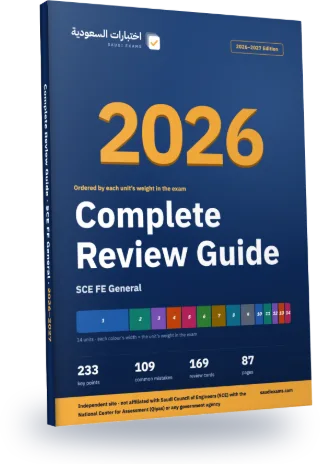
SCE FE General Complete Review Guide 2026–2027
Every exam topic in a 87-page Arabic PDF, ordered from the heaviest unit to the lightest. The first three chapters alone cover about 41% of the exam questions.
- 87Pages
- 233Key points
- 109Common mistakes
- 169Flashcards
Guide map
Each chapter is one exam unit, ordered by its weight in the real exam.
| Chapter | Unit | Weight | Exam questions | Key points |
|---|---|---|---|---|
| 1 | General Skills | 24% | 22 | 17 |
| 2 | Mathematics | 10% | 9 | 16 |
| 3 | Computer Literacy | 7% | 6 | 17 |
| 4 | Statics and Dynamics | 7% | 6 | 15 |
| 5 | Chemistry | 7% | 6 | 15 |
| 6 | Materials Science and Engineering | 7% | 6 | 18 |
| 7 | Engineering Economics | 7% | 6 | 18 |
| 8 | Project Management | 7% | 6 | 18 |
| 9 | Ethics and Professionalism | 7% | 6 | 16 |
| 10 | Probability and Statistics | 4% | 4 | 16 |
| 11 | Engineering Drawing | 4% | 4 | 18 |
| 12 | Thermodynamics | 3% | 3 | 14 |
| 13 | Fluid Mechanics | 3% | 3 | 18 |
| 14 | Electricity and Magnetism | 3% | 3 | 17 |
Chapter 1 in full: General Skills
24% of the exam, about 22 questions. These are its key points, as in the guide.
- Deductive reasoning moves from general to specific and guarantees the conclusion if the premises hold; inductive reasoning moves from specific to general and only makes the conclusion probable (GE-T14-01).
- Valid form: if A then B; A is true, so B is true (modus ponens). Denying B implies denying A (GE-T14-01).
- In written communication: start with the summary, then the evidence, and match the language to the reader (GE-T14-02).
The rest of chapter 1, on this page
- In graphs: a clear title, labelled axes with units, and a suitable scale (GE-T14-02).
- Effective oral communication includes active listening and checking understanding by paraphrasing (GE-T14-02).
- Successful teamwork needs clear roles, shared goals, open communication and accountability (GE-T14-03).
- SMART goals: specific, measurable, achievable, relevant, time-bound (GE-T14-04).
- Continuing professional development (CPD) includes courses, certifications, mentoring and reading (GE-T14-04).
- The five conflict styles: competing, collaborating, compromising, avoiding, accommodating (GE-T14-05).
- In resolving conflict: separate people from the problem, focus on interests rather than positions, and look for win-win options (GE-T14-05).
- Eisenhower matrix: urgent and important, do now; important not urgent, schedule; urgent not important, delegate (GE-T14-06).
- The critical path is the longest chain of activities; any delay on it delays the whole project (GE-T14-06).
- Sustainability looks at three dimensions: environmental, social and economic (triple bottom line) (GE-T14-07).
- An environmental impact assessment (EIA) is done before construction to identify project impacts and ways to reduce them (GE-T14-07).
- Hierarchy of controls: eliminate the hazard, substitute, engineering controls, administrative controls, then personal protective equipment (GE-T14-07).
- Significant figures: for multiplication and division keep the fewest significant figures; for addition and subtraction keep the fewest decimal places (GE-T14-10).
- Standard deviation measures spread around the mean; about 95% of normally distributed values fall within ±2σ (GE-T14-11).
Common mistakes in this chapter
- Mixing up necessary and sufficient conditions in inference questions.
- Confusing an assumption with a conclusion: an assumption is an unstated premise the reasoning needs.
- Affirming the consequent: if A then B, and B happened, does not mean A happened.
- Escalating to the manager at once in any dispute between colleagues before trying direct dialogue.
- Using one communication style for every audience: a technical report does not suit a non-specialist client without simplification.
- Adding relative uncertainties for sums and differences, or absolute ones for products and quotients.
- Counting zeros to the left of a number as significant: 0.0045 has only two significant figures.
- Picking the alternative on cost alone in a decision matrix, ignoring weights, safety and environment.
The other chapters are in the full guide
One purchase · lifetime access · review guide included
7-day review plan
The chapters are spread over 6 days by weight so each day carries a similar load. Day 7 is a full exam.
Day 1 · 24% of the exam
Chapter 1: General Skills
Day 2 · 17% of the exam
Chapter 2: Mathematics
Chapter 11: Engineering Drawing
Chapter 13: Fluid MechanicsDay 3 · 17% of the exam
Chapter 3: Computer Literacy
Chapter 7: Engineering Economics
Chapter 14: Electricity and MagnetismDay 4 · 14% of the exam
Chapter 4: Statics and Dynamics
Chapter 8: Project ManagementDay 5 · 14% of the exam
Chapter 5: Chemistry
Chapter 9: Ethics and ProfessionalismDay 6 · 14% of the exam
Chapter 6: Materials Science and Engineering
Chapter 10: Probability and Statistics
Chapter 12: ThermodynamicsDay 7
Full mock exam: 90 questions in 180 minutes, then review the common mistakes in the units where you lost marks.
Before you read: see your score today
10 free questions from the main units, no sign-up. Then you know which chapter to start with.
Try 10 free questions and see your levelA look at each chapter
The first three key points of each chapter, as they appear in the guide (in Arabic in the PDF).
Chapter 1: General Skills
- Deductive reasoning moves from general to specific and guarantees the conclusion if the premises…
- Valid form
- In written communication
Chapter 2: Mathematics
- Chain rule \( \frac{d}{dx}f(g(x))=f'(g(x))\,g'(x) \), product rule \( (uv)'=u'v+uv' \), quotient rule \( (u/v)'=(u'v-uv')/v^2…
- The tangent slope at \( x_0 \) is \( f'(x_0) \), and the tangent…
- The absolute maximum on a closed interval comes from comparing function values at the…
Chapter 3: Computer Literacy
- The CPU contains the ALU and the control unit; main memory (RAM) is volatile…
- Input devices include the keyboard and mouse, output devices the monitor and printer, and…
- 1 byte \( =8 \) bits; 1 KB \( =1024 \) bytes in traditional…
Chapter 4: Statics and Dynamics
- A particle in equilibrium has zero resultant force; no moment equation is needed because…
- Moment of a force
- A pin support gives two reaction components, a roller gives one reaction perpendicular to…
Chapter 5: Chemistry
- The formula of an ionic compound makes total charge zero
- Common names
- Group 1 elements other than hydrogen are reactive alkali metals, group 17 are halogens…
Chapter 6: Materials Science and Engineering
- Mechanical properties
- Electrical properties
- Selecting a material
Chapter 7: Engineering Economics
- The balance sheet shows financial position at a specific date: assets = liabilities +…
- The income statement shows revenues and expenses over a period, with net income =…
- The cash flow statement splits cash into operating, investing, and financing activities (indicator 11.1).
Chapter 8: Project Management
- A project is a temporary effort with a start and an end that produces…
- The three constraints are scope, time, and cost; a change in one affects the…
- Project process groups
Chapter 9: Ethics and Professionalism
- Engineering codes of ethics rest on core principles
- An engineer makes truthful, objective public statements and does not exaggerate qualifications or experience…
- An engineer keeps client and employer information confidential unless that conflicts with public safety…
Chapter 10: Probability and Statistics
- Mean \( \bar{x}=\frac{1}{n}\sum x_i \); the median is the middle value after sorting; the…
- Sample variance \( s^2=\frac{\sum(x_i-\bar{x})^2}{n-1} \) and standard deviation \( s=\sqrt{s^2} \) (GE-T2-01).
- Multiplication rule \( P(A\cap B)=P(A)P(B|A) \); for independent events \( P(B|A)=P(B) \) (GE-T2-02).
Chapter 11: Engineering Drawing
- Thick continuous line
- Dashed line
- Thin chain line
Chapter 12: Thermodynamics
- \( R=8.314 \) J/(mol·K) \( =0.08206 \) L·atm/(mol·K); choose the constant that matches the…
- For a fixed mass of ideal gas
- The saturated steam table is entered by pressure or temperature and gives \( v_f…
Chapter 13: Fluid Mechanics
- At depth \( h \) in a static fluid of constant density
- Pascal's law
- A piezometer is a vertical tube that measures the gauge pressure of a liquid…
Chapter 14: Electricity and Magnetism
- Electric charge \( Q \) is in coulombs, and the electron charge is about…
- Power \( P=VI=I^2R=\dfrac{V^2}{R} \) is in watts, energy \( W=Pt \) is in joules…
- Magnetism
The full guide comes with lifetime access
The full guide (87 pages) is included with lifetime access to this exam, together with every question and full mock exam. Chapter 1 is free for everyone.
Questions about the guide
Is the guide free?
Chapter 1 is free to read on the guide page. The full guide comes with lifetime access to this exam; 7-day access does not include it.
Is it up to date for 2026–2027?
Yes. Unit weights and exam facts follow what the exam body last published, and the last check date is printed in the guide. If the standards change we update the file and buyers download the new version.
Does the guide have questions?
No. The guide covers key points and common mistakes; scoring, weak-area practice and full mock exams are on the site.
Can I read it on my phone?
Yes. A5 pages in a single column, with chapters linked from the contents.
- Pages
- 87
- Edition
- 1448 AH · 2026–2027
- Language
- Arabic
- Last updated
All Engineering Exams review guides
Back to Saudi Council of Engineers FE Exam: General Engineering Part
Buy this exam
Pick the access that lasts until your test date.
Included
- Full mock exams: 90 questions in 180 minutes, with a score for every unit
- 508 questions, every option explained with its source
- Practice that starts with your weakest units, plus a review of your mistakes
- Complete Review Guide 2026–2027 (PDF), with lifetime access only
Continue with your Google account and you go straight to the payment page.
You pay on the Waffo Pancake checkout page (in English). The amount is in US dollars and your bank converts it to riyals. One payment with no automatic renewal, by Visa, Mastercard (a mada card with either logo works too), Apple Pay or Google Pay. Your statement shows "WAFFO". Purchases are not refundable.