FE
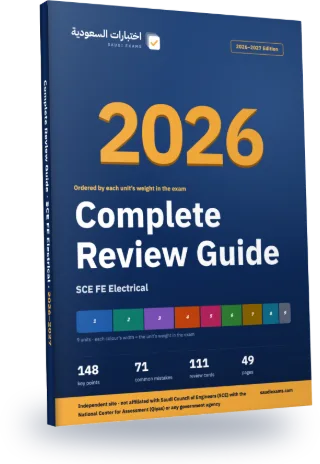
SCE FE Electrical Complete Review Guide 2026–2027
Every exam topic in a 49-page Arabic PDF, ordered from the heaviest unit to the lightest. The first three chapters alone cover about 44% of the exam questions.
- 49Pages
- 148Key points
- 71Common mistakes
- 111Flashcards
Guide map
Each chapter is one exam unit, ordered by its weight in the real exam.
| Chapter | Unit | Weight | Exam questions | Key points |
|---|---|---|---|---|
| 1 | Circuits | 16% | 8 | 17 |
| 2 | Power | 14% | 7 | 18 |
| 3 | Electronics | 14% | 7 | 16 |
| 4 | Digital Systems | 12% | 6 | 16 |
| 5 | Control Systems | 10% | 5 | 17 |
| 6 | Communications | 10% | 5 | 16 |
| 7 | Computer Systems | 10% | 5 | 17 |
| 8 | Signal Processing | 8% | 4 | 16 |
| 9 | Electromagnetics | 6% | 3 | 15 |
Chapter 1 in full: Circuits
16% of the exam, about 8 questions. These are its key points, as in the guide.
- KCL: \( \sum I_{in}=\sum I_{out} \) at a node; KVL: \( \sum V=0 \) around a loop; choose reference directions for currents and voltages and keep them consistent (EE-T1-01).
- Two resistors in parallel: \( R_{eq}=R_1R_2/(R_1+R_2) \); voltage divider for series: \( V_k=V_s\,R_k/\sum R \) (EE-T1-02).
- Current divider for two parallel resistors: \( I_1=I_s\,R_2/(R_1+R_2) \), so the larger current flows through the smaller resistance (EE-T1-02).
The rest of chapter 1, on this page
- In DC steady state an inductor acts as a short circuit and a capacitor as an open circuit; the reverse holds at very high frequency (EE-T1-03).
- Complex impedance \( Z=R+jX \) with magnitude \( \sqrt{R^2+X^2} \) and angle \( \tan^{-1}(X/R) \); \( X_L=\omega L \) and \( X_C=1/(\omega C) \) (EE-T1-03).
- Zeros of \( H(s) \) are numerator roots and poles are denominator roots; the first-order low-pass transfer function is \( H(s)=1/(1+sRC) \) (EE-T1-04).
- In nodal analysis pick a reference node and write KCL for the others; a supernode encloses a voltage source between two non-reference nodes and adds the constraint \( V_a-V_b=V_s \) (EE-T1-05).
- In mesh analysis write KVL for each independent mesh; a current source shared by two meshes is handled with a supermesh, which adds the constraint \( I_a-I_b=I_s \) (EE-T1-05).
- Norton from Thevenin: \( I_N=V_{th}/R_{th} \) and \( R_N=R_{th} \); source transformation preserves what the load sees (EE-T1-06).
- Two-port parameters: \( V=ZI \), \( I=YV \), \( V_1=AV_2-BI_2 \); for a reciprocal network \( Z_{12}=Z_{21} \) and \( AD-BC=1 \) (EE-T1-07).
- Series second-order circuit: \( \alpha=R/2L \), \( \omega_0=1/\sqrt{LC} \); overdamped if \( \alpha>\omega_0 \), critically damped if equal, underdamped if \( \alpha<\omega_0 \) with damped frequency \( \omega_d=\sqrt{\omega_0^2-\alpha^2} \) (EE-T1-08).
- Laplace: \( \mathcal{L}\{di/dt\}=sI(s)-i(0) \); a capacitor with initial voltage \( v_0 \) is \( 1/sC \) in series with a \( v_0/s \) source, and an inductor is \( sL \) in series with a \( Li_0 \) source (EE-T1-09).
- Initial and final value theorems: \( f(0^+)=\lim_{s\to\infty}sF(s) \) and \( f(\infty)=\lim_{s\to0}sF(s) \), valid only when the poles of \( sF(s) \) are in the left half-plane (EE-T1-09).
- In design, damping ratio \( \zeta=\alpha/\omega_0 \); in series RLC, increasing \( R \) raises damping and lowers \( Q \) (EE-T1-10).
- Series resonance: \( Q=\omega_0L/R=1/(\omega_0RC) \) and \( BW=R/L \) in rad/s; parallel: \( Q=R/(\omega_0L)=\omega_0RC \) and \( BW=1/(RC) \) (EE-T1-11).
- A first-order passive filter rolls off at 20 dB per decade past the cutoff, with a 45° phase shift there; a high-pass swaps the positions of \( R \) and \( C \) (EE-T1-12).
- Practical aspects: a high \( Q \) gives high selectivity but, in series resonance, raises the voltage across \( L \) and \( C \) to \( Q \) times the source voltage, which can overstress components (EE-T1-13).
Common mistakes in this chapter
- When finding \( R_{th} \), only independent sources are deactivated: voltage sources are shorted and current sources opened. Dependent sources stay, and the resistance is found with a test source.
- Maximum power transfer at \( R_L=R_{th} \) gives only 50% efficiency in the equivalent circuit; it is not maximum efficiency. And \( P_{max}=V_{th}^2/(4R_{th}) \), not \( V_{th}^2/R_{th} \).
- Mixing frequency \( f \) in hertz with angular frequency \( \omega=2\pi f \) in rad/s; many wrong answers come from forgetting \( 2\pi \) in \( X_L \), \( X_C \) and \( f_0 \).
- The time constant of an RL circuit is \( L/R \), not \( RL \); for RC it is \( RC \). After one \( \tau \) the response has covered 63.2% of the total change, and it settles after about \( 5\tau \).
- At series resonance the impedance is minimum (equal to \( R \)) and current is maximum; at ideal parallel resonance the impedance is maximum and the line current is minimum. Do not swap them.
- The damping coefficient \( \alpha \) differs by topology: \( R/2L \) for series RLC and \( 1/(2RC) \) for parallel RLC; using the wrong one flips the answer between overdamped and underdamped.
- Two-port connections: series adds Z parameters, parallel adds Y parameters, and cascade multiplies ABCD matrices in the correct order; changing the order changes the result.
- Passive filters have no active gain: the voltage gain stays at or below 1 except for resonance peaking, and real amplification needs active elements. At the cutoff the gain is \( 1/\sqrt{2} \) (−3 dB), not 0.5.
The other chapters are in the full guide
One purchase · lifetime access · review guide included
7-day review plan
The chapters are spread over 6 days by weight so each day carries a similar load. Day 7 is a full exam.
Day 1 · 16% of the exam
Chapter 1: Circuits
Day 2 · 14% of the exam
Chapter 2: Power
Day 3 · 14% of the exam
Chapter 3: Electronics
Day 4 · 18% of the exam
Chapter 4: Digital Systems
Chapter 9: ElectromagneticsDay 5 · 20% of the exam
Chapter 5: Control Systems
Chapter 7: Computer SystemsDay 6 · 18% of the exam
Chapter 6: Communications
Chapter 8: Signal ProcessingDay 7
Full mock exam: 50 questions in 180 minutes, then review the common mistakes in the units where you lost marks.
Before you read: see your score today
10 free questions from the main units, no sign-up. Then you know which chapter to start with.
Try 10 free questions and see your levelA look at each chapter
The first three key points of each chapter, as they appear in the guide (in Arabic in the PDF).
Chapter 1: Circuits
- KCL
- Two resistors in parallel
- Current divider for two parallel resistors
Chapter 2: Power
- Balanced three-phase power
- A balanced system is solved with a per-phase equivalent circuit using an equivalent wye…
- Resistance \( R=\rho l/A \) rises with temperature and, for AC, with the skin…
Chapter 3: Electronics
- Silicon
- Mass-action law
- Drift
Chapter 4: Digital Systems
- Unsigned range for n bits
- BCD encodes each decimal digit in four bits. Gray code changes only one bit…
- One's complement just inverts the bits; two's complement is one's complement plus 1. In…
Chapter 5: Control Systems
- Series blocks
- The closed-loop characteristic equation is \( 1+G(s)H(s)=0 \); its roots are the closed-loop poles…
- A BIBO-stable system has an absolutely integrable impulse response, which means all poles are…
Chapter 6: Communications
- AM modulation index from the envelope
- AM power
- AM variants
Chapter 7: Computer Systems
- Classic five-stage pipeline
- CPI with a pipeline
- Cache miss types
Chapter 8: Signal Processing
- Quantization step \( \Delta=V_{FS}/2^n \); example
- Quantization noise power is \( \Delta^2/12 \) for uniformly distributed error (indicator 6.1).
- Bits needed for a given resolution
Chapter 9: Electromagnetics
- Coulomb's law
- Electric potential \( V=-\int\vec E\cdot d\vec l \) and \( \vec E=-\nabla V \);…
- Magnetic circuit
The full guide comes with lifetime access
The full guide (49 pages) is included with lifetime access to this exam, together with every question and full mock exam. Chapter 1 is free for everyone.
Questions about the guide
Is the guide free?
Chapter 1 is free to read on the guide page. The full guide comes with lifetime access to this exam; 7-day access does not include it.
Is it up to date for 2026–2027?
Yes. Unit weights and exam facts follow what the exam body last published, and the last check date is printed in the guide. If the standards change we update the file and buyers download the new version.
Does the guide have questions?
No. The guide covers key points and common mistakes; scoring, weak-area practice and full mock exams are on the site.
Can I read it on my phone?
Yes. A5 pages in a single column, with chapters linked from the contents.
- Pages
- 49
- Edition
- 1448 AH · 2026–2027
- Language
- Arabic
- Last updated
All Engineering Exams review guides
Back to Saudi Council of Engineers FE Exam: Electrical Engineering Part
Buy this exam
Pick the access that lasts until your test date.
Included
- Full mock exams: 50 questions in 180 minutes, with a score for every unit
- 330 questions, every option explained with its source
- Practice that starts with your weakest units, plus a review of your mistakes
- Complete Review Guide 2026–2027 (PDF), with lifetime access only
Continue with your Google account and you go straight to the payment page.
You pay on the Waffo Pancake checkout page (in English). The amount is in US dollars and your bank converts it to riyals. One payment with no automatic renewal, by Visa, Mastercard (a mada card with either logo works too), Apple Pay or Google Pay. Your statement shows "WAFFO". Purchases are not refundable.