FE
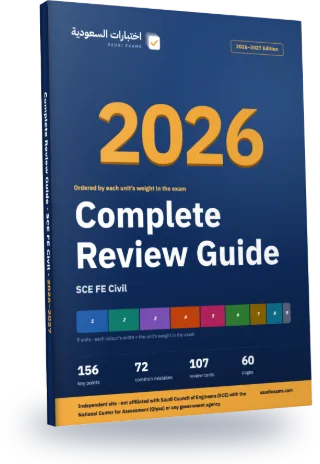
SCE FE Civil Complete Review Guide 2026–2027
Every exam topic in a 60-page Arabic PDF, ordered from the heaviest unit to the lightest. The first three chapters alone cover about 42% of the exam questions.
- 60Pages
- 156Key points
- 72Common mistakes
- 107Flashcards
Guide map
Each chapter is one exam unit, ordered by its weight in the real exam.
| Chapter | Unit | Weight | Exam questions | Key points |
|---|---|---|---|---|
| 1 | Structural Analysis | 14% | 7 | 17 |
| 2 | Structural Design | 14% | 7 | 17 |
| 3 | Geotechnical Engineering | 14% | 7 | 18 |
| 4 | Water Resources Engineering | 14% | 7 | 17 |
| 5 | Environmental Engineering | 12% | 6 | 17 |
| 6 | Transportation Engineering | 12% | 6 | 18 |
| 7 | Materials | 8% | 4 | 17 |
| 8 | Construction Management | 8% | 4 | 18 |
| 9 | Surveying | 4% | 2 | 17 |
Chapter 1 in full: Structural Analysis
14% of the exam, about 7 questions. These are its key points, as in the guide.
- Axial stress \( \sigma=P/A \), strain \( \varepsilon=\delta/L \), elongation \( \delta=PL/(AE) \) (CE-T1-01).
- Torsion in a circular shaft: \( \tau=Tr/J \), angle of twist \( \phi=TL/(GJ) \), and \( J=\pi d^4/32 \) for a solid circle.
- Bending stress \( \sigma=My/I \): maximum at the extreme fibre. The neutral axis passes through the centroid, and section modulus is \( S=I/c \) (CE-T1-02).
The rest of chapter 1, on this page
- Shear stress \( \tau=VQ/(Ib) \). For a rectangle the maximum is \( 1.5V/A \) at the neutral axis.
- Mohr's circle: centre \( (\sigma_x+\sigma_y)/2 \), radius \( R=\sqrt{((\sigma_x-\sigma_y)/2)^2+\tau_{xy}^2} \). Principal stresses = centre \( \pm R \); maximum in-plane shear = \( R \) (CE-T1-03).
- Generalized Hooke's law: \( \varepsilon_x=[\sigma_x-\nu(\sigma_y+\sigma_z)]/E \), and \( G=E/(2(1+\nu)) \).
- Euler load \( P_{cr}=\pi^2EI/(KL)^2 \). Theoretical \( K \): pinned-pinned 1.0, fixed-free 2.0, fixed-fixed 0.5, fixed-pinned about 0.7 (CE-T1-04).
- Slenderness ratio \( KL/r \) with \( r=\sqrt{I/A} \). The larger it is, the lower the critical stress \( \sigma_{cr}=\pi^2E/(KL/r)^2 \).
- Loads: dead = weight of permanent elements; live = occupancy and use; wind pressure varies with height, exposure and building shape. Combinations and values come from the Saudi loads code (CE-T1-05).
- Equilibrium: \( \sum F_x=0 \), \( \sum F_y=0 \), \( \sum M=0 \). Also \( dM/dx=V \) and \( dV/dx=-w \); maximum moment occurs where \( V=0 \) (CE-T1-06).
- A planar truss is statically determinate when \( m+r=2j \) (members + reactions = twice the number of joints).
- Method of joints: two equilibrium equations per joint. Method of sections: cut through at most three unknown members and write a moment or force balance (CE-T1-07).
- Two non-collinear members at an unloaded joint are both zero-force. If two of three members are collinear at an unloaded joint, the third is zero-force.
- An influence line shows the effect of a moving unit load on a reaction, shear or moment at one point. Its shape is the deflected shape after releasing the constraint by a unit displacement (Müller-Breslau) (CE-T1-08).
- Standard deflections: cantilever tip load \( PL^3/(3EI) \); simple beam with midspan load \( PL^3/(48EI) \); simple beam with uniform load \( 5wL^4/(384EI) \) (CE-T1-09).
- Virtual work for trusses: \( \Delta=\sum nNL/(AE) \), where \( n \) is the member force from a unit load at the joint, in the required direction (CE-T1-10).
- Indeterminate structures: force (compatibility) method, slope-deflection, moment distribution. Fixed-end moments are \( wL^2/12 \) for uniform load and \( PL/8 \) for a midspan point load (CE-T1-11).
Common mistakes in this chapter
- Mixing up \( I \) and \( J \): \( I \) is for bending, and \( J \) (polar moment of inertia) is for torsion.
- Forgetting that shear stress in a rectangular section is zero at the top and bottom and peaks at the neutral axis (\( 1.5V/A \)).
- Using \( I \) about the strong axis for buckling. The column buckles about the weak axis (smallest \( I \)).
- Applying Euler's formula to a short column. It holds for slender columns whose stress stays in the elastic range.
- Counting with \( m+r-2j \) and forgetting that zero means statically determinate, not that the truss carries no force.
- Placing the moving load at one fixed spot instead of finding the critical position from the influence line, where the ordinate is largest.
- Confusing stiffness \( 4EI/L \) (far end fixed) with \( 3EI/L \) (far end pinned) in moment distribution.
- Using virtual work without placing a unit load at the required point and in the required direction.
The other chapters are in the full guide
One purchase · lifetime access · review guide included
7-day review plan
The chapters are spread over 6 days by weight so each day carries a similar load. Day 7 is a full exam.
Day 1 · 18% of the exam
Chapter 1: Structural Analysis
Chapter 9: SurveyingDay 2 · 14% of the exam
Chapter 2: Structural Design
Day 3 · 14% of the exam
Chapter 3: Geotechnical Engineering
Day 4 · 14% of the exam
Chapter 4: Water Resources Engineering
Day 5 · 20% of the exam
Chapter 5: Environmental Engineering
Chapter 7: MaterialsDay 6 · 20% of the exam
Chapter 6: Transportation Engineering
Chapter 8: Construction ManagementDay 7
Full mock exam: 50 questions in 180 minutes, then review the common mistakes in the units where you lost marks.
Before you read: see your score today
10 free questions from the main units, no sign-up. Then you know which chapter to start with.
Try 10 free questions and see your levelA look at each chapter
The first three key points of each chapter, as they appear in the guide (in Arabic in the PDF).
Chapter 1: Structural Analysis
- Axial stress \( \sigma=P/A \), strain \( \varepsilon=\delta/L \), elongation \( \delta=PL/(AE) \) (CE-T1-01).
- Torsion in a circular shaft
- Bending stress \( \sigma=My/I \)
Chapter 2: Structural Design
- Limit-state design
- Basic LRFD combinations
- Serviceability covers deflection, cracking and vibration, and is checked under service loads, not factored…
Chapter 3: Geotechnical Engineering
- Rocks fall into three types
- Weathering is mechanical (freeze-thaw, thermal expansion) or chemical (oxidation, dissolution); erosion carries the products…
- Void ratio \(e=V_v/V_s\), porosity \(n=V_v/V\), saturation \(S=V_w/V_v\), water content \(w=W_w/W_s\), and the relation \(Se=wG_s\)…
Chapter 4: Water Resources Engineering
- Water has specific weight \(\gamma=\rho g\approx 9.81\) kN/m³ and density 1000 kg/m³. Drag is…
- Hydrostatic pressure is \(p=\gamma h\). The force on a submerged plane surface is \(F=\gamma…
- Continuity for incompressible fluid
Chapter 5: Environmental Engineering
- Pollution types
- A point source has a specific location, such as a stack or an outfall;…
- Pollutant pathways
Chapter 6: Transportation Engineering
- Braking distance is \( d_b = \dfrac{V^2}{254(f \pm G)} \), with V in km/h…
- Basic traffic relation
- In the Greenshields model \( u = u_f(1 - k/k_j) \); at capacity the…
Chapter 7: Materials
- Portland cement
- Aggregate occupies roughly three quarters of concrete volume. Fineness modulus summarizes the grading of…
- Aggregate moisture states
Chapter 8: Construction Management
- Present worth of a future sum is \( P = F/(1+i)^n \), and of…
- Effective annual rate for nominal rate r compounded m times is \( i_{eff} =…
- Three main contract types
Chapter 9: Surveying
- Temperature correction is \( C_t = \alpha(T - T_0)L \), and the expansion coefficient…
- Random errors accumulate as the square root of the sum of squares: \( E…
- Horizontal distance from slope distance is \( H = \sqrt{S^2 - h^2} \), and…
The full guide comes with lifetime access
The full guide (60 pages) is included with lifetime access to this exam, together with every question and full mock exam. Chapter 1 is free for everyone.
Questions about the guide
Is the guide free?
Chapter 1 is free to read on the guide page. The full guide comes with lifetime access to this exam; 7-day access does not include it.
Is it up to date for 2026–2027?
Yes. Unit weights and exam facts follow what the exam body last published, and the last check date is printed in the guide. If the standards change we update the file and buyers download the new version.
Does the guide have questions?
No. The guide covers key points and common mistakes; scoring, weak-area practice and full mock exams are on the site.
Can I read it on my phone?
Yes. A5 pages in a single column, with chapters linked from the contents.
- Pages
- 60
- Edition
- 1448 AH · 2026–2027
- Language
- Arabic
- Last updated
All Engineering Exams review guides
Back to Saudi Council of Engineers FE Exam: Civil Engineering Part
Buy this exam
Pick the access that lasts until your test date.
Included
- Full mock exams: 50 questions in 180 minutes, with a score for every unit
- 330 questions, every option explained with its source
- Practice that starts with your weakest units, plus a review of your mistakes
- Complete Review Guide 2026–2027 (PDF), with lifetime access only
Continue with your Google account and you go straight to the payment page.
You pay on the Waffo Pancake checkout page (in English). The amount is in US dollars and your bank converts it to riyals. One payment with no automatic renewal, by Visa, Mastercard (a mada card with either logo works too), Apple Pay or Google Pay. Your statement shows "WAFFO". Purchases are not refundable.