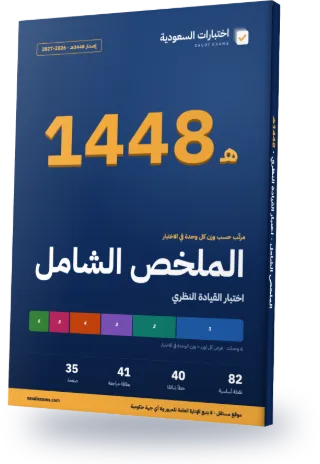
Driving Theory Complete Review Guide 2026–2027
Every exam topic in a 35-page Arabic PDF, ordered from the heaviest unit to the lightest. The first three chapters alone cover about 65% of the exam questions.
- 35Pages
- 82Key points
- 40Common mistakes
- 41Flashcards
Guide map
Each chapter is one exam unit, ordered by its weight in the real exam.
| Chapter | Unit | Weight | Exam questions | Key points |
|---|---|---|---|---|
| 1 | Traffic signs and markings | 30% | 6 | 14 |
| 2 | Rules of the road and manoeuvres | 20% | 4 | 14 |
| 3 | Right-of-way and intersections | 15% | 3 | 14 |
| 4 | Speed, distance and safety | 15% | 3 | 14 |
| 5 | Violations and demerit points | 10% | 2 | 14 |
| 6 | Behaviour, emergencies and lights | 10% | 2 | 12 |
Chapter 1 in full: Traffic signs and markings
30% of the exam, about 6 questions. These are its key points, as in the guide.
- Read the sign family before the symbol. A red-bordered upright triangle warns of a hazard; a red-bordered circle usually prohibits or limits; a blue circle gives a mandatory direction or route. STOP has an octagonal shape and GIVE WAY an inverted triangle. A red border alone is therefore not enough to choose an answer. First identify shape, then read the internal symbol and any plate.
- A warning identifies what may be ahead, not necessarily what is already happening. A children or pedestrian warning calls for anticipation and appropriate speed; it does not prove someone is currently in the road. A curve sign shows the bend direction. In a double-curve sign, identify the first bend rather than treating the drawing as an instruction to change lanes.
- Distinguish narrowing from merging. Two road-edge strokes that move inward describe reduced road width; one inward edge identifies the affected side. A joining traffic stream is a different feature. Respond by reducing speed as necessary, observing oncoming traffic and following the actual lane controls; a narrowing warning does not itself grant priority or order you to overtake.
The rest of chapter 1, on this page
- Use the visible hazard features. A skidding car warns of a slippery road; stones thrown from a wheel indicate loose material; a windsock indicates crosswind; falling rocks show material descending from a slope. These are different reasons to adjust speed and vehicle control. Avoid selecting a hazard merely because it can occur in the same weather or location.
- Yellow backgrounds with red borders identify temporary work-area signs in the handbook. The internal symbol still determines the message: worker, narrowing, traffic lights or another hazard. A worker warns of roadworks; it does not automatically require a detour. Follow a separately posted detour, lane direction or on-site traffic instruction when present. Temporary signs deserve the same attention as permanent controls.
- A red disc with a white horizontal bar means no entry from that direction. A crossed turning arrow prohibits the depicted turn; it is different from a blue mandatory arrow. The two-car no-overtaking symbol is not a general road-closure sign. Read exactly which movement or vehicle class the sign restricts, rather than extending one prohibition to every possible movement.
- Cancellation markings end the restriction shown. An 80 with diagonal cancellation stripes ends that posted restriction; it does not create an unrestricted road. Continue to obey the applicable general limit, other signs and conditions. Likewise, the end-of-priority-road symbol removes that priority designation; it does not grant a new right-of-way at the next junction.
- A white bicycle in a blue circle identifies a compulsory bicycle route in this sign family, whereas a bicycle inside a warning triangle warns of cyclists or a crossing. Circular direction arrows specify a required movement; a triangular roundabout warning announces the junction ahead. Compare both the pictogram and its surrounding shape before applying the rule.
- Information signs help identify facilities or route features. A hospital H, a mosque pictogram and a dead-end T convey different information; none alone authorizes a prohibited turn. A bus-lane sign identifies a designated lane in its stated direction and must be read with its lane markings and supplementary information. Do not confuse a facility sign with a warning that a vehicle may cross ahead.
- The locomotive warning identifies a railway crossing, not the presence of a particular barrier system. Approach cautiously, look for trains and be ready to stop. Obey active railway signals, closed or moving barriers and the responsible controller; cross only when safe and when the exit is clear. A picture of a train is not permission to cross just because a barrier happens to be raised.
- Road markings work with signs and the manoeuvre. The handbook prohibits crossing a double continuous centre line into opposing traffic. A broken centre line can allow an otherwise lawful overtake; it does not guarantee sufficient visibility, clearance or a safe return. Identify whether the marking separates opposing traffic, lanes or an edge before interpreting it. A permitted crossing still requires the full safety checks.
- A steady red light requires stopping before the stop line; do not creep onto the pedestrian crossing while waiting for permission to move. A steady yellow requires a stop when it can be made without endangering road users, rather than merely preparing to stop. Green permits movement but not entry into an intersection whose exit is blocked. Always observe the applicable controls and other road users.
- Flashing signals must be distinguished from steady signals. The handbook gives a flashing red the stop-sign meaning: stop and proceed only when the applicable priority and crossing conditions allow it. Flashing yellow calls for great care and caution. For an image question, state the visible feature, its meaning and the appropriate response; do not infer an unseen detour, open crossing or fixed speed from a warning alone.
- Relate placement to the approach. The handbook generally places signs on the right and uses reflective signs for visibility by day and night. Warnings are placed in advance so a driver can recognize the hazard and adjust in time. Read signs facing your direction and the relevant lane; do not invent a fixed placement distance or assume a sign for another approach controls yours.
Common mistakes in this chapter
- Shape and color classify the message; the internal symbol identifies the actual hazard or restriction.
- A yellow worker warning is not a detour arrow; temporary narrowing does not depict a worker.
- A locomotive does not prove gates are installed, and raised gates alone do not establish a safe crossing.
- The end of one posted limit does not cancel general speed limits or other restrictions.
- A broken line does not authorize an overtake without adequate visibility and a safe return.
- Steady yellow means stop when safe; flashing yellow is a different signal.
The other chapters are in the full guide
One purchase · lifetime access · review guide included
7-day review plan
The chapters are spread over 6 days by weight so each day carries a similar load. Day 7 is a full exam.
Day 1 · 30% of the exam
Chapter 1: Traffic signs and markings
Day 2 · 20% of the exam
Chapter 2: Rules of the road and manoeuvres
Day 3 · 15% of the exam
Chapter 3: Right-of-way and intersections
Day 4 · 15% of the exam
Chapter 4: Speed, distance and safety
Day 5 · 10% of the exam
Chapter 5: Violations and demerit points
Day 6 · 10% of the exam
Chapter 6: Behaviour, emergencies and lights
Day 7
Full mock exam: 20 questions in 20 minutes, then review the common mistakes in the units where you lost marks.
Before you read: see your score today
10 free questions from the main units, no sign-up. Then you know which chapter to start with.
Try 10 free questions and see your levelA look at each chapter
The first three key points of each chapter, as they appear in the guide (in Arabic in the PDF).
Chapter 1: Traffic signs and markings
- Read the sign family before the symbol. A red-bordered upright triangle warns of a…
- A warning identifies what may be ahead, not necessarily what is already happening. A…
- Distinguish narrowing from merging. Two road-edge strokes that move inward describe reduced road width;…
Chapter 2: Rules of the road and manoeuvres
- Use the paved carriageway and drive on the right. On a road with several…
- A broken centre line can permit a crossing when the manoeuvre is otherwise lawful…
- Prepare while stationary
Chapter 3: Right-of-way and intersections
- Identify what controls your approach before deciding who goes first. Follow the traffic officer…
- STOP and GIVE WAY require different initial actions. At STOP, make a complete stop…
- For steady signals, red requires a stop before the line; do not creep onto…
Chapter 4: Speed, distance and safety
- Stopping begins before the brake pedal is pressed. Reaction distance is the travel while…
- Reaction distance increases with speed and with a longer reaction time. Fatigue, distraction, alcohol…
- Braking distance depends on speed, available grip, brake and tyre condition, load and how…
Chapter 5: Violations and demerit points
- Separate the kind of consequence before learning its number. A fine is money; traffic…
- Read the whole offence label, including its conditions and negatives. The handbook’s points table…
- In the cited table, driving under the influence of alcohol or drugs and drifting…
Chapter 6: Behaviour, emergencies and lights
- At a collision, first avoid creating another casualty. Check moving traffic, fire, fuel and…
- For an injury emergency in Saudi Arabia, the Saudi Red Crescent lists 997 for…
- Do not routinely pull an injured person from a vehicle. Moving them may worsen…
The full guide comes with lifetime access
The full guide (35 pages) is included with lifetime access to this exam, together with every question and full mock exam. Chapter 1 is free for everyone.
Questions about the guide
Is the guide free?
Chapter 1 is free to read on the guide page. The full guide comes with lifetime access to this exam; 7-day access does not include it.
Is it up to date for 2026–2027?
Yes. Unit weights and exam facts follow what the exam body last published, and the last check date is printed in the guide. If the standards change we update the file and buyers download the new version.
Does the guide have questions?
No. The guide covers key points and common mistakes; scoring, weak-area practice and full mock exams are on the site.
Can I read it on my phone?
Yes. A5 pages in a single column, with chapters linked from the contents.
- Pages
- 35
- Edition
- 1448 AH · 2026–2027
- Language
- Arabic
- Last updated
Buy this exam
Pick the access that lasts until your test date.
Included
- Timed supplementary practice sessions: 20 questions in 20 minutes
- 500 questions, every option explained with its source
- Practice that starts with your weakest units, plus a review of your mistakes
- Complete Review Guide 2026–2027 (PDF), with lifetime access only
Continue with your Google account and you go straight to the payment page.
You pay on the Waffo Pancake checkout page (in English). The amount is in US dollars and your bank converts it to riyals. One payment with no automatic renewal, by Visa, Mastercard (a mada card with either logo works too), Apple Pay or Google Pay. Your statement shows "WAFFO". Purchases are not refundable.