Try the questions in the test above first, then open each one here to see the correct answer and why every other option is wrong.
01What must you do at this sign?
Practice question Unit: Traffic signs and markings

AStop before the line only if other traffic is present
A STOP (octagon) always requires a full stop; you do not wait for other traffic to appear before stopping.
BSlow without a full stop if the road looks empty
Slowing without a complete stop is the classic STOP error and is a separate demerit offence (6 points).
CCome to a complete stop, then go when the way is clear ✓ Correct answer
The red octagon means stop fully at the line/sign, check, then proceed only when safe — handbook Unit on regulatory signs.
DDrive very slowly and watch for children only
Watching for children is good practice but is not the meaning of the STOP sign itself.
Reference: Muroor Trainee Theoretical Driving Handbook
02What does this warning sign tell you to do?
Practice question Unit: Traffic signs and markings
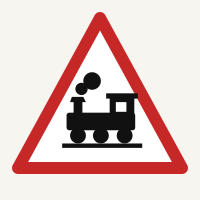
ASlow and prepare to yield inside the next roundabout
A roundabout-ahead warning is a different symbol (circular arrows), not a level-crossing warning.
BSlow down, check for trains, and be ready to stop before the crossing ✓ Correct answer
The locomotive warns of a railway crossing. Approach cautiously, yield to trains and cross only when safe with an unobstructed exit. The symbol does not establish whether signals or barriers are installed.
CFollow a permanent work-zone detour until further notice
A temporary work-zone detour uses yellow works signs; this is the permanent railway warning.
DUse the lane reserved for buses only
A bus-lane plate is regulatory/informatory and does not match this warning triangle.
Reference: Muroor Trainee Handbook, printed158–159: locomotive warning and safe crossing rules. https://sites.qu.edu.sa/quds/wp-content/uploads/sites/71/2025/09/Theoretical-Driving-Handbook-Trainee-Moroor.pdf
03Before setting off, you test the lights and find that a turn indicator does not work. What is the safest response?
Practice question Unit: Rules of the road and manoeuvres
AStart the journey because the headlights still work
Headlights help you see and be seen; they do not communicate a left or right turn. The pre-drive check includes the condition of lights, so working headlights do not resolve the failed indicator.
BStart the journey and use the hazard lights for every turn
Hazard lights do not tell others which direction you intend to turn. They are not a repair for a failed directional indicator; correct the known fault rather than improvise a substitute for each turn.
CHave the indicator fault corrected before setting off ✓ Correct answer
The handbook requires checking the lights and ensuring the vehicle is safe before driving, and it teaches signalling turns early. Correcting the known indicator fault before departure allows you to communicate your intended turns properly.
DLeave the fault until after the journey if it is only a short trip
A short trip can still include turns and interactions with other traffic. Journey length does not remove the pre-drive duty to check the lights and ensure the vehicle is safe.
Reference: Muroor trainee handbook, 2022 training edition, printed pp. 85, 87, 117: pre-drive light checks and early turn signals
Ask a friend
04Traffic lights at a busy junction are out. How should you treat the junction?
Practice question Unit: Rules of the road and manoeuvres
ATreat every approach as having absolute free priority
Absolute free priority for every approach would cause conflicts; dark signals mean the junction is uncontrolled.
BTreat it as uncontrolled: use caution, priority rules, and lower speed ✓ Correct answer
With lights out, the handbook treats the junction as uncontrolled: slow down, apply the usual priority rules (e.g. right / roundabout / signs), and proceed with extra caution.
CProceed without applying any priority rules
Ignoring priority rules at a dark junction is dangerous and unlawful.
DTreat your approach as still having a green signal
A previous green does not survive a power/signal failure; you must reassess as uncontrolled.
Reference: Muroor Trainee Theoretical Driving Handbook
Ask a friend
05You turn right on a green light while pedestrians are on the crossing. What must you do?
Practice question Unit: Right-of-way and intersections
AYield to the pedestrians where the rules require it ✓ Correct answer
Even on green, you must yield to pedestrians who are on the crossing when you turn; green authorises the turn but does not cancel pedestrian protection (handbook).
BGreen light cancels any duty to pedestrians
Green never cancels the duty to pedestrians already on or entering the crossing lawfully.
CSound the horn once and keep moving through
The horn does not clear a legal duty to yield; forcing through endangers pedestrians.
DKeep moving if your light is green; pedestrians must wait
Pedestrians on the crossing have protection; your green does not give you the right to hit or crowd them.
Reference: Muroor Trainee Theoretical Driving Handbook
Ask a friend
06You approach a junction with a priority-road sign in your favour. Who has preference?
Practice question Unit: Right-of-way and intersections
AYou have preference unless a higher control cancels it ✓ Correct answer
A priority-road sign gives you preference over traffic from the non-priority road, unless lights, an officer, or another higher control overrides it (handbook / priority rules).
BAbsolute preference always goes to traffic from the left
Left-origin traffic does not automatically outrank a priority-road sign.
COnly whoever arrived first has preference, sign or not
Arrival order alone does not override a posted priority-road sign.
DPreference applies only after you sound the horn once
Sounding the horn is not a condition for enjoying priority granted by the sign.
Reference: Muroor Trainee Theoretical Driving Handbook
Ask a friend
07You can see a stationary barrier ahead. What should your chosen speed allow you to do?
Practice question Unit: Speed, distance and safety
AStop in time before reaching the barrier ✓ Correct answer
The handbook requires adapting speed so the vehicle can stop for a barrier. Allow for both response travel and the distance needed after braking begins.
BReach the barrier at the posted maximum
A maximum limit does not establish a safe approach speed to an obstruction. Reaching the barrier at that speed defeats the need to stop before it.
CMaintain the speed of the vehicle behind
Pressure from behind does not change the stopping room ahead. Your speed must fit the visible obstruction rather than another driver’s pace.
DDelay slowing until the brakes must be applied as hard as possible
Waiting wastes available stopping room. Early speed adaptation is preferable to making maximum emergency braking the planned response to a visible barrier.
Reference: Muroor, Theoretical Driving Handbook – Trainee (2022 training text), printed pp. 13, 169 (PDF page = printed page + 6).
Ask a friend
08In good conditions, how does the handbook’s two-second method check your following gap?
Practice question Unit: Speed, distance and safety
ACount two lane markings between the vehicles
Marking lengths and speeds vary; two markings are not the two-second interval. The handbook measures time between the vehicles passing the same point.
BStart counting when your car passes the reference point
Starting with your own passage misses the interval behind the lead vehicle. Begin when its rear passes the chosen point, then end when your front arrives.
CCount from the lead vehicle’s rear passing a fixed point until your front reaches it ✓ Correct answer
This uses the same fixed point for both vehicles and checks elapsed time. The handbook calls for at least two seconds and more space when conditions worsen.
DKeep exactly one car length regardless of speed
A fixed car length does not allow the time gap to grow in metres as speed rises. It is not the handbook’s time-based checking method.
Reference: Muroor, Theoretical Driving Handbook – Trainee (2022 training text), printed pp. 183–185; PDF page = printed page + 6.
Ask a friend
09Using only the 2022 handbook’s points table, compare recorded speeds of 105 and 106 km/h where the limit is 80 km/h. Which pair of points values fits, in that order?
Practice question Unit: Violations and demerit points
A6 then 6
105 − 80 is exactly 25, so the first case belongs to the not-more-than-25 category, not the higher category.
B4 then 4
106 − 80 is 26, which exceeds the dividing value and moves the second case to 6 points.
C6 then 4
This reverses the categories: the larger excess belongs to the higher points band.
D4 then 6 ✓ Correct answer
The excesses are 25 and 26. The table assigns 4 points to an excess up to 25 and 6 to an excess above 25; neither is permission to speed.
Reference: Muroor, Theoretical Driving Handbook for Trainees, 2022 edition, printed pp. 37. Numerical penalties here describe that edition; current legal status is not established by this citation.
Ask a friend
10In the 2022 handbook's collision example, you are an involved driver and have safely moved your obstructing car to a nearby safe place. What should follow?
Practice question Unit: Behaviour, emergencies and lights
ATreat the response as complete once both cars have been photographed.
Photographs preserve information, but the handbook also calls for reporting the circumstances and location. Taking photographs does not complete those reporting steps.
BContinue reporting the incident and follow the responsible authority's instructions. ✓ Correct answer
The handbook distinguishes moving a vehicle to address obstruction or danger from abandoning the incident. Continue the reporting process from safety and follow the authority's directions.
CLeave the other driver to handle everything because they remained nearby.
Another driver's presence does not, by itself, complete your part in the handbook's reporting process. Cooperate and provide the information requested rather than assuming they have done it for you.
DPut the car back in the traffic lane before providing any report.
Returning the car to the live lane would recreate the obstruction. The handbook allows safety-related movement; reporting does not require deliberately restoring the danger.
Reference: Muroor trainee handbook, 2022 training edition, printed pp. 22–23: reporting and movement of involved vehicles.
Ask a friend

