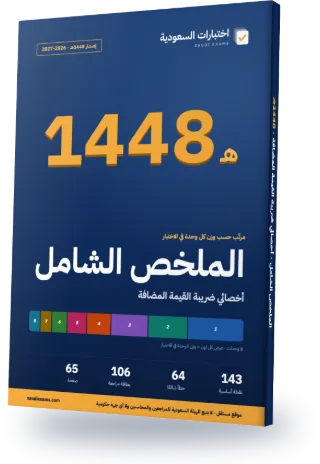
SOCPA VAT Specialist Complete Review Guide 2026–2027
Every exam topic in a 65-page Arabic PDF, ordered from the heaviest unit to the lightest. The first three chapters alone cover about 61% of the exam questions.
- 65Pages
- 143Key points
- 64Common mistakes
- 106Flashcards
Guide map
Each chapter is one exam unit, ordered by its weight in the real exam.
| Chapter | Unit | Weight | Exam questions | Key points |
|---|---|---|---|---|
| 1 | VAT Policies and Scope of Application | 25% | 15 | 18 |
| 2 | Accounting and Tax Treatment of VAT and Its Requirements | 18% | 11 | 18 |
| 3 | In-Depth Look at Key Sectors Under VAT | 18% | 10 | 18 |
| 4 | Rights, Obligations, Penalties and VAT Administration | 12% | 7 | 18 |
| 5 | Principles of Financial Accounting | 10% | 6 | 17 |
| 6 | Real Estate Transaction Tax (RETT) | 8% | 5 | 18 |
| 7 | The General Tax Framework in Saudi Arabia | 6% | 3 | 18 |
| 8 | The Theoretical and Practical Framework of VAT | 6% | 3 | 18 |
Chapter 1 in full: VAT Policies and Scope of Application
25% of the exam, about 15 questions. These are its key points, as in the guide.
- Scope: VAT is charged on taxable supplies made by a taxable person in the Kingdom in the course of an economic activity, on supplies it receives where the reverse charge applies, and on imports of goods, at a standard rate of 15% unless an exemption or zero rate applies (VAT Law, Article 2; Implementing Regulations, Article 14).
- Non-economic or out-of-scope activity: a government entity acting as a public authority when three conditions are met (a legal instrument empowering it, the activity is not carried out on commercial criteria, and it is exclusive with no private-sector competition), and work done by employees for their employer (Implementing Regulations, Article 9); supplies between VAT group members and supplies by a legal person to itself (Article 18); and issuing a voucher, except to the extent the consideration exceeds its face value (Article 19).
- Deemed supply of goods: disposing of them for non-business purposes with or without consideration, changing their use to make non-taxable supplies, keeping them after ceasing the activity, or supplying them free of charge. Of services: using business assets for private purposes, or supplying services free of charge. These rules apply only where the related input tax was deducted (GCC Unified Agreement, Article 8). The value of a deemed supply is the purchase price or cost, or fair market value if these cannot be determined (Implementing Regulations, Article 39).
The rest of chapter 1, on this page
- Deemed supply exceptions: promotional gifts and samples, and goods or services given free to employees, are not deemed supplies if their market value does not exceed SAR 200 excluding VAT per recipient per calendar year, with an annual cap of SAR 50,000 for goods and for services; goods that are damaged, stolen or lost are not deemed supplies (Implementing Regulations, Article 15).
- Transfer of an economic activity is outside the scope of VAT if all conditions are met: the transferred part can operate independently and includes all the assets needed, the recipient is registered or becomes taxable as a result and continues the same activity, the parties agree in writing, and both notify ZATCA by the end of the month after the month of transfer; otherwise the transfer is a taxable supply (Implementing Regulations, Article 17).
- The tax point is the earliest of the date of supply, the date the tax invoice is issued, or the date consideration is received in whole or in part, to the extent of the amount received. The date of supply is when goods are placed at the customer's disposal (no transport), when transport begins (with transport), when installation or assembly is completed, or when the service is completed (GCC Unified Agreement, Article 23).
- Special tax points: successive services with payments on set dates are taxed at the earliest of the payment due date, actual payment or invoice, and at least once every 12 months; other continuous supplies at the earlier of invoice or payment; supplies to government entities under the Government Tenders and Procurement Law at the earlier of the payment order or receipt of consideration; and a deemed supply on ceasing activity at the earlier of cessation or deregistration (Implementing Regulations, Article 20).
- Registration: the mandatory threshold is SAR 375,000 (Agreement, Article 50) and the voluntary threshold is 50% of it, SAR 187,500 (Article 51), which may be met by supplies or expenses (Regulations, Article 7). Annual supplies exclude exempt supplies and sales of capital assets (Agreement, Article 52). The application is due within 30 days of the end of the month in which the threshold is exceeded (Regulations, Articles 3–4); a non-resident must register with no threshold within 30 days of its first supply on which it owes VAT (Article 5); a person whose supplies are all zero-rated is exempt from mandatory registration (Article 9).
- VAT group: two or more legal persons may register as a group if each is resident and entitled to register, 50% or more of each one's capital, voting rights or market value is owned by the same legal person(s) or there is control, no member is licensed in a special zone with customs suspension or belongs to another group, and none is an eligible refund person (Implementing Regulations, Article 10). The group starts on the first day of the month after ZATCA's approval and is treated as one taxable person with its own TIN (Article 11); members are jointly liable (VAT Law, Article 4).
- Deregistration is mandatory on complete cessation of activity, and a resident must deregister when all apply: supplies or expenses in the previous 12 months do not exceed the voluntary threshold, in the previous 24 months do not exceed the mandatory threshold, and are not expected to exceed the voluntary threshold in the next 11 months; the application is due within 30 days. Deregistration is optional if supplies do not exceed, and are not expected to exceed, the mandatory threshold; a voluntary registrant cannot apply to deregister before 12 months (Implementing Regulations, Article 13).
- General place of supply: goods without transport are supplied where they are when placed at the customer's disposal, and with transport where transport begins (GCC Unified Agreement, Articles 10–11); services are supplied where the supplier resides, but between two taxable persons they are supplied where the customer resides (Articles 15–16).
- Special place-of-supply rules for services take priority over the general rules (Regulations, Article 22): hire of means of transport to a non-taxable customer where it is put at their disposal; transport of goods and passengers where transport begins; real-estate services where the property is located; telecoms and electronic services where actually used; restaurants, hotels and cultural, sporting, educational and entertainment services where actually performed (GCC Unified Agreement, Articles 17–21). A member state that has not implemented VAT is treated as outside the GCC (Implementing Regulations, Article 79).
- Exempt supplies: financial services (credit, operating accounts, dealing in money and securities, derivatives) unless the consideration is an explicit fee, commission or commercial discount, equivalent Islamic finance products, and life insurance and reinsurance contracts even with explicit charges (Implementing Regulations, Article 29); supplies of real estate by transfer of ownership, and leasing of residential property, which excludes hotels, guesthouses and other temporary accommodation (Article 30).
- Zero-rated supplies: exports of goods outside the GCC, with evidence held within 90 days of the supply (Implementing Regulations, Article 32); services to a customer not resident in any member state, unless the place of supply is in a member state under the special rules, the customer benefits directly while in a member state, or the services are performed on goods located there (Article 33); international transport and qualifying means of transport used at least 75% for international transport (Article 34); qualifying medicines and medical goods (Article 35); and gold, silver and platinum of at least 99% purity (Article 36).
- The value of a supply is the consideration excluding VAT, including any non-cash part at market value and all charges, fees and other taxes such as excise tax, reduced by discounts, subsidies and amounts paid in the customer's name and on its behalf (GCC Unified Agreement, Article 26). For a VAT-inclusive price, VAT = consideration × 15 ÷ 115 (Implementing Regulations, Article 45). The value of imported goods is the customs value plus customs duties, excise taxes and any other charges (Agreement, Article 28). Under the reverse charge, a resident taxable person that receives services from a person not resident in the GCC is treated as supplying them to itself (GCC Unified Agreement, Article 9), and reports the output tax and any deductible input tax in the same VAT return (Implementing Regulations, Article 47).
- Input tax deduction: VAT on goods and services used for taxable supplies, including zero-rated supplies, is deductible if the person holds a tax invoice or acceptable alternative evidence, in any later period up to five years after the end of the calendar year of the supply; VAT on services received in the six months before registration may also be deducted (Implementing Regulations, Article 49). VAT is blocked on entertainment, sporting and cultural services, hospitality and catering, employee insurance and healthcare unless legally required, vehicles designed to carry 10 or fewer persons with their fuel and maintenance, and personal use (Article 50).
- Apportionment: VAT linked only to taxable supplies is fully deductible, VAT linked only to exempt supplies is not, and shared VAT is apportioned using a fraction of taxable supplies over taxable plus exempt supplies for the previous calendar year, excluding supplies of capital assets, with a true-up to actual figures in the last return of the year (Implementing Regulations, Article 51). Input tax on a capital asset is adjusted when its use changes, over 6 years for movable and 10 years for immovable assets from the purchase date (Article 52).
- Payment and refunds: the tax period is monthly for persons with annual supplies above SAR 40 million and quarterly otherwise (Implementing Regulations, Article 58); the return is filed and VAT paid by the last day of the month after the period ends (Articles 59 and 62). A credit balance is carried forward or claimed within 5 years of the end of the calendar year, and ZATCA pays within 60 days of approval (Article 69). Eligible persons such as diplomatic missions, charities and licensed real estate developers claim refunds within 6 months of the end of the refund period, with a minimum of SAR 5,000 (Article 70); non-GCC businesses claim on a calendar-year basis (Article 72). The transitional principle is that the rate applicable is the rate in force on the date of supply (VAT Law, Article 18).
Common mistakes in this chapter
- Confusing exempt with zero-rated: neither carries VAT, but a zero-rated supply is still a taxable supply that allows input tax deduction, whereas the input tax linked to an exempt supply is not deductible. A supply that is both exempt and zero-rated is treated as zero-rated (Regulations, Article 31).
- The sale of real estate is exempt from VAT and is subject instead to Real Estate Transaction Tax under its own law; residential leasing is exempt, but hotels, guesthouses and serviced accommodation are not residential property and are standard-rated, as is the leasing of commercial property.
- Financial services are exempt only where the consideration is implicit (interest or a margin); explicit fees and commissions are taxed at 15%. Life insurance is the exception and stays exempt even with an explicit charge, while non-life insurance is not within the exemption.
- Fair market value between related persons applies only when all three conditions are met: the parties are related, the price is below market value, and the customer cannot fully deduct the input tax. If the customer can deduct in full, VAT is charged on the price actually agreed.
- The SAR 200 limit for gifts and samples is per recipient per calendar year and excludes VAT, with an overall annual cap of SAR 50,000. A free supply is not a deemed supply at all if the person never deducted input tax on its direct costs and keeps evidence of that.
- Supplies between members of a VAT group are outside the scope of VAT; they are neither exempt nor zero-rated. A group can only consist of two or more legal persons, so a natural person cannot join one.
- Effective date of mandatory registration: if actual supplies over the previous 12 months exceed the threshold, registration takes effect from the start of the month after the month in which the application is filed, not the month the threshold was crossed; if the threshold is expected to be exceeded in the next 12 months, it takes effect from the first month in which it is expected to be exceeded.
- Private education supplied to Saudi citizens is neither exempt nor zero-rated: it is standard-rated and the State bears the VAT on behalf of the citizen, while the provider still issues an invoice and reports the supply (ZATCA bulletin on the State bearing VAT on private education, pp. 6–8).
The other chapters are in the full guide
One purchase · lifetime access · review guide included
7-day review plan
The chapters are spread over 6 days by weight so each day carries a similar load. Day 7 is a full exam.
Day 1 · 25% of the exam
Chapter 1: VAT Policies and Scope of Application
Day 2 · 18% of the exam
Chapter 2: Accounting and Tax Treatment of VAT and Its Requirements
Day 3 · 18% of the exam
Chapter 3: In-Depth Look at Key Sectors Under VAT
Day 4 · 12% of the exam
Chapter 4: Rights, Obligations, Penalties and VAT Administration
Day 5 · 15% of the exam
Chapter 5: Principles of Financial Accounting
Chapter 8: The Theoretical and Practical Framework of VATDay 6 · 13% of the exam
Chapter 6: Real Estate Transaction Tax (RETT)
Chapter 7: The General Tax Framework in Saudi ArabiaDay 7
Full mock exam: 60 questions in 150 minutes, then review the common mistakes in the units where you lost marks.
How many correct answers do you need?
- Pass mark 60%36 correct out of 60
Before you read: see your score today
10 free questions from the main units, no sign-up. Then you know which chapter to start with.
Try 10 free questions and see your levelA look at each chapter
The first three key points of each chapter, as they appear in the guide (in Arabic in the PDF).
Chapter 1: VAT Policies and Scope of Application
- Scope
- Non-economic or out-of-scope activity
- Deemed supply of goods
Chapter 2: Accounting and Tax Treatment of VAT and Its Requirements
- A tax invoice is required for taxable supplies to a taxable person, a non-taxable…
- A simplified tax invoice is issued for supplies to anyone outside that list (i.e…
- A summary tax invoice may cover several supplies to one customer within a period…
Chapter 3: In-Depth Look at Key Sectors Under VAT
- Retail prices
- Promotions and vouchers
- Margin scheme for used goods
Chapter 4: Rights, Obligations, Penalties and VAT Administration
- A resident applies for registration within 30 days from the end of the month…
- The return is filed and the tax paid no later than the last day…
- Invoices, records and documents are kept for at least 6 years from the end…
Chapter 5: Principles of Financial Accounting
- The accounting equation
- Transaction effects
- The objective of general purpose financial reporting is to provide financial information useful to…
Chapter 6: Real Estate Transaction Tax (RETT)
- The RETT Law was issued by Royal Decree M/84 dated 19/3/1446H and took effect…
- Real estate means immovable property inside the Kingdom; a real estate disposal is any…
- The tax is 5% whatever the property's state, form or use, whether the disposal…
Chapter 7: The General Tax Framework in Saudi Arabia
- A tax is a monetary levy that the state collects compulsorily and finally from…
- Features of a tax
- Tax accounting applies tax laws and regulations to an entity's data to determine the…
Chapter 8: The Theoretical and Practical Framework of VAT
- VAT is an indirect tax on the import and supply of goods and services…
- Its features
- A sales tax is usually charged at one stage with no credit for tax…
The full guide comes with lifetime access
The full guide (65 pages) is included with lifetime access to this exam, together with every question and full mock exam. Chapter 1 is free for everyone.
Questions about the guide
Is the guide free?
Chapter 1 is free to read on the guide page. The full guide comes with lifetime access to this exam; 7-day access does not include it.
Is it up to date for 2026–2027?
Yes. Unit weights and exam facts follow what the exam body last published, and the last check date is printed in the guide. If the standards change we update the file and buyers download the new version.
Does the guide have questions?
No. The guide covers key points and common mistakes; scoring, weak-area practice and full mock exams are on the site.
Can I read it on my phone?
Yes. A5 pages in a single column, with chapters linked from the contents.
- Pages
- 65
- Edition
- 1448 AH · 2026–2027
- Language
- Arabic
- Last updated
Buy this exam
Pick the access that lasts until your test date.
Included
- Full mock exams: 60 questions in 150 minutes, with a score for every unit
- 395 questions, every option explained with its source
- Practice that starts with your weakest units, plus a review of your mistakes
- Complete Review Guide 2026–2027 (PDF), with lifetime access only
Continue with your Google account and you go straight to the payment page.
You pay on the Waffo Pancake checkout page (in English). The amount is in US dollars and your bank converts it to riyals. One payment with no automatic renewal, by Visa, Mastercard (a mada card with either logo works too), Apple Pay or Google Pay. Your statement shows "WAFFO". Purchases are not refundable.