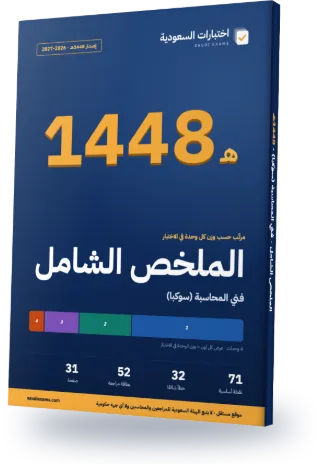
SOCPA Accounting Technician Complete Review Guide 2026–2027
Every exam topic in a 31-page Arabic PDF, ordered from the heaviest unit to the lightest. The first three chapters alone cover about 93% of the exam questions.
- 31Pages
- 71Key points
- 32Common mistakes
- 52Flashcards
Guide map
Each chapter is one exam unit, ordered by its weight in the real exam.
| Chapter | Unit | Weight | Exam questions | Key points |
|---|---|---|---|---|
| 1 | Elements of the financial statements: recognition, measurement, valuation, presentation and disclosure | 51% | 30 | 18 |
| 2 | Nature and systems of cost accounting and measurement concepts | 25% | 15 | 18 |
| 3 | Conceptual framework, professional standards, presentation and disclosure | 17% | 10 | 18 |
| 4 | Decision analysis | 8% | 5 | 17 |
Chapter 1 in full: Elements of the financial statements: recognition, measurement, valuation, presentation and disclosure
51% of the exam, about 30 questions. These are its key points, as in the guide.
- Cash and cash equivalents include cash on hand and demand deposits, plus short-term, highly liquid investments that convert to a known amount of cash with insignificant risk of change in value, normally maturing within three months or less of acquisition (IAS 7). The statement of cash flows (IAS 7) classifies cash flows as operating, investing or financing. Under the indirect method, operating cash flow starts from profit for the year and is adjusted for non-cash items (such as depreciation) and changes in working capital (item 2.1).
- Trade receivables are handled with the allowance method: the loss allowance is estimated as a percentage of credit sales or from an ageing schedule, and it measures lifetime expected credit losses under the simplified approach in IFRS 9. Writing off a specific account reduces receivables and the allowance together, so net receivables and profit are unchanged. When a previously written-off account is collected, first reinstate it (debit receivables, credit the allowance), then record the cash receipt (debit cash, credit receivables) (item 2.2).
- Interest on a note receivable = principal x annual rate x time in years (or months / 12). When the note is discounted at the bank, net proceeds = maturity value - discount, where discount = maturity value x discount rate x remaining time. Employee advances, prepayments and accrued income are other receivables (item 2.3).
The rest of chapter 1, on this page
- Inventories are measured at the lower of cost and net realisable value (IAS 2). Cost includes purchase price, non-refundable duties, conversion costs and what it takes to bring inventory to its present location and condition; it excludes abnormal waste and selling and administrative costs. FIFO or weighted average applies, and LIFO is not permitted. Cost of sales = opening inventory + purchases (net of returns and discounts, plus purchase costs) - closing inventory. The perpetual system updates cost with every transaction, while the periodic system computes it at period end. Under the gross profit method, estimated closing inventory = goods available for sale - (sales x (1 - gross profit margin)) (item 2.4).
- The cost of an item of PP&E (IAS 16) includes its purchase price, non-refundable duties, any directly attributable cost of bringing it to the location and condition needed to operate, and the estimated cost of dismantling and removal. Depreciation: straight-line = (cost - residual) / life; declining balance = rate x carrying amount; units of production = (cost - residual) x actual output / estimated output. Land is not depreciated (item 2.5).
- Residual value, useful life and depreciation method are reviewed at least at each financial year end, and a change is treated prospectively as an estimate change. Gain or loss on disposal = proceeds - carrying amount. Under the revaluation model the surplus goes to other comprehensive income, and the model applies to a whole class of assets. An impairment loss arises when carrying amount exceeds recoverable amount (the higher of fair value less costs of disposal and value in use) (item 2.5).
- Investment property (IAS 40) is property held to earn rentals, for capital appreciation or both, not for use in production or administration and not for sale in the ordinary course (that would be inventory). The entity chooses the cost model (with depreciation) or the fair value model (changes go to profit or loss, no depreciation). Listed companies in Saudi Arabia may use fair value from 2022 (item 2.6).
- A current liability is expected to be settled in the normal operating cycle or is due within 12 months of the reporting date. Examples: trade payables, notes payable, accrued expenses, income received in advance, the current portion of long-term loans, accrued salaries and amounts withheld from them (item 2.7).
- Bonds are issued at face value when the stated and market rates are equal, at a premium when the stated rate is higher and at a discount when it is lower. Under the effective interest method: interest expense = opening carrying amount x market rate, cash interest = face value x stated rate, and the difference is amortisation of the discount or premium. For a loan repaid in instalments, the part due within a year is a current liability (item 2.8).
- A provision (IAS 37) is recognised when three conditions are all met: a present obligation (legal or constructive) from a past event, a probable outflow of resources, and a reliable estimate of the amount. A contingent liability is disclosed unless the outflow is remote, and a contingent asset is not recognised. A warranty provision on sales is a typical example. No provision is made for future operating losses (item 2.9).
- Share premium = proceeds - par value of the shares issued. Declaring a cash dividend reduces retained earnings and creates a liability, while a stock dividend moves an amount from retained earnings to share capital with no change in total equity. Treasury shares are deducted from equity and no gain or loss is recognised on reissue. In a partnership, profit is shared as the partners agreed, and agreed interest and salaries are part of the allocation, not expenses (item 2.10).
- IFRS 15 applies five steps to revenue: identify the contract, identify the performance obligations, determine the transaction price, allocate it to the performance obligations, then recognise revenue as each obligation is satisfied. Revenue is recognised at a point in time when control transfers, or over time if the conditions for that are met. The transaction price reflects discounts and variable consideration, and cash received in advance is a contract liability until performance (item 2.11).
- Under matching, expenses are recognised in the period when the related revenue is earned. Expenses are classified either by nature (salaries, depreciation, rent) or by function (cost of sales, selling and distribution, general and administrative), and under the function method depreciation and employee benefits are disclosed in a note (item 2.12).
- Gains and losses arise from incidental or non-core activities, such as a gain on selling a fixed asset, a disposal loss, foreign exchange differences on monetary items and an impairment loss. They normally appear in profit or loss, while a revaluation surplus on fixed assets goes to other comprehensive income. They are not part of operating revenue (item 2.13).
- An intangible asset (IAS 38) is an identifiable non-monetary asset without physical substance that the entity controls and expects to bring benefits. Research-phase costs are expensed. Development costs are capitalised once technical feasibility, intention, ability to use or sell, probable benefits, adequate resources and reliable measurement are shown. Internally generated goodwill and brands are not recognised. A finite life is amortised, and an indefinite life is not amortised but tested for impairment every year (item 2.14).
- The lessee (IFRS 16) recognises a right-of-use asset and a lease liability at the present value of unpaid lease payments, discounted at the implicit rate or the incremental borrowing rate. Afterwards the asset is depreciated and interest is charged on the liability. Short-term leases (12 months or less) and low-value assets are exempt. The lessor classifies a lease as finance if substantially all risks and rewards are transferred, and as operating otherwise (item 2.15).
- A related party (IAS 24) includes anyone who controls, jointly controls or has significant influence over the entity, key management personnel and their close family members, and entities they control. Disclose the nature of the relationship, the transactions and their balances, and key management compensation, and disclose the parent-subsidiary relationship even when there are no transactions (item 2.16).
- An accounting information system consists of people, procedures, data, software, hardware and controls. Internal control tools include segregation of duties, authorisation of access rights, access controls and backups. Input, processing and output controls include batch totals and data validation. An enterprise resource planning (ERP) system links the entity's modules on a single database (item 2.17).
Common mistakes in this chapter
- In a bank reconciliation, outstanding cheques are deducted from the bank balance, deposits in transit are added to it, and bank charges are deducted from the book balance. Mixing up the two sides is the most common mistake.
- Overstating closing inventory overstates profit for that year because cost of sales falls, and the effect reverses the next year. Total profit over the two years stays correct.
- A stock dividend leaves total equity unchanged and creates no liability; it only moves an amount from retained earnings to share capital. A cash dividend creates a liability when declared and reduces equity.
- Bonds are issued at a premium when the stated rate is above the market rate and at a discount when it is below. Under the effective interest method, interest expense is the current carrying amount times the market rate, not the face value.
- If an outflow is probable (more likely than not) and can be estimated reliably, it is a provision and is recognised. If it is only possible, or cannot be estimated, it is a contingent liability: disclose it, do not recognise it. A contingent asset is not recognised.
- Straight-line depreciation subtracts residual value from cost before dividing by life, while declining balance applies the rate to carrying amount without subtracting residual value. A change in life or residual value is an estimate change applied prospectively, with no restatement.
- Cash received before the service is performed or the goods are delivered is a contract liability, not revenue. An agent recognises only its commission (net), not the gross sale amount.
- Under IFRS 16 the lessee no longer splits leases into operating and finance: every lease goes on the balance sheet as a right-of-use asset and a liability, except short-term leases (12 months or less) and low-value assets.
The other chapters are in the full guide
One purchase · lifetime access · review guide included
7-day review plan
The chapters are spread over 6 days by weight so each day carries a similar load. Day 7 is a full exam.
Day 1 · 51% of the exam
Chapter 1: Elements of the financial statements: recognition, measurement, valuation, presentation and disclosure
Day 2 · 25% of the exam
Chapter 2: Nature and systems of cost accounting and measurement concepts
Day 3 · 17% of the exam
Chapter 3: Conceptual framework, professional standards, presentation and disclosure
Day 4 · 8% of the exam
Chapter 4: Decision analysis
Day 5
Full mock exam: 60 questions in 150 minutes, then review the common mistakes in the units where you lost marks.
How many correct answers do you need?
- Pass mark 60%36 correct out of 60
Before you read: see your score today
10 free questions from the main units, no sign-up. Then you know which chapter to start with.
Try 10 free questions and see your levelA look at each chapter
The first three key points of each chapter, as they appear in the guide (in Arabic in the PDF).
Chapter 1: Elements of the financial statements: recognition, measurement, valuation, presentation and disclosure
- Cash and cash equivalents include cash on hand and demand deposits, plus short-term, highly…
- Trade receivables are handled with the allowance method
- Interest on a note receivable = principal x annual rate x time in years…
Chapter 2: Nature and systems of cost accounting and measurement concepts
- An expenditure is an outlay or obligation to pay for an asset or service…
- Product costs are direct materials, direct labor and manufacturing overhead, and stay in inventory…
- Manufacturing overhead includes indirect materials, indirect labor, factory depreciation, rent and power; non-manufacturing costs…
Chapter 3: Conceptual framework, professional standards, presentation and disclosure
- The five fundamental principles
- There are five types of threat
- The objective of general purpose financial reporting is to give information useful to existing…
Chapter 4: Decision analysis
- Unit contribution margin = selling price per unit − variable cost per unit. (indicator…
- Contribution margin ratio = contribution margin ÷ sales, which equals 1 − (variable cost…
- Break-even in units = fixed costs ÷ unit contribution margin. Profit is zero at…
The full guide comes with lifetime access
The full guide (31 pages) is included with lifetime access to this exam, together with every question and full mock exam. Chapter 1 is free for everyone.
Questions about the guide
Is the guide free?
Chapter 1 is free to read on the guide page. The full guide comes with lifetime access to this exam; 7-day access does not include it.
Is it up to date for 2026–2027?
Yes. Unit weights and exam facts follow what the exam body last published, and the last check date is printed in the guide. If the standards change we update the file and buyers download the new version.
Does the guide have questions?
No. The guide covers key points and common mistakes; scoring, weak-area practice and full mock exams are on the site.
Can I read it on my phone?
Yes. A5 pages in a single column, with chapters linked from the contents.
- Pages
- 31
- Edition
- 1448 AH · 2026–2027
- Language
- Arabic
- Last updated
Buy this exam
Pick the access that lasts until your test date.
Included
- Full mock exams: 60 questions in 150 minutes, with a score for every unit
- 337 questions, every option explained with its source
- Practice that starts with your weakest units, plus a review of your mistakes
- Complete Review Guide 2026–2027 (PDF), with lifetime access only
Continue with your Google account and you go straight to the payment page.
You pay on the Waffo Pancake checkout page (in English). The amount is in US dollars and your bank converts it to riyals. One payment with no automatic renewal, by Visa, Mastercard (a mada card with either logo works too), Apple Pay or Google Pay. Your statement shows "WAFFO". Purchases are not refundable.